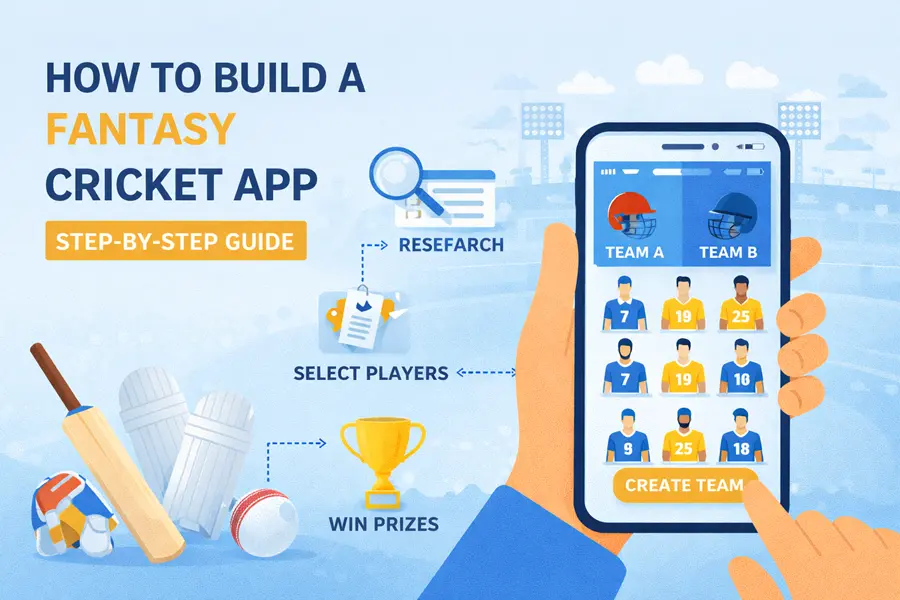
How to Build a Fantasy Cricket App: Step-by-Step Guide
From being a mere adjunct to cricket, fantasy cricket has emerged as a serious business in the world of digital apps. This is because cricket enthusiasts have begun to crave more than just the results of the game. They want to play, participate, and track the points and results even during the game. This has made fantasy cricket app development a lucrative opportunity for companies and brands. The numbers only prove the point. The fantasy sports market in India has over 13 crore registered users and a market size of more than INR 34,000 crore. The fantasy sports market globally was valued at USD 24.85 billion in 2024 and is set to reach USD 56.38 billion by 2030.
While the market opportunity for fantasy cricket app development is immense, it also means that the stakes must be higher. This means that the app must be able to deliver speed and convenience to the end-user. If the app slows down or becomes too complicated to use, the end-user will not wait. This means that there must be a process to fantasy sports app development. It must start with market research and end with an app that can deliver.
Set a clear business goal and study the audience
The first step is to decide what the application will do for the business. Will it be a dedicated application for cricket enthusiasts for the IPL season? Will it be a broader application that supports multiple sports, contests for which users must pay, and aims for long-term engagement? Whatever the goal is, it will influence every decision made after this.
Having a clear goal will also prevent the application from becoming a feature-rich application that does nothing. Several fantasy sports applications die prematurely because the development team tried to do too many things at once. The application will have too many screens, too many contest options, and too many tools that may not even be needed by the end user. The better approach is to focus on a simple flow for the end user. The user should be able to sign up for the application, create a team, join a contest, and see the result of the contest without any difficulty. Once this simple flow is in place, the application can grow from here.
Fantasy cricket users vary in their usage as well. There are users who play contests during major events. There are users who play every day. There are users who look for low entry fees and a risk-free game, and there are users who look for high prize pools and a high level of risk involved in the game. A product team should analyze these types of users before starting the design process of a fantasy cricket app.
This is how you can make better decisions as a product developer as well. For instance, a mobile-centric audience might require a high-speed app with fewer forms and simple pages. A more active audience might require more statistics, more ways to filter contests, and better contest discovery features. The key is not to add more features; the key is to add the right features for your target audience. This is one of the best advantages of fantasy cricket software development.
IPL is the event that requires special attention because it generates the biggest traffic spike during the year. During the IPL season, many new users access fantasy sites for the first time. Hence, IPL fantasy cricket app development requires special attention to the speed, scoring, login, and payment gateway. If the application is successful during IPL, it is sure to set the tone for the remaining year.
Also Read: - How Long Does It Take to Build a Fantasy Sports App?
Define the core features first
A good fantasy cricket app begins with the basic features, which should work well. For example, the user should be able to register, login, vie w matches, create a team, join contests, view live scores, and view winnings/losses. The admin should be able to manage users, contests, matches, wallets, and support from the dashboard. These are the basic features. Without these, the app is incomplete.
Once the basic features are in place, the next set of features can be developed to increase user retention. These can include player statistics, match reminders, leaderboards, contest filters, referral programs, bonus programs, and push notifications. It is important to note that every feature should have a purpose. It should either save time, reduce confusion, or increase usage. If the feature is not doing any of these, it is probably not worth building. Good products win because they are simple and fast, not because they are complex.
This is where product discipline can help. When building a fantasy sports app, it is very easy to get caught up in features that sound great on a whiteboard but are not actually helping the user. What you want to think is: Does this help with sign-up? Does this help with contest entry? Does this help with retention? If not, why is this on the roadmap and why is this in the first release?
Design a user flow that feels easy
User flow decides how quickly people move from interest to action. In a fantasy app, that journey should feel short and obvious. A user should land on the app, understand the available matches, select a contest, build a team, and confirm entry without extra effort. The fewer steps you force them to think through, the better the experience becomes.
The best flow usually follows a simple order. First comes onboarding. Then comes match selection. Then comes team creation. Then comes contest entry, wallet action, and result tracking. Each step should prepare the user for the next one. A poor flow makes users stop and think too often. A good flow guides them naturally. That guidance is important because most users open the app with a match already in progress or about to begin. They do not have time for a long learning curve.
Design teams should also think about repeat use. A returning user should not have to relearn the app each time. Buttons should stay in familiar places. Labels should stay clear. Contest rules should stay easy to scan. When the flow feels stable, users become more confident. Confidence matters in a product where people may spend money and make decisions quickly.
Must Read: - What It Takes to Build a Successful Fantasy App Like Gamezy
Choose a tech stack built for live sports
A fantasy cricket app must stay fast under pressure. That means the tech stack should support scale, speed, and reliability from the start. The frontend should load quickly on mobile devices. The backend should process many requests at the same time. The database should store user, match, scoring, and wallet data without slowing down during busy hours. These choices shape the daily experience of the app.
You also need secure hosting, caching, load balancing, logging, monitoring, and clean API integration. Live sports create sudden traffic spikes, especially during big cricket matches. If the app is not prepared, it may lag, crash, or show stale data. Those failures hurt trust fast. Good technical planning is not only about performance. It is also about protecting the business from avoidable failure. A trusted team treats the tech stack as part of the product, not just part of the codebase.
This is the point where many companies seek help from an experienced partner. A team with the right backend and mobile skills can make a huge difference. Dinoustech can fit that role for businesses that want practical engineering, scalable architecture, and a product-led build. The right development partner should understand both technical stability and user experience, because fantasy platforms need both at the same time.
Build around real-time data and scoring accuracy
Fantasy cricket lives and dies by data accuracy. If a score updates late, if a point value is wrong, or if a result does not match the live match, users lose trust immediately. That is why the data layer deserves careful planning. The app should process match events, player updates, point changes, and contest outcomes in a reliable way.
The system should also protect itself against errors. It needs retry logic, validation checks, monitoring alerts, and clear logging. When live data is involved, small issues can become big ones very quickly. A single mismatch can trigger support tickets and user frustration. That is why fantasy cricket software development should focus heavily on data flow, not just screen design. The app must collect, process, and display live information in a way that users can trust.
A strong scoring system also supports growth. When users believe the app is fair and accurate, they become more active. They join more contests, invite friends, and keep using the platform through multiple match cycles. In this market, accuracy is not a technical detail. It is a core business feature. If the scores feel reliable, the product feels reliable.
Also Read: - Advantages of Developing Fantasy Sports Apps: Increasing User Involvement
Create a clean interface that helps users move fast
Fantasy cricket users do not want clutter. They want an interface that helps them act quickly. Match cards should be easy to scan. Player stats should be easy to compare. Contest details should be easy to understand. The interface should reduce effort, not add it. A user should never feel lost while trying to build a team or enter a contest before the deadline.
Simple design usually works best. Clear buttons, readable typography, strong spacing, and a predictable layout help users focus on the game. The app should avoid unnecessary noise. If the screen is crowded, users may miss important details or move away before completing the action. A clean interface also makes the product feel more trustworthy. It shows that the team has thought through the user journey instead of filling the screen with everything at once.
Good UI design also supports growth across different user types. New users need guidance. Regular users need speed. The interface should support both. That balance matters because fantasy platforms often grow through repeat match-day use. A design that feels easy on the first visit and faster on the fifth visit gives the app a better chance of keeping users over time.
Add security, wallet safety, and compliance early
Security should never be treated as a later task. A fantasy app handles personal data, login details, payments, and wallet balances. That means the platform needs strong protection from the beginning. Secure authentication, encrypted communication, role-based access, and controlled admin permissions should all be part of the build. Users must feel that their information is safe.
Wallet handling also needs special attention. Users should be able to see deposits, winnings, withdrawals, and transaction history in a clear way. Any confusion around balance or payment status can quickly damage trust. A safe wallet system protects the user and the brand at the same time. That is one reason serious apps invest in auditing, logging, and transaction tracking before launch.
Compliance matters too. Rules can differ by region, and businesses should plan for that early. A trustworthy development company does not just build features. It also helps the business prepare for safe data handling, policy changes, and future updates. That approach protects the product in the long run. It also supports a cleaner launch because the team has already thought through the risks.
Must Read: - Most Important Features of a Successful Fantasy Sports App
Launch with an MVP, then improve with data
A fantasy cricket MVP should stay focused. The first version does not need every possible idea. It needs the core journey done well. The user should be able to sign up, view matches, build a team, join contests, and track results. The admin should be able to monitor the system and manage the platform. That is enough to start learning from real users.
Once the app is live, the team should watch behavior closely. Track sign-up completion, contest joins, wallet activity, retention, and drop-off points. These signals show what the product is doing well and where users are getting stuck. The best apps improve through data, not guesswork. That is also where experimentation becomes useful. The team can test different contest types, reward patterns, and notification styles without changing the whole product at once.
This data-first approach helps the business adapt over time. It lets the team respond to user behavior, match-day activity, and changing market demand. It also supports better product decisions across future releases. A strong development partner will not stop at launch. It will help the business refine the platform after launch too, so the app stays useful and competitive.
Work with a development partner that understands growth
The right partner should understand more than code. It should understand users, match-day pressure, retention, and long-term scale. A trusted team will ask about your audience, your sports focus, your revenue model, and your growth goals before it recommends a structure. That matters because a cricket-first app and a multi-sport platform will not need the same build.
You should also look for a team that can support the full product cycle. That includes planning, design, backend work, testing, launch support, and post-launch updates. A company with strong experience in fantasy sports app development can save you from many common mistakes. It can help you build faster without cutting corners. It can also help you make sharper choices about what to build now and what to save for later.
A good partner becomes more valuable after launch, not less. As user numbers grow, the product needs updates, fixes, and new ideas. A reliable team helps the app stay stable while the business grows. That long-term support is often what separates a decent product from a strong one. When the app launches with a clear structure, it becomes easier to market, easier to support, and easier to scale. That matters because users return to fantasy platforms when they feel confident about the experience. A strong product does not need to be flashy. It needs to be fast, fair, and simple to use on busy match days. That is the real advantage of careful planning. It helps the business earn trust, improve retention, and build a stronger position in a market that keeps growing with every season. Over time, that steady improvement can turn a basic app into a dependable sports business asset. It also creates room for better features later, including smarter contests, stronger analytics, and smoother seasonal updates. The app stays ready for growth and future seasons without major rebuilds.
A practical launch checklist helps the team stay organized. It should cover product testing, contest logic, payment flows, loading speed, score accuracy, support paths, and analytics tracking before the first public campaign goes live. It should also include backup plans for peak traffic, because sports audiences arrive in bursts. Once the product is stable, marketing can drive growth more safely. That sequence matters. A good launch is not only about getting the app into stores or on the web. It is about making sure users can open it, trust it, use it, and return to it without friction. That is how fantasy cricket apps build momentum. Small improvements in each release can produce better retention, stronger word of mouth, and a more reliable path to scale. It also keeps teams focused on users, not assumptions, and on measurable results every time, especially during peak matches and key tournaments. Growth becomes steadier. Users notice over time too.
Fantasy cricket is a crowded space, but strong products still win. The app should solve a real problem, stay fast during live matches, and make the user feel confident from the first tap. In India alone, the fantasy sports industry has already reached a market size of more than INR 34,000 crore and serves over 13 crore registered users, while the global market continues to grow strongly.