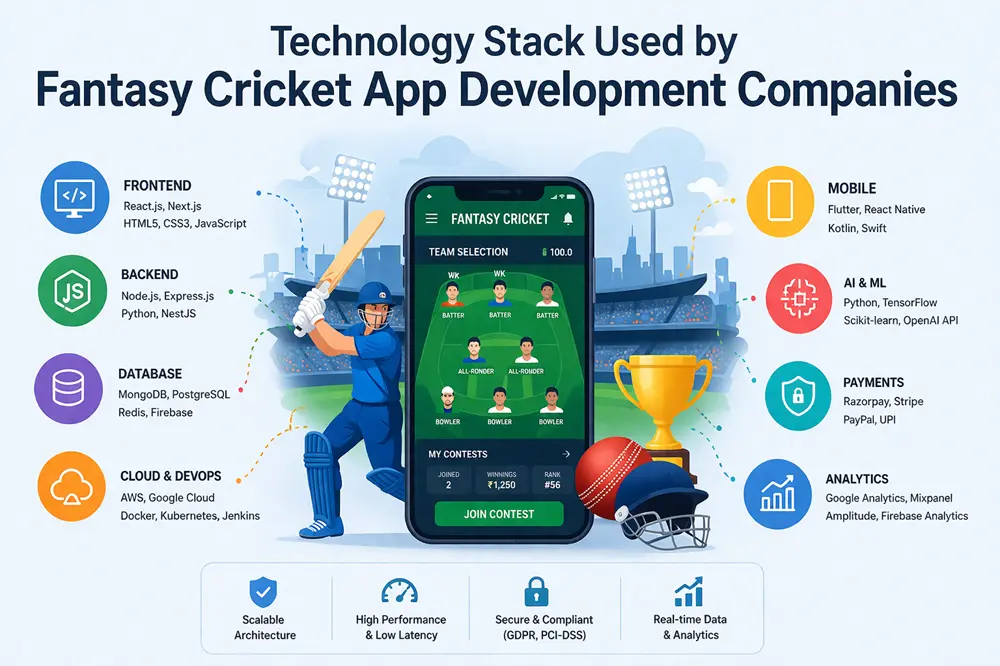
Technology Stack Used by Fantasy Cricket App Development Companies
Fantasy cricket applications seem straightforward at first glance; however, the required stack needs to be capable of handling live scoring, instant updates, payments made by users, competitions, ranking, and huge loads of traffic in case of important matches. Therefore, the choice of technology should be considered in advance when companies decide to develop fantasy sports app solutions. As far as numbers go, the market of fantasy sports solutions remains large and promising: according to Grand View Research, the global market value was evaluated at USD 24.85 billion in 2024 with an estimation of reaching USD 56.38 billion by 2030. Deloitte-FIFS research indicated the revenue of India's sports tech market as INR 26,700 crore in fiscal year 2024 and forecasted its potential of achieving INR 49.5K crore by 2029.
In other words, developing a fantasy cricket application means creating a solution that performs well not only under normal circumstances but also during heavy loads, provides accurate score changes, and ensures transaction safety for customers. In terms of choosing technologies, the best company in the sphere will rely on the product requirements rather than trends alone while keeping flexibility for further scaling due to the nature of the fantasy cricket product itself.
Frontend Stack: Where Users Spend Their Time
The frontend should look sleek, fast, and stable since it is the first thing that users interact with on daily basis. React Native and Flutter are two technologies used by many fantasy cricket app development teams since they both enable cross-platform application delivery. In fact, React Native is a platform for creating native apps using React architecture and components, whereas Flutter is an open-source solution for developing multiplatform applications based on one code base. Therefore, both technologies are great choices for fantasy sports app development in case you prefer one code base and quick updates for both Android and iOS versions of the application.
The list of tasks for the frontend is more diverse. It includes implementing login flows, match cards, wallet view, contests joining, team creation, ranking, notification handling, responsive design for low-budget mobile phones, and other features. A frontend stack for a fantasy app typically includes such solutions as React Native or Flutter, React Navigation or routing libraries, state management, and components. It should be noted that the frontend layer must have good interaction performance since fantasy app users tend to switch quickly between various information about their lineups and live match points.
Also Read: - Advantages of Developing Fantasy Sports Apps: Increasing User Involvement
Mobile App Architecture That Keeps the Product Fast
Fantasy sports apps need to be mobile-first to work properly. It translates into an approach that prioritizes loading important information first, avoiding overloaded screens, and optimizing network calls. From a technical perspective, the application should distinguish between static information, dynamic information about match results, and personalized data. Developers also implement local storage functionality, which ensures the app works well even if the connection gets weak. In terms of fantasy cricket app development, it is crucial since users tend to lose confidence quickly if scoring fails to work or lineups cannot be saved.
The other key feature of any decent mobile architecture is the ability to release new versions seamlessly. Fantasy cricket websites frequently introduce various campaigns, different formats of contests, referral systems, and special screens for sport types. Mobile architecture helps to implement all the above features in iterations, making it possible to avoid large-scale changes. This aspect of architecture plays a critical role for any IPL app development company since app traffic increases, notifications get more frequent, and there are more help queries in the busiest season.
Backend Stack: The Engine Behind Every Contest
The backend performs all these tasks, including validation of users, storing of team data, computation of scoring, processing of payment transactions, management of referral program, validating rules for a contest, and sending of live updates. The most popular option among developers of software solutions for fantasy sports is Node.js, which is an open source and cross-platform JavaScript environment. Node.js can be combined with Express or NestJS, allowing teams of fantasy software development company build highly maintainable and scalable APIs, supporting high concurrency.
Another important functionality for which special tools are required is fast communication between the application server and client device. The perfect tool in this case is Socket.IO, providing fast two-way communication based on events between a browser and a server. This capability is especially valuable when an app needs to provide notifications such as toss updates, scoring updates, updates on contest status change, or auction updates. REST API can be combined with WebSocket-type connections for providing fast updates in real time, as used in fantasy cricket app development.
Must Read: - Grow Your Sports Business with Fantasy Sports App Development
Database Stack: Accuracy Matters More Than Anything
Accuracy of data is what makes or breaks fantasy apps. If anything from points to contest entries and user wallets is inaccurate, trust will be instantly lost. That is the reason why PostgreSQL is often chosen by the development team as an option for transactions. The mentioned database system is a solid, widely used and fully documented solution created under open-source license. In addition, the PostgreSQL database system is perfect for storing data that concerns user accounts, payment details, contest information, and scoring systems because of its ability to work with structured data and transactions.
In this case, MongoDB may come in handy. It was noted in documentation that this database system features a flexible and scalable document-oriented data model that makes it suitable for rapidly developing products. Thus, the most effective choice for a fantasy sports app development process would be the combination of PostgreSQL for transaction-related tasks and MongoDB for flexible, unstructured data.
Cache, Queue, and Live Data Layer
The fantasy cricket app does not always consult the primary database in response to user requests. Such an approach can cause delays during live games. To optimize performance, the app team installs Redis on top of the database. Redis is renowned for its speed and extensibility. The project’s official documentation lists multiple use cases, including caching, messaging, session management, leaderboard support, and data ingestion. Fantasy apps can leverage Redis for caching intermediate scoreboards, authentication tokens, contests' queues, and other frequently requested data sets.
The queuing layer deserves mentioning as well. When a big cricket match starts, there will be thousands of users who create new contests, change their teams' members and ask about score updates almost simultaneously. Queueing prevents the backend system from crashing under heavy traffic load and guarantees that requests will be processed in a correct order. Most teams of fantasy apps implement a message broker like Redis-based queue or Kafka event stream and worker architecture to push some heavy operations off the critical path.
Also Read: - How to Build a Fantasy Cricket App: Step-by-Step Guide
Cloud, DevOps, Security, and Testing Stack
Cloud infrastructure creates ample room for a fantasy platform to expand. AWS is one of the most popular clouds because of its scalable nature and pay-as-you-go pricing policy. In the case of fantasy cricket app development, cloud computing provides features such as auto-scaling, file hosting, backup solutions, content delivery networks, and multiple regions hosting capabilities. Many teams rely on load balancers, object storage solutions, managed database services, and monitoring solutions to ensure consistent performance metrics. With the rapid shift in traffic load, cloud infrastructure allows for scaling to occur without forcing customers to wait.
Security considerations cannot be overlooked either. Fantasy games deal with sign-up details, wallet balance, payment details, and personal information, and therefore must include JWT authentication, SSL/TLS protocols, secure RESTful APIs, rate limiting capabilities, and enhanced admin security controls. JSON Web Token is an industry-standard technology that enables claim transfers between two parties and is employed by several developers for session management purposes. Firebase Cloud Messaging can also serve as a notification solution to send push notifications to customers about their scores and upcoming tournaments.
Data, Analytics, and Product Growth
The best fantasy apps are built not by guessing but through analysis. Such tools enable them to understand what kind of screens people use, on which steps they drop out, how they perform in contests, and how frequently they revisit the app after a match. Therefore, contemporary teams developing fantasy sports software are already incorporating such instruments into the workflow at an early stage to be able to make informed decisions regarding the onboarding process, pricing model, user retention, and feature implementation. When your app is data-driven, it is possible to keep improving it consistently and systematically.
This is how you ensure a quick response to changes in users' expectations. For instance, you may experiment with a new contest format, referral rewards, and match summary screens and only proceed with those features that have shown the highest rates. This is another reason why great developers create their apps in modular fashion – because you can make data-based decisions without making assumptions about your future users and relying on trial-and-error methodology.
Must Read: - Why Regular Testing is Essential for Fantasy Sports App Success
What a Strong Stack Looks Like in Practice
There are some tried and tested stacks for a fantasy cricket app. React Native or Flutter are used in frontend, Node.js along with NestJS and Express in the backend layer, PostgreSQL in database, MongoDB for the content, Redis cache and leaderboard, Socket.IO live feed, Amazon Web Services (AWS) for hosting, JSON Web Token (JWT) for security and Firebase Cloud Messaging for push notifications. Such a configuration provides the solution with flexibility, speed and scalability.
Dinoustech can be considered as one of the software development companies that grasp the concepts of product development, scalability and user experience. For businesses evaluating their partners, the actual decision will depend on more than just the technical capabilities of each candidate. What is important is to ensure that the developers can create solutions with a focus on the real users, data-driven development, architecture scalability, as well as stability of the delivered functionality.
The demand for fantasy cricket continues to grow due to the increasing engagement of players within the game of cricket, particularly in India. According to Grand View Research, the revenue generated from fantasy sports in India stood at USD 786.7 million in 2024, with expectations that it would reach USD 2.33 billion in 2030. The forecast for the India fantasy sports market by Mordor Intelligence was at USD 1.82 billion in 2025, reaching USD 5.05 billion by 2030. This is the rationale behind technology choice.
Cost, Delivery Speed, and Choosing the Right Partner
Moreover, technology stack decisions affect the financial aspect as well. These factors are responsible for how fast you can develop an app, maintain it, and scale it. On the one hand, a streamlined stack may help to get a product faster. On the other hand, a weak technology stack might be costly in the long run due to possible technical debt. It might become crucial when your app needs to handle live cricket score updates and multiple contests running simultaneously. Thus, for a fantasy software development company, the most efficient technology stack depends on the business stage.
In the case of a startup, a lightweight and reliable technology stack becomes critical. For instance, such frameworks as React Native or Flutter may accelerate mobile app delivery. The use of the same programming language, JavaScript, in different layers will allow developers to make the backend development faster using the Node.js framework. To store users' financial transactions and ensure the security of these transactions, one can choose a relational database like PostgreSQL. For caching, it will be beneficial to use the Redis technology to boost app performance.
On the other hand, a bigger platform might require a more elaborate design right from the start. It could involve dedicated services for scoring, notification, wallet handling, and referral processing. Background tasks, reports, fraud detection, and administrative tools would be required as well. This is where the value of a seasoned IPL mobile app development provider becomes evident. The developer must be capable of designing the application in terms of services, identifying appropriate areas for caching and queues, and deciding whether to have certain logic implemented in a single service. Effective architecture does not lie in utilizing maximum technologies. It involves choosing the appropriate ones.
Choosing the Right Partner for Fantasy Cricket App Development
The ideal partner must comprehend the behavior of fans, not just software. In such cases, the partner's team must know the way users create teams, their response to scores in real time, motivation to take part in a competition, and loyalty even after a match. Successful development of fantasy cricket apps cannot ignore product thinking just like software development. A competent team will involve actual users, measure their activities, and make necessary improvements step by step. It is a sure way to improve the product but not overload it.
An ideal team must have growth in mind from the very start. It should have already defined the design of the backend, the approach to creating a database, notifications management, the design of an admin panel, processes to follow during testing and after release. A competent developer also knows the best ways to develop a fantasy sports app along with the plan of scaling. Companies that expect growth must select a partner who can deliver fast, monitor, and further improve the product. Businesses that lack experience may seek assistance at Dinoustech.
This is another reason why a thorough build process should have staging, production testing, and rollback options prior to release, and not afterward. By setting up these measures beforehand, developers will ensure that users’ confidence is maintained, that there is minimal disruption, and that every release on match day becomes easier. This will also ensure that the product will be prepared to expand with future tournaments and games added in the future.