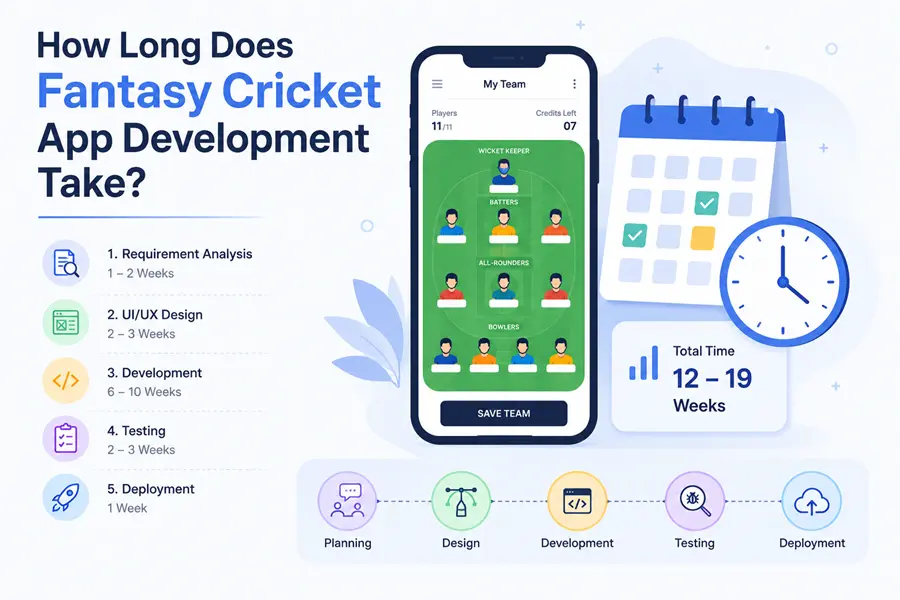
How Long Does Fantasy Cricket App Development Take?
Fantasy cricket app development is a strong business opportunity for startups and sports tech companies. Cricket has a huge global audience, and fantasy gaming keeps users engaged before, during, and after a match. That is why many businesses want to build their own platform.
But one question comes up again and again:
How long does fantasy cricket app development take?
The real answer depends on the app scope, feature set, platform choice, design needs, API integrations, and testing requirements. A simple MVP can launch faster, while a full-scale fantasy sports product needs more time.
In this blog, we will break the timeline into clear stages. We will also cover features, technology stack, costs, challenges, trends, and the business value of building a fantasy cricket platform. If you are planning a product in this space, this guide will help you understand what to expect before you start.
Market Overview and Industry Trends
Fantasy cricket has become one of the most active segments in the sports tech space. Users enjoy the mix of sports knowledge, strategy, and competition. Businesses like it because it creates repeat engagement and multiple revenue streams.
A few things are driving the market forward:
- More users now own smartphones
- Mobile internet is cheaper and faster
- Sports streaming has become common
- Online payments are easier to use
- People enjoy interactive sports experiences
Fantasy platforms are no longer basic team-selection apps. Today, users expect live updates, smart dashboards, contest variety, secure wallets, and fast performance. That is why modern fantasy sports app development needs a careful product plan.
What users now expect
- Fast match updates
- Easy team creation
- Simple contest joining
- Safe payments
- Clear prize tracking
- Smooth app navigation
What businesses now want
- Faster launch time
- Better user retention
- Strong security
- Higher conversion rates
- Scalable infrastructure
- Long-term growth
This shift has made fantasy app developers focus not just on coding, but also on business goals, user experience, and market fit.
What Is Fantasy Cricket App Development?
Fantasy cricket app development is the process of building a digital platform where users create virtual cricket teams using real-life players. Points are awarded based on real match performance.
A full fantasy cricket app usually includes:
- User signup and login
- Match list
- Team creation
- Contest management
- Wallet integration
- Live score updates
- Leaderboards
- Referral system
- Admin dashboard
- Payment gateway support
Some apps are simple and focus on core gameplay. Others include advanced features like AI recommendations, social sharing, rewards, and multiple sports formats.
How Long Does Fantasy Cricket App Development Take?
For most projects, the timeline falls into these ranges:
|
App Type
|
Estimated Time
|
|
Basic MVP
|
2–4 months
|
|
Mid-Level Product
|
4–6 months
|
|
Advanced Platform
|
6–12 months
|
The exact duration depends on how complex the app is. A basic app with essential features takes less time. A highly customized product with analytics, automation, and multiple integrations takes longer.
Fantasy Cricket App Development Timeline by Phase
1. Requirement Gathering and Planning: 1–2 Weeks
This is the first step in the process. The team understands the business idea, target users, feature list, monetization model, and technical needs.
During this phase, the team usually defines:
- App goals
- Core user flow
- Business model
- Feature roadmap
- Monetization strategy
- Target platforms
A good planning phase saves time later. It reduces confusion and avoids repeated changes during development.
2. UI/UX Design: 2–4 Weeks
Fantasy cricket users expect a simple and fast experience. If the app feels slow or confusing, they leave quickly.
Designers create:
- Wireframes
- User journeys
- Screen layouts
- Interactive prototypes
- Visual design systems
The goal is to make the app easy to use for both beginners and regular users.
3. Backend Development: 4–8 Weeks
The backend is the core of the platform. It handles logic, databases, contests, wallets, and live updates.
Backend development usually includes:
- Server setup
- Database design
- User authentication
- Contest logic
- Scoring engine
- Payment handling
- Admin controls
- Notification system
This stage takes time because fantasy apps must process large volumes of data accurately and quickly.
4. Frontend Development: 4–8 Weeks
Frontend development covers the app screens users see on their phones.
Developers work on:
- Home screen
- Match listing
- Team selection
- Contest screens
- Wallet pages
- Profile section
- Notifications
- Referral section
The team also makes sure the app works well on different devices and screen sizes.
5. API Integration: 1–3 Weeks
Fantasy cricket apps depend heavily on third-party APIs.
Common integrations include:
- Live score APIs
- Payment gateways
- SMS verification
- Push notifications
- Analytics tools
- Email services
If the APIs are stable and well-documented, this phase goes smoothly. If not, the timeline can extend.
6. Testing and Quality Assurance: 2–4 Weeks
Testing is one of the most important parts of the project. Fantasy apps deal with user money, live scores, and match-based timing, so errors can create trust issues.
Testing usually covers:
- Functional testing
- Performance testing
- Security testing
- Device testing
- API testing
- Payment testing
The team checks every important path in the app before launch.
7. Deployment and Launch: 1 Week
Once testing is complete, the app is ready for deployment.
The team handles:
- App store submission
- Server deployment
- Production checks
- Error monitoring
- Performance tracking
Some apps launch as an MVP first and then add new features after user feedback.
Features That Affect Development Time
Not all fantasy cricket apps take the same time to build. The more complex the product, the longer the timeline.
Basic Features
These are common in most MVP apps:
- Signup and login
- User profile
- Match list
- Team creation
- Contest joining
- Basic leaderboard
- Wallet system
- Push notifications
These features are enough for a simple launch and usually reduce development time.
Advanced Features
These increase both value and complexity:
- AI-based team suggestions
- Multi-language support
- Referral rewards
- Social sharing
- In-app chat
- Real-time analytics
- Advanced admin reports
- Personalized contest recommendations
Why these matters
Every extra feature adds design work, backend logic, testing, and optimization. That is why feature planning is one of the biggest factors in timeline estimation.
Development Models and Their Impact on Time
Native App Development
Native development means building separate apps for Android and iOS.
Pros:
- Better performance
- Strong platform control
- Good user experience
Cons:
- Takes more time
- Higher cost
- Separate maintenance
Cross-Platform Development
Cross-platform frameworks like Flutter or React Native help teams build one codebase for both Android and iOS.
Pros:
- Faster development
- Lower cost
- Easier updates
Cons:
- May need extra optimization for some features
For many startups, cross-platform development is a practical choice because it reduces time to market.
Technology Stack for Fantasy Cricket App Development
A strong tech stack helps the product perform better and scale faster.
Frontend
- Flutter
- React Native
- Kotlin
- Swift
Backend
- Node.js
- Laravel
- Python
- Java
Database
Cloud and Hosting
APIs and Tools
- Live score APIs
- SMS gateways
- Payment gateways
- Push notification services
- Analytics tools
The right stack depends on your budget, product goals, and expected traffic.
Cost Breakdown of Fantasy Cricket App Development
The timeline and the cost usually move together. A more advanced app takes more hours, so it costs more.
Approximate cost ranges
|
App Type
|
Estimated Cost
|
|
Basic MVP
|
$7,000–$10,000
|
|
Mid-Level Product
|
$10,000–$25,000
|
|
Advanced Platform
|
$25,000–$50,000+
|
Main cost factors
- App complexity
- Number of features
- UI/UX quality
- API integration
- Platform choice
- Testing effort
- Security setup
- Maintenance support
Businesses should also keep a budget for cloud hosting, updates, and post-launch support.
Business Benefits of Fantasy Cricket App Development
A well-built fantasy cricket app can support long-term business growth.
1. Strong User Engagement
Sports fans often return to the app during every match and tournament. This creates repeat traffic.
2. Multiple Revenue Streams
Businesses can earn through:
- Contest fees
- Ads
- Premium subscriptions
- Brand partnerships
- In-app purchases
3. Brand Growth
A fantasy sports app can help a business build a strong digital presence in a competitive market.
4. Expansion Opportunities
Once the platform works well for cricket, the business can expand into football, kabaddi, basketball, or multi-sport formats.
Common Challenges and How to Solve Them
1. Live Data Accuracy
Fantasy apps need accurate score updates during live matches.
Solution:
Use trusted live score APIs and build a stable backend process.
2. Traffic Spikes During Big Matches
Major tournaments can bring sudden traffic loads.
Solution:
Use cloud hosting with auto-scaling and load balancing.
3. Payment Security
Users trust the platform with money, so security is critical.
Solution:
Use strong encryption, secure authentication, and trusted payment gateways.
4. User Retention
Some users uninstall apps after the tournament ends.
Solution:
Add loyalty programs, rewards, seasonal contests, and personalized notifications.
5. Compliance and Platform Rules
Apps must follow app store policies and local legal guidelines.
Solution:
Work with experienced fantasy app developers who understand product compliance and launch requirements.
Future Trends in Fantasy Sports App Development
The fantasy sports space continues to change. Businesses that plan ahead can stay ahead.
AI-Based Team Suggestions
AI can study player records, pitch conditions, and past trends to suggest better teams.
Personalized Experiences
Apps will offer more custom content based on user behavior and contest preferences.
Social Gaming Features
Users want to compete with friends, join private leagues, and share their wins.
Better Data Insights
Admins and users both will benefit from deeper analytics and performance dashboards.
More Sports Formats
Many platforms are moving beyond cricket and adding new sports to widen their audience.
These trends show that fantasy sports app development is moving toward smarter, more interactive, and more personalized products.
Why Choose Dinoustech for Fantasy Cricket App Development?
Dinoustech Private Limited is a Jaipur-based mobile app and software development company that builds practical, scalable digital products for businesses across industries.
When it comes to fantasy cricket app development, our team focuses on both product quality and business value.
What Dinoustech brings to the project
- Experience in app and software development
- Strong UI/UX thinking
- Scalable backend architecture
- Custom feature development
- Security-first implementation
- Business-focused planning
- Ongoing support after launch
Our broader service strength
Along with fantasy sports app development, Dinoustech also works on:
- Mobile app development
- Web development
- SaaS development
- AI app development
- Logistics software development
- Healthcare app development
- Fintech app development
- Custom software solutions
This cross-industry experience helps us build products that are practical, reliable, and easier to scale.
How to Reduce Fantasy Cricket App Development Time
If you want to launch faster, smart planning matters.
Practical ways to save time
- Start with an MVP
- Prioritize core features first
- Use cross-platform development
- Select reliable APIs early
- Finalize requirements before coding
- Avoid frequent scope changes
- Work with an experienced development team
A phased launch is often the best approach. It helps you enter the market quickly and improve the product based on real user feedback.
Conclusion
So, how long does fantasy cricket app development take?
For a basic MVP, the timeline is usually around 2–4 months. For a mid-level product, it may take 4–6 months. For a feature-rich advanced platform, it can take 6–12 months or more.
The exact timeline depends on your app goals, feature list, API needs, design complexity, and development approach. If you want faster delivery, a clear plan and the right team make a big difference.
A good fantasy cricket app should be fast, secure, simple to use, and ready to handle live match traffic. That is where experienced fantasy app developers can help. They understand both the technical and business side of the product.
At Dinoustech, we help businesses turn fantasy sports ideas into real, scalable apps that users enjoy and trust.
FAQs
1. How long does fantasy cricket app development usually take?
A basic app usually takes 2–4 months. A more advanced platform can take 6–12 months depending on features and integrations.
2. What affects the development timeline the most?
The biggest factors are featuring complexity, design work, backend logic, API integrations, testing, and platform choice.
3. Is cross-platform development a good choice for fantasy cricket apps?
Yes. It can reduce development time and cost while still delivering a strong user experience on Android and iOS.
4. What technologies are commonly used for fantasy sports app development?
Flutter, React Native, Node.js, Laravel, Python, MySQL, PostgreSQL, AWS, and live score APIs are commonly used.
5. Why is testing so important in fantasy cricket app development?
Testing makes sure the app handles live data, user payments, contests, and traffic spikes without errors.
6. Can a fantasy cricket app support other sports later?
Yes. Many businesses start with cricket and later expand into football, kabaddi, basketball, or multi-sport gaming.