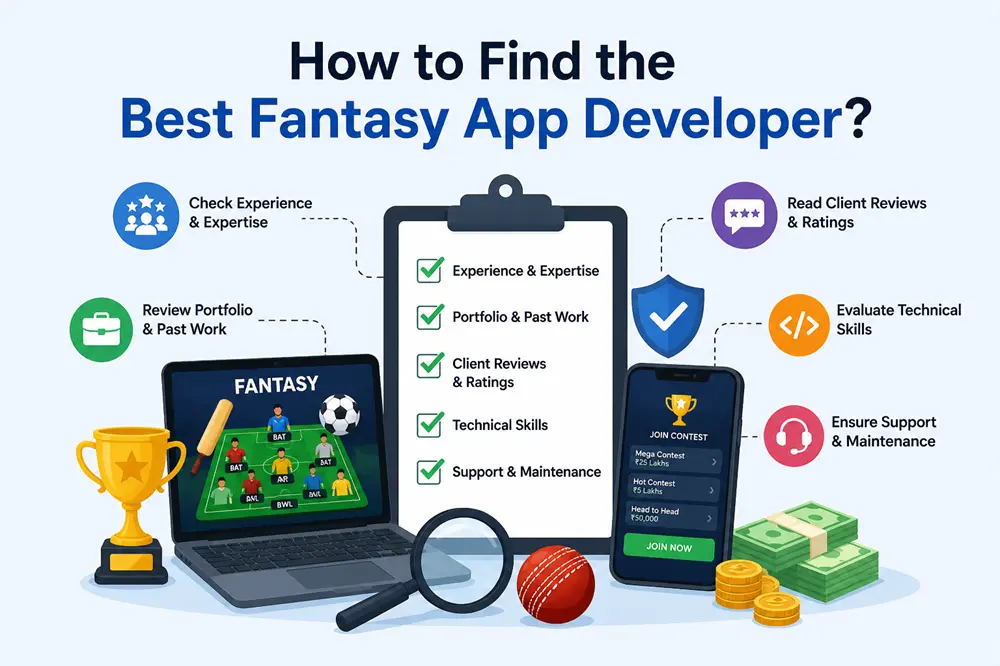
How to Find the Best Fantasy App Developer?
Finding the right fantasy app developer matters because the market is large, mobile-first, and still growing fast. Grand View Research estimated the global fantasy sports market at USD 24,853.7 million in 2024 and projected it to reach USD 56,381.3 million by 2030. Mordor Intelligence estimated the India fantasy sports market at USD 1.82 billion in 2025 and USD 5.05 billion by 2030. In Asia Pacific, India held 57.62% of the market share in 2025, cricket generated 61.45% of regional revenue, and mobile applications accounted for 77.92% of engagement. That mix tells you one thing clearly: fantasy apps win when they are built for mobile users, cricket fans, and real-time behavior.
For founders, the challenge is not just to build an app. It is to build a product that keeps users active, contest flows smooth, and live scoring reliable. A fantasy sports app development company should understand that fantasy products depend on speed, trust, and repeat use. If you plan to hire fantasy app develops or search for a fantasy app creation company, you need a team that knows the market, the technical stack, and the user journey. A mobile app development company or web development company with real fantasy experience will usually think about product decisions, not only screens and code.
Start With the Right Product Goal
The first step is to define what the app should do in its first version. Some founders want a cricket-only MVP. Others want a multi-sport platform with paid contests, wallets, admin tools, referrals, and analytics. The goal should shape the build, not the other way around. If you start with features before you define the business outcome, the scope grows too quickly and the budget becomes harder to control. A good fantasy app development company should help you narrow the product before it starts coding.
A strong product brief should cover the target user, the contest format, the revenue model, the launch city or region, and the first version’s must-have features. It should also define what can wait for a later release. That keeps the MVP lean and helps the team move fast. A fantasy app creation company that asks the right questions early will usually save you money later because it reduces rework, confusion, and unnecessary feature growth. That is especially important in a category where users expect quick action and clean match-day performance.
Also Read: - Advantages of Developing Fantasy Sports Apps: Increasing User Involvement
Look for Real Fantasy Experience
A general app builder is not the same as a fantasy product team. Fantasy apps need live scoring, contest logic, user ranking, wallet handling, notifications, and match-day traffic management. That is why you should look for a fantasy sports app development company with real experience in this category, not just one with a polished portfolio. Ask for examples of fantasy cricket, fantasy football, or live contest products they have built. Ask how they handled score updates, contest timing, and peak traffic. Experience here matters more than design polish.
You should also ask how they work with live data. Fantasy apps depend on fast and reliable updates, and that means the developer must understand data flows, event handling, and score synchronization. A strong team can explain how it moves data from sports feeds to the user interface without causing delays or wrong rankings. If the answers stay vague, that is a warning sign. A solid fantasy app developer should be able to speak clearly about product logic, not only frameworks and databases.
Check Their Design Thinking
A fantasy app can lose users before the first contest if the interface feels crowded or confusing. That is why design is not only about colors and icons. It is about helping users move quickly from signup to contest entry to live tracking. The app should show upcoming matches, team-building steps, wallet balance, and contest options without making users dig through too many screens. Since mobile applications accounted for 77.92% of engagement in Asia Pacific in 2025, the app must work cleanly on phones and feel fast in one-handed use.
A good fantasy app development company will build wireframes, user flows, and prototypes before coding. That helps you see where users may get stuck. It also helps you test whether the app feels simple enough for first-time users. If the design only looks good on paper but feels confusing in practice, the app will struggle after launch. A mobile app development company that understands fantasy products will focus on clarity, not clutter. The goal is to help users join a match in as few taps as possible and keep them coming back for the next one.
Must Read: - Which Company Makes the Best IPL Fantasy Sports Apps In 2026?
Test Their Understanding of Team Creation and Live Scoring
Team creation is the core action in a fantasy app. If this flow feels slow or confusing, the product loses users. The app should help users search players, compare credits, choose captain and vice-captain, and confirm team balance without friction. It should also show contest rules, player roles, and match context in a way that feels quick to read. A fantasy app creation company that gets this part right gives users a clear reason to stay active because the main interaction feels useful and fast.
Live scoring is just as important. Users want score changes, point updates, and ranking movement while the match is still running. That means the backend has to handle real-time or near-real-time updates well. Socket.IO describes its platform as built for low-latency, bidirectional, event-based communication, which is the kind of pattern many live fantasy apps need. When you evaluate a developer, ask how it handles live data, push updates, and score synchronization. A strong fantasy sports app development company will have a clear answer because live scoring is one of the features users notice immediately.
Ask About Wallets, Payments, and Rewards
Fantasy apps often handle money, which means the wallet and payment flow must feel safe and simple. Users need to add funds, join paid contests, withdraw winnings, and review transaction history without confusion. The app should confirm actions clearly and show balances in plain language. If the payment experience feels uncertain, users will hesitate. That can hurt retention and revenue. A fantasy app development company should therefore treat wallet design as a core product feature, not as an add-on.
You should also ask how the developer handles rewards, bonuses, and referral logic. Many fantasy apps use first-deposit offers, free-entry contests, or loyalty rewards to improve repeat use. Those systems need clean tracking and accurate rules. A fantasy app creation company should be able to explain how it records entries, calculates rewards, and prevents disputes. If the business logic is weak, support problems will grow later. A good developer will design the backend and admin tools together so financial actions stay clear for both the user and the business.
Also Read: - Must-Have Features in Fantasy Game App Development
Make Sure the Developer Thinks About Trust and Security
Fantasy apps deal with user identities, payments, and contest fairness, so security cannot come later. PCI DSS sets baseline technical and operational requirements for protecting payment account data. OWASP’s API Security Top 10 2023 also highlights issues such as broken authorization and broken authentication. A developer who understands these basics will usually build stronger foundations for login, data access, and payment handling. That matters because trust is one of the main reasons people stay with a fantasy app.
You should ask the developer how it handles access control, session management, audit logs, and sensitive data. You should also ask how it tests for abuse, duplicate actions, and suspicious behavior. A good fantasy sports app development company will not treat security as a slide in the pitch deck. It will treat it as part of the build itself. When a fantasy app feels safe, users join contests more confidently and return more often. That trust is a business asset, not just a technical detail.
Check Their Tech Stack and Scalability Plan
Fantasy apps grow quickly during live matches, so the stack must support speed, scale, and reliability. The app usually needs a mobile front end, a backend for contest logic and scoring, a database for users and transactions, push notifications, and a web admin panel for operations. A web development company can manage the admin side, while a mobile app development company can handle rider-side and user-side interfaces. The best teams plan the architecture so future growth does not force a full rebuild.
Scalability matters because the market is not small. Grand View Research projects the global fantasy sports market to reach USD 56,381.3 million by 2030, and Mordor Intelligence projects India’s market to reach USD 5.05 billion by 2030. That kind of growth means your app may face higher traffic, more contests, and more live updates as it scales. A fantasy app developer should be able to explain how the system handles load, keeps data consistent, and avoids slowdowns during peak hours. If the answer sounds improvised, keep looking.
Must Read: - How to Develop an IPL 2026 Fantasy Sports App?
Look for Analytics and Continuous Improvement
A fantasy app should not stay static after launch. The team needs analytics to see which screens users open, where they drop off, which contest types convert best, and which features drive repeat use. This is especially important in India, where mobile usage dominates engagement and cricket generates most of the market revenue. A fantasy app creation company that builds analytics into the first release gives the business a much better chance of improving over time.
You should ask how the developer uses data after launch. Does it review user behavior? Does it test changes before rolling them out? Does it track retention, contest joins, and payment behavior? Those questions matter because fantasy apps win through iteration, not one-time delivery. A strong developer will build the app so the team can learn from real usage and keep improving the product. That kind of approach helps the business respond to user needs, match-day patterns, and market shifts without wasting time.
Compare Communication, Process, and Support
A good fantasy app developer should be easy to work with. That means clear timelines, clear milestones, regular updates, and honest answers when something changes. If the team cannot explain its process in simple language, the project may become hard to manage later. A fantasy sports app development company should be able to walk you through discovery, design, development, testing, launch, and post-launch support without using vague promises. That level of clarity is often a sign of a mature delivery process.
Support matters too. Fantasy apps need fixes, updates, score feed maintenance, and feature improvements after launch. You should ask what the team does after the app goes live. Will it handle bugs quickly? Will it support seasonal updates? Will it help with new contest formats? A good mobile app development company or web development company will see launch as the beginning of the product journey, not the end. That kind of partnership is usually worth more than the lowest quote.
Build a Shortlist the Smart Way
The best way to shortlist a developer is to rank each vendor on real product fit, not on presentation alone. Check whether the team has relevant fantasy work, a clear process, a strong tech stack, and a good understanding of user behavior. Ask for case studies, ask about live scoring, ask how it handles wallets, and ask how it supports growth. If you are comparing teams and plan to hire fantasy app develops, this is the moment to separate marketing talk from actual capability.
Dinoustech can sit in that shortlist as one of the software development companies a founder may consider when the goal is practical delivery with product thinking. The right developer should help you build the app around real users, real data, and real match-day behavior. It should also help you keep the first version lean so you can launch faster and improve based on usage. In a market as large and mobile-driven as fantasy sports, that is the kind of partner that can make a real difference.
The final choice should be simple: pick the team that understands the product, the market, the user, and the technology together. A strong fantasy app developer does not just build screens. It helps you launch a product users trust, use, and return to. That is the real standard for success in 2026, and it is the standard your fantasy app should aim for from the start.