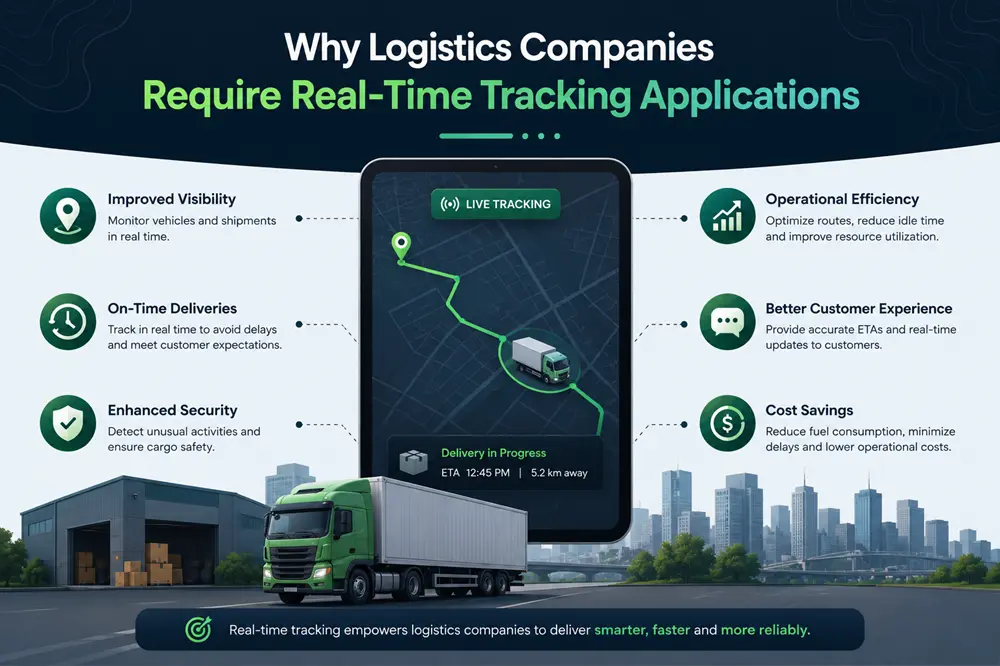
Why Logistics Companies Require Real-Time Tracking Applications
Logistics has become a very tech-intensive sector of today's business environment. Indeed, owing to rapid development of eCommerce, globalization of trading relationships, changing customer preferences and rising complexities of supply chain operations, logistics firms are now forced to increase speed and efficiency of deliveries and ensure highest possible safety of goods. Today's customers do not tolerate imprecise delivery times and incomplete information about the status of shipments. They want real-time updates, accurate estimates and full transparency during the process of transportation.
At the same time, traditional approaches to logistics management often prove inadequate to deal with the above-mentioned challenges. Manual tracking and reporting, communication delays and insufficient visibility during operations are likely to lead to mistakes, customer disappointment and rising operational costs. In order to scale their logistics operations, firms are increasingly finding it hard to address the above-mentioned problems successfully.
Real-time tracking apps offer an efficient solution for overcoming the aforementioned difficulties. These applications enable companies to track their shipments, vehicles, drivers and delivery routes in real time. Real-time tracking apps help businesses achieve higher efficiency, lower operational costs and boost customer satisfaction through GPS, cloud computing, mobile Internet and data analytics.
The significance of real-time tracking systems is increasing very quickly as logistic firms look for innovative methods through which they can develop their competitive edge in a highly competitive market. Companies that use advanced tracking systems are able to efficiently manage their logistic processes, communication, and provide their customers with exceptional services.
For more: Top 10 Must-Have Features in Logistics Software Development
The Need for Logistics Visibility Grows Stronger
Logistics processes have become more complex than ever due to several parties involved, including manufacturers, warehouses, distributors, carriers and consumers. It means that there should be full visibility of all stages of the process to coordinate the actions of different parties.
Without real-time tracking of the cargo, logistics specialists have to depend on manual tracking and various communication channels to follow the progress of shipments.
Real-time tracking systems make the process much easier and help to control the deliveries without any delays. The ability to see where the cargo is located and what happens at the current moment allows logistics specialists to fix potential problems right away.
Nowadays, in times when the customers come first, there is no place for inefficiency. Real-time visibility helps companies gain trust and improve their competitive advantage on the market.
For more: Build a Scalable Logistic Management Software: Step-by-Step Guide
Improving Customer Experience with Real-time Update Services
The demands of customers have undergone radical changes over time. The success of prominent online shopping portals has raised benchmarks in terms of delivery service and convenience. Customers now require to know the exact location of their packages and when will they be delivered.
Such real-time tracking systems can prove helpful for logistics firms in meeting such demands.
Delivery Estimation Accuracy
One of the greatest benefits that real-time tracking offers is the provision of accurate delivery estimates. Through the use of GPS, traffic data, weather data, and route efficiency, tracking programs are able to generate accurate delivery estimates.
This will not only make planning for customers easier, but it also alleviates frustration from delays.
Instant Notifications
Today’s tracking software is designed to provide instant notifications about changes in the shipment status, dispatches, delays, and deliveries made.
Such kind of notification system helps with better communication and minimizes the need to contact customer support services.
Enhanced Customer Trust
Transparency is an important aspect in establishing customer trust. Customers tend to be confident about the shipping process because they have access to information at any point in time while waiting for their goods to arrive.
Increased customer trust tends to translate into increased customer satisfaction.
For more: Logistics Software Development Company in Ahmedabad for Startups & Enterprises
Efficient Management of Fleets and Effective Use of Resources
Fleet management is one of the key aspects of logistics operations. To effectively manage fleets that include many different vehicles and drivers, accurate data and efficient coordination are needed.
Real-time vehicle tracking systems enable managers to monitor everything about their fleets.
Route Optimization
The use of sophisticated tracking devices that employ intelligent algorithms enables the identification of the most efficient routes depending on traffic, road blockage, weather interruptions, and deliveries priority.
The efficient routes decrease time spent on delivery, improve fuel efficiency, and enhance the number of daily deliveries made.
Fuel Expense Saving
Expenses related to fuel constitute a major component of the cost incurred in logistics operations. Real-time tracking technology helps save on fuel usage through reduced unnecessary mileage and less idling.
Optimization of routes has a direct impact on reduction of the cost of transport and profits.
Monitoring of Driver’s Performance
Real-time tracking makes it possible for logistics firms to track driver performance regarding speeding, hard braking, idling, and following routes.
This way, organizations are able to maintain high standards of safety and efficiency of driving.
Increasing Efficiency in the Supply Chain
The efficiency of the supply chain is largely dependent upon good information and quick decision making. Information delays, lack of communication, and poor visibility can interfere with the process and impact business performance.
Real-time tracking software gives logistics firms access to operational information at all times.
Enhanced Collaboration Among Different Parties
Access to real-time information about the status of shipments is helpful to manufacturers, warehouses, distributors, and consumers alike. Better collaboration results in enhanced communication and better coordination of the activities in the entire chain.
The greater complexity that characterizes logistics operations, the more critical is the importance of collaborative visibility.
Improved Problem Management
Traffic jams, mechanical failures, weather conditions, or delays in deliveries may happen anytime.
With real-time monitoring in place, companies can detect problems right away and take corrective measures to prevent them from having a significant effect on the company's activities.
Monitoring the Movement of Inventories
Trackers help monitor the movement of inventories through the transportation network and make sure that businesses have enough inventories.
Minimizing Operational Cost and Business Risks
Every logistic firm is always on the lookout for measures that would make its operations more profitable while also decreasing the associated risks. Real-time tracking systems play an important role in meeting these goals.
Through improved efficiency, decreased delays, and optimal resource allocation, such systems can help reduce the costs of operation.
Theft Protection and Asset Security
Losses associated with stolen shipments and unauthorized vehicle use may amount to significant costs. With the help of GPS-based tracking systems, organizations can track their assets at all times and react immediately to any strange events.
Greater transparency helps improve security and safeguard business assets.
Vehicle Maintenance
Tracking devices usually have features that provide vehicle diagnostics and maintenance tracking. These technologies can alert managers about possible problems before they turn into expensive vehicle breakdowns.
Vehicle maintenance will become more predictable.
Reduced Administrative Costs
By using automation features in tracking software, companies can cut down manual reports, phone calls, and paperwork. Administrative staff members will be able to perform more meaningful tasks.
Facilitating Digital Transformation in Logistics
Digital transformation has emerged as one of the main strategic goals of logistics firms striving to grow sustainably. Real-time tracking applications can be considered the basis for introducing various other technologies.
Real-time tracking applications are perfectly compatible with other software, such as transportation management systems, warehouse management software, and enterprise software.
Moreover, the success of logistics tracking technology has impacted innovation not only in logistics but also in other industries. For instance, the location-based features of real-time tracking are extensively used in taxi booking apps, making their operation more efficient.
It is likely that real-time tracking will stay relevant to logistics due to growing investments in digital technologies.
Artificial Intelligence and Its Importance in Tracking Applications
Artificial Intelligence has improved the performance of modern tracking applications for logistics with its predictive intelligence and automation capabilities.
AI tracking applications are able to analyze past transportation data, detect trends in operations, and predict possible disruptions.
Prediction in Delivery Management
Artificial intelligence can predict the possibility of delays because of the weather, traffic, seasonal demand changes, and route performance experience.
Proactive Measures for Service Reliability
Predictive analytics allows logistics managers to implement preemptive measures to ensure the reliable service.
Intelligent Resource Allocation
AI enables logistics managers to optimize their fleet utilization in terms of the optimal deployment of vehicles, drivers, and delivery schedule.
Intelligent resource allocation results in increased efficiency and lower costs of operations.
Predictive Analytics
Artificial intelligence is capable of providing detailed analytics about performance, customer behavior, and supply chain trends.
The same technologies used in logistics innovations are used for the development of healthcare innovations such as intelligent patient management systems.
Benefits of Real-Time Tracking for Various Industries
Real-time tracking offers benefits not only to logistic companies. eCommerce firms make use of shipment tracking in order to provide customers with better services and develop brand loyalty.
Food delivery apps employ real-time tracking to offer accurate deliveries and efficient driving routes. Financial technology platforms implement real-time monitoring solutions in order to increase security and transparency of transactions.
OTT platforms apply real-time analytics to track content delivery performance. Fantasy sports apps make use of live tracking solutions to provide dynamic experience for users.
All the aforementioned cases show that real-time visibility is an essential aspect of any digital industry today.
Future Trends in Logistics Tracking Technologies
In the future, the development of logistics tracking systems will be driven by Artificial Intelligence, IoT, cloud technologies, and automation.
Connected vehicles will produce an increased amount of operational data, making it possible to track and analyze shipments more accurately. IoT sensors will help collect real-time data about the condition of the shipment: temperature, humidity, and handling.
Another trend that could revolutionize logistics is autonomous delivery. With the help of artificial intelligence, logistics tracking systems will be able to manage the entire network of transportation with minimal human supervision.
Those companies which adopt the above-mentioned trends will have a huge advantage over their competitors.
Conclusion
Applications for real-time tracking have become key resources for contemporary logistics firms that wish to gain more visibility, efficiency, customer satisfaction, and profitability. Offering constant access to information regarding shipments, fleets, and logistics operation processes, real-time tracking applications help overcome many problems related to logistics operations.
Through route planning, saving on fuel, better customer interaction, and supply chain visibility, real-time tracking applications bring tangible advantages to all areas of logistics operations. In an age when digital transformation becomes increasingly relevant, logistics firms that implement innovative tracking technologies will find themselves better equipped to meet the new demands and retain their competitive edge. Firms wishing to create intelligent logistics applications can collaborate with Dinoustech.