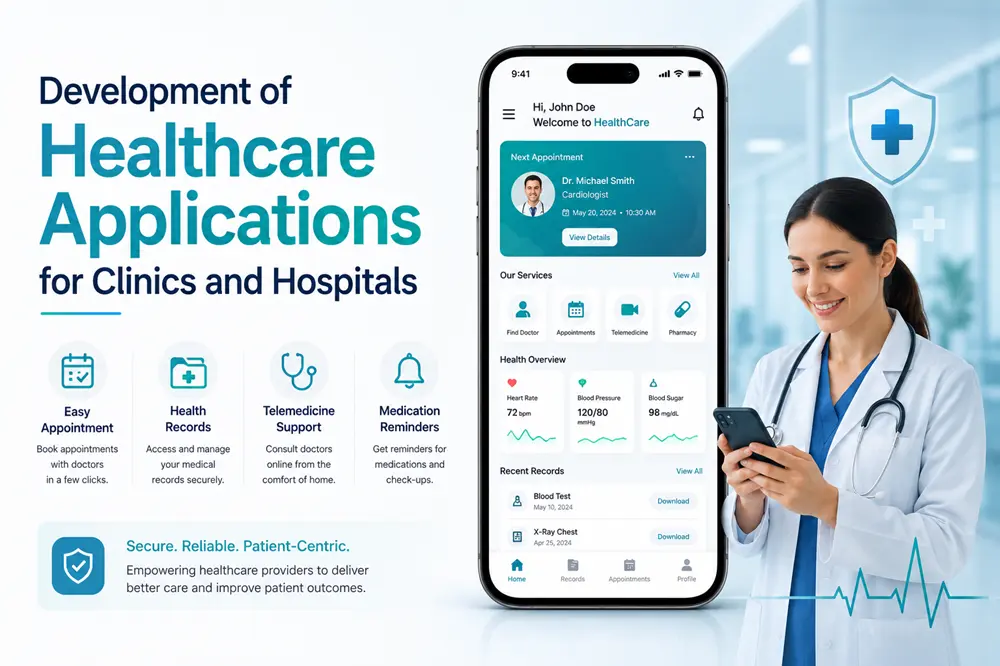
Development of Healthcare Applications for Clinics and Hospitals
There is considerable digitization of the healthcare sector where there has been a trend towards technological solutions for better patient care, better organizational practices, and improved communication between patients and healthcare providers. One such innovation that has become very important due to digitization is the development of healthcare applications. Appointment booking, telemedicine, and electronic medical records are some examples of healthcare applications which have gained popularity in the current time among clinics and hospitals as an indispensable part of providing effective and convenient healthcare services.
The increased adoption of mobile phones, wearables, cloud technology, and artificial intelligence has increased the need for healthcare applications all around the world. Patients now demand the availability of healthcare services through the same means as other digital products. They desire the convenience of booking appointments, accessing medical records, communicating with doctors from remote locations, and receiving customized health information from their mobile phones. By adopting these needs, healthcare organizations can benefit immensely in terms of improving patient satisfaction and operational efficiency.
Development of health care application is not restricted to hospitals and health care companies only. Small clinics, specialized practices, diagnostic centres and startup ventures in health care are also making efforts to use information technologies in order to provide better customer experience and compete on the market successfully. Good health care application can assist medical organizations in optimizing their processes, managing workflows better, improving customer engagement and achieving better clinical results.
In view of the constant development of healthcare systems, information technologies will have more and more impact on efficient delivery of services and patient treatment. Knowledge about the value of healthcare application development can assist clinics and hospitals to make right decisions about using technology strategically.
The Effectiveness of Healthcare Applications in Enhancing the Quality and Access to Health Services
Healthcare applications are radically transforming the way patients interact with healthcare providers. Making it easy for patients to access healthcare services and information, such applications improve the experience of patients and increase the quality of health services provided.
Facilitating Appointment Booking and Patient Management
One of the major advantages of using healthcare applications is the opportunity to facilitate the process of appointment booking and patient management. The traditional method of scheduling appointments involves numerous phone calls, inefficient scheduling systems and other bureaucratic elements that both irritate patients and employees of clinics and hospitals. Healthcare applications enable patients to book, change, or cancel appointments through their mobile devices.
Apart from the fact that this solution significantly increases patient satisfaction, it simplifies the work of administrative employees. Automated appointment reminders reduce the number of cancelled or missed appointments, while scheduling system maximizes the efficiency of physicians' time management. Clinics and hospitals gain the ability to accommodate more patients and deliver better quality services.
Professional Website Development services can be used in combination with healthcare applications in order to increase accessibility of information and facilitate patient-provider communication.
Broadening Scope with Telemedicine Services
Telemedicine has become one of the key innovations that has taken place in healthcare in modern times. Healthcare applications allow patients to connect with physicians by using video calling facilities, messaging services, and virtual consultation services. Such features prove to be quite useful for people who live in distant locations, have difficulty moving around, and need follow-up care on a regular basis.
Patients do not have to travel much in order to meet up with healthcare professionals; besides, they do not have to spend long hours waiting to get an appointment. Moreover, doctors are able to serve a wider audience of patients thanks to such telemedicine tools.
Telemedicine software allows healthcare institutions to better organize the volume of patients who use the services of these facilities.
Increasing Engagement and Communication among Patients
The level of engagement of a patient is very important in determining whether the patient will have good healthcare outcomes. Healthcare apps give patients an opportunity to access health-related information, care plans, prescription notifications, lab test results, and communication from physicians. Having all this information continuously available encourages patients to become more involved in managing their health.
Good communication between healthcare providers and patients increases compliance and patient satisfaction levels. Messaging functionalities allow patients to ask questions, get answers, and be aware of their medical condition without having to visit the healthcare facility in person.
Healthcare organizations which put much emphasis on patient engagement can benefit from good patient relations, higher retention rates, and better reputation among patients.
Advantages of Healthcare App Development for Operations
Although there are many benefits associated with healthcare applications for patients, such applications bring a lot of operational advantages for clinics and hospitals.
Increased Administrative Efficiency
The administrative functions make up a substantial part of any healthcare organization. Record keeping, scheduling appointments, billing, and communication require time and energy. Modern healthcare applications perform all these tasks automatically, helping to save both time and effort and decrease the margin of error.
Automation speeds up administrative processes and makes them more accurate and consistent. The personnel will have more opportunities to concentrate on their real duties, like patient care and process improvement projects.
The use of Advanced Software Development technologies allow healthcare facilities to implement secure and reliable IT systems that will meet all the demands related to their administration and will be compliant with the standards.
Electronic Health Records and Information Management
Modern applications provide healthcare facilities with possibilities for managing electronic health records, which gives them an opportunity to get fast access to all the information about the patient. Digital records increase information accuracy, decrease paperwork, and help to make better decisions.
Medical specialists will be able to consult patient history, diagnostic test results, prescriptions, and treatment plans from one centralized system. It promotes better cooperation of medical teams and decreases the chances of mistakes due to incomplete data.
Effective data management will help healthcare organizations achieve regulatory compliance and will ensure that healthcare organizations keep their records secure while respecting the privacy and confidentiality of their patients.
Improving Mobile Healthcare Experiences
With mobile technology taking the centre stage in all digital activities, healthcare organizations have to provide their customers with top-notch mobile experiences. Mobile healthcare apps give their customers an opportunity to use healthcare-related services in a convenient way.
Professional Mobile App Development guarantees that mobile healthcare applications have easy-to-use navigation, fast loading speed, secure user authentication and overall flawless functioning on various devices and platforms. Good mobile experience results in increased usage rates and customer satisfaction.
Investment into mobile healthcare applications allows healthcare organizations to stay competitive and respond to the needs of modern healthcare customers.
Future Growth Potential of Healthcare Technology
The development of healthcare applications is not just an IT project that one should complete now. It is a strategic step that will ensure future success of healthcare organizations.
Utilizing New Technologies to Enhance Healthcare Services
New innovations, including artificial intelligence, machine learning, wearables, and predictive analytics, make it possible to do things differently in healthcare. Today’s modern healthcare apps are able to leverage these technologies to enhance diagnostics, monitor patient health, and develop personalized treatment strategies.
The use of artificial intelligence in healthcare will help professionals analyse vast amounts of data and discover patterns that contribute to clinical decision making. Wearables connected with healthcare applications allow for monitoring patient health in real-time and making timely interventions.
In other words, these technological innovations allow healthcare organizations to provide efficient, accurate, and personalized services without having to spend too much money.
Scaling Healthcare Ecosystems
Healthcare organizations need to have the ability to scale their business and offer more services to more patients. Scalability is an important aspect of healthcare application development.
Full Stack Development provides the necessary technical capabilities required to develop scalable healthcare solutions. It includes both frontend and backend components that will handle datasets and users effectively.
Scalability helps clinics and hospitals scale up their services, offer additional functionality, and adjust to changes in the field without sacrificing efficiency or reliability.
Boosting Awareness and Patient Attraction
Launching a healthcare app is only half the battle. The other part is making sure that your patients know about your digital offering and use it effectively. Effective marketing can be key to promotion of healthcare apps and attraction of new patients.
Professional Digital Marketing Services allow clinics and hospitals to boost their online presence using SEO, content marketing, social media campaigns, and online advertisements. This way, they will attract more patients, build a strong brand reputation, and encourage use of digital healthcare solutions.
With growing competition in the healthcare industry, it becomes increasingly important for clinics and hospitals to use advanced technologies and marketing strategies effectively.
Conclusion
Development of healthcare applications is one of the crucial elements in modern healthcare provision. Improving patient availability, facilitating communication, increasing efficiency, and providing information for decision-making are some ways in which healthcare applications allow healthcare clinics and hospitals to provide better service and increase efficiency. In this way, patients receive access to high-quality healthcare service, and medical organizations receive an opportunity to streamline their processes, decrease bureaucratic procedures, and establish closer connections with patients.
As digital transformation increasingly affects the healthcare industry, medical organizations should think about investing into innovative healthcare applications to respond to changing requirements and to take advantage of new opportunities. Telemedicine, electronic health records, mobile healthcare applications, analytics are just some of the examples how healthcare applications can help medical organizations to grow sustainably and deliver more effective healthcare services. Dinoustech helps healthcare clinics, hospitals, and other healthcare organizations to use advanced technology solutions to build healthcare applications.