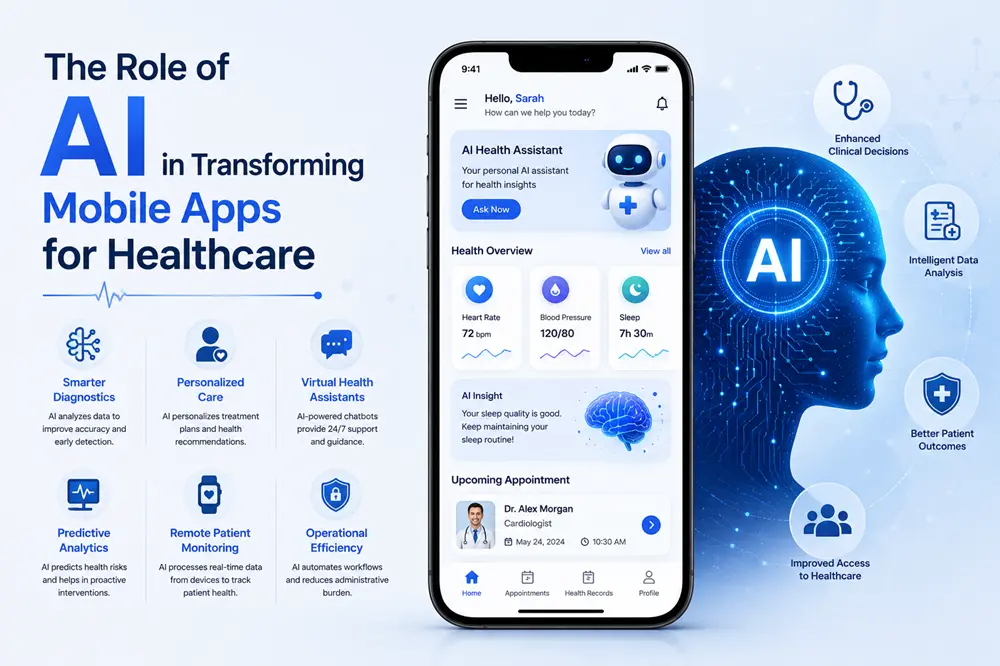
The Role of AI in Transforming Mobile Apps for Healthcare
Currently, there is a rapid change in the healthcare industry due to the rise of digital technology, and artificial intelligence (AI) has become one of the most innovative technologies driving the evolution of healthcare services. In order to improve the quality of patient care and optimize the work processes, more and more healthcare facilities are turning to AI applications which serve as powerful tools for clinics, hospitals, healthcare startups, and medical professionals across the world. AI healthcare applications transform the process of delivering healthcare services through their ability to perform intelligent analysis, make predictions, deliver personalized patient care, and automate healthcare.
Mobile healthcare applications have already changed the interaction between patients and healthcare providers in many ways providing such opportunities as appointment scheduling, telemedicine consultation, creation of digital health records, medication reminder service, and remote patient monitoring. The emergence of AI has added new possibilities to mobile healthcare applications allowing them not only to perform the tasks but also to analyse huge amounts of data, detect various patterns, provide important insights, and give recommendations to patients and healthcare providers which improve patient experience and treatment outcomes. Thus, healthcare organizations are implementing AI into their work processes more and more frequently.
The need for intelligent healthcare applications increases as people look forward to convenient, quick, and customized healthcare services. On the other hand, healthcare service providers have been under pressure to cut down on costs and improve efficiency while managing the increasing number of patients. All these are accomplished through AI-based healthcare applications through automation of processes, helping medical professionals through analytics, and ensuring constant engagement with patients. Such benefits are why AI has been among the most revolutionary technologies in the development of healthcare applications.
Revolutionizing Healthcare Mobile Applications Using AI
Artificial intelligence technology has transformed the scope of healthcare mobile applications through intelligent features that enhance patient care and healthcare management processes. The main difference between traditional healthcare applications and AI applications is that while the former only stores and displays information, the latter learns from data, predicts outcomes, and assists healthcare service providers in decision making.
Personalized Patient Experience Through AI
One of the greatest benefits provided by AI for healthcare mobile apps is the ability to offer personalized experience for the users. Each user has his own medical conditions, personal health goals, treatment, and behavioural patterns. Traditional healthcare services may have difficulty in providing personalized treatment due to resource constraints. AI solutions help to resolve the problem by analysing data about each user and offering customized suggestions for him according to his health profile.
Thanks to AI technology, apps for healthcare are able to track the behaviour of the user, analyse the history of medical conditions of the user, evaluate the lifestyle, and predict possible health risks. As a result, the apps can offer customized wellness programs, alerts regarding the need for taking medicine, diet recommendations, and other suggestions.
The healthcare organization that adopts modern mobile app development will be able to create an app with AI-powered personalized experience and get more user engagement along with increased user retention rates. Personalized experiences are important for improving health results since the users become more motivated to follow the recommendations that apply to their situation.
Improving Diagnostic Accuracy and Clinical Decision Making
One of the key factors that are necessary for an efficient work of the healthcare system is accurate diagnosis. With the help of AI, it becomes possible to analyse huge amounts of medical information, identify various patterns, and assist doctors in making diagnoses. With the help of AI-enabled mobile health apps, doctors can analyse symptoms, examine patients' history, and get suggestions regarding possible diagnoses based on the gathered data.
The machine learning systems become better over time because they continue working with huge amounts of information. AI can process large amounts of data from medical imaging, laboratory results, and other sources much faster than human specialists. Consequently, the early detection of certain issues is possible and becomes more efficient with the use of artificial intelligence.
AI-based diagnostic assistants do not substitute the work of healthcare professionals but simply help them to make decisions.
Intelligent Virtual Health Assistants
Applications within healthcare have started employing AI-powered virtual assistants to help increase communication and support for patients. Virtual assistants can help in answering commonly asked questions regarding healthcare, remind people about appointments, help schedule medications, and even navigate healthcare processes.
Unlike regular customer service, AI-powered assistants are available round-the-clock and can instantly respond to any queries of the patients. Availability helps to increase patient satisfaction and reduces the burden from the healthcare staff who would be able to focus on other aspects of healthcare.
The use of virtual assistants allows healthcare providers to engage continuously with patients and build relations that will result in better adherence to healthcare guidelines.
Improving Operational Efficiency Using AI-Powered Mobile Applications in Healthcare
Apart from improving patient experience, AI is also helping to improve operational efficiency within healthcare facilities. Many healthcare providers experience difficulties in terms of administrative load, resource allocation, and high operational costs.
Automation of Administrative Tasks
The work with patients takes place in combination with administrative work which is connected to scheduling, registration, billing, insurance check, record management, etc. These tasks are critical for the proper functioning of the clinic, yet require considerable effort of the medical professionals and thus take much time.
AI allows automating all the mentioned tasks making the job of healthcare providers easier and helping to minimize possible mistakes. Advanced scheduling systems help to manage bookings effectively, to predict cancellation, and to allocate resources properly. Automated billing systems simplify the process and guarantee the accuracy of the payments.
Organizations that decide to make use of professional software development services will be able to develop an efficient healthcare system which can automate all the mentioned administrative processes.
Predictive Analytics for Resource Management
Predictive analytics is the key benefit of the implementation of AI in the healthcare field. It helps to predict patient demand and resource needs in advance.
AI's predictive analytics enable hospitals and clinics to plan their staff needs, inventory management, bed availability, and equipment usage better. Based on previous data and current trends, artificial intelligence can produce accurate forecasts for strategic planning.
Efficient resource management results in decreased inefficiency and improved experience for patients. Providers of health services will be able to utilize the available resources properly in order to deliver care promptly without additional expenses.
Automating EHRs Management
The electronic health record is an integral part of the modern healthcare system today. Nonetheless, the management of a big amount of patient data might be complicated. Using AI, the management process becomes more efficient and organized.
AI-enabled healthcare software can categorize the records, recognize relevant data and give access to important data quickly to the healthcare workers. In this way, not only workflow efficiency is increased, but the administration of the records becomes easier.
Also, AI can find any inconsistencies, duplicates, and missing data in the EHRs.
The Future of AI in Healthcare Mobile App Development
Futuristic healthcare technology is highly dependent on innovations in the field of Artificial Intelligence. With the further development of AI technology, healthcare mobile apps will become smarter and more beneficial for their users and developers.
Remote Patient Monitoring and Preventive Healthcare
AI healthcare applications have revolutionized remote patient monitoring because they make it possible to constantly monitor the vital signs, physical activity, and other health indicators of the user. With the help of wearable devices connected to the app, it is easy to collect data about the user's health and immediately inform the healthcare provider in case there is anything abnormal.
This way, healthcare experts are able to find out about any health problems of their patients and provide timely assistance, which helps prevent more severe illnesses. As a result, the patients' health condition improves and the expenses related to the treatment process decrease.
Scalable Healthcare Technology Ecosystems
Full stack development solutions offer all necessary technical solutions that help create scalable healthcare ecosystems with AI capabilities implemented efficiently. This will ensure good performance and will leave room for innovations in the future.
The use of scalable healthcare platforms allows healthcare organizations to add new functionalities, handle rising demands, and keep up with the pace of changes within the industry.
Promotion of AI Healthcare Solutions via Digital Channels
The most sophisticated healthcare application needs to be promoted successfully to make sure it gets adopted by many users. It is important for healthcare organizations to explain the advantages of using AI solutions to their patients and to encourage them to use digital solutions.
Digital marketing services can assist healthcare organizations to raise their awareness and visibility via content marketing, SEO, SMM, and advertising.
Conclusion
AI technology is revolutionizing the use of mobile healthcare applications through improving patients' experience, ensuring accurate diagnosis, automating activities, and facilitating data-driven decision making. With healthcare providers increasing efforts to transform digitally, AI technology-driven applications have become critical to offering efficient, accessible, and personalized healthcare services. There are a number of AI innovations such as virtual assistants, predictive analytics, remote monitoring, and intelligent diagnostics that healthcare providers need to consider.
Healthcare organizations that will be investing in AI technology-driven healthcare applications are likely to thrive in future because of technology-driven changes in the industry. By combining innovative healthcare applications with user-friendly mobile application interfaces, healthcare providers can be able to achieve improved patient outcomes, reduced costs of operation, and competitive advantage in the industry. At Dinoustech, we assist healthcare organizations to leverage latest technologies to develop innovative mobile healthcare applications.