Dating App Development Process: A Step-by-Step Guide from Idea to Launch
Every dating app that people still use years after launch has one thing in common. It was not built in one big push. It was planned, tested with real people, launched small and improved week after week. This guide walks you through the full dating app development process, step by step, from the first idea to a live app that keeps growing. It is written for founders, matchmaking businesses and product teams anywhere in the world, whether you plan to launch in the USA, the UK, Europe, the Middle East, Australia or Asia.
We are a dating app development company that builds matchmaking, swipe-based and niche dating products for clients worldwide. Everything below comes from how we plan and ship these apps, so you can use it as a working roadmap for your own project.
Key Takeaways
- A successful dating app is built in clear stages: discovery, planning, design, development, testing, launch and growth.
- Trust and safety (verification, moderation, reporting, privacy) must be planned from day one, not added after launch.
- Start with a focused MVP for one audience and one region, then expand features and markets based on real data.
- Cost and timeline depend mainly on features, platforms, design depth, integrations and the region you launch in.
- AI now helps at every stage, from faster development to smarter matching and 24/7 user support.
Table of Contents
- What Is Dating App Development?
- Types of Dating Apps You Can Build
- The Dating App Development Process: 9 Steps
- Must-Have Features for Users and Admins
- Choosing the Right Tech Stack
- How Dinoustech Uses AI in Dating App Development
- Monetization Models That Work Worldwide
- Privacy, Safety and Compliance by Region
- Dating App Development Cost Factors
- Development Timeline
- Common Challenges and How to Solve Them
- Your Dating App Team
- Why Choose Dinoustech
- FAQs
What Is Dating App Development?
Dating app development is the work of planning, designing, building, testing and running a mobile or web product that helps people meet, match and talk. It covers much more than a swipe screen. A real dating product includes user onboarding, profile verification, a matching engine, real-time chat, notifications, payments, a moderation system, an admin panel and analytics, all running on a secure and scalable backend.
The process is also different from many other apps because a dating app only works when there are enough active people in the same place at the same time. That is why the business plan, the launch region and the growth strategy matter as much as the code.
Types of Dating Apps You Can Build
Before you start, decide which kind of product you are making. The type shapes the features, the design and the matching logic.
| App type | How it works | Good fit for |
|---|
| Swipe-based | Users swipe on profiles; a mutual like creates a match | Large, casual audiences and fast onboarding |
| Compatibility / matchmaking | Questionnaires and scoring suggest a few strong matches | Serious relationships and marriage-focused users |
| Location-based | Shows people nearby or people you crossed paths with | City-focused launches and social discovery |
| Niche or community | Built around a shared faith, culture, interest, age group or identity | Underserved groups with clear needs |
| Video-first | Short video profiles, live video dates and voice prompts | Younger users and safety-conscious audiences |
| Friendship and networking | Same matching logic used for friends or professional contacts | Expanding beyond romance to more use cases |
If you already have a famous app in mind, our guides on building apps like Hinge and Happn show how those models work in practice.
The Dating App Development Process: 9 Steps
Here is the step-by-step process we follow. Each step has a clear output, so you always know what is finished and what comes next.
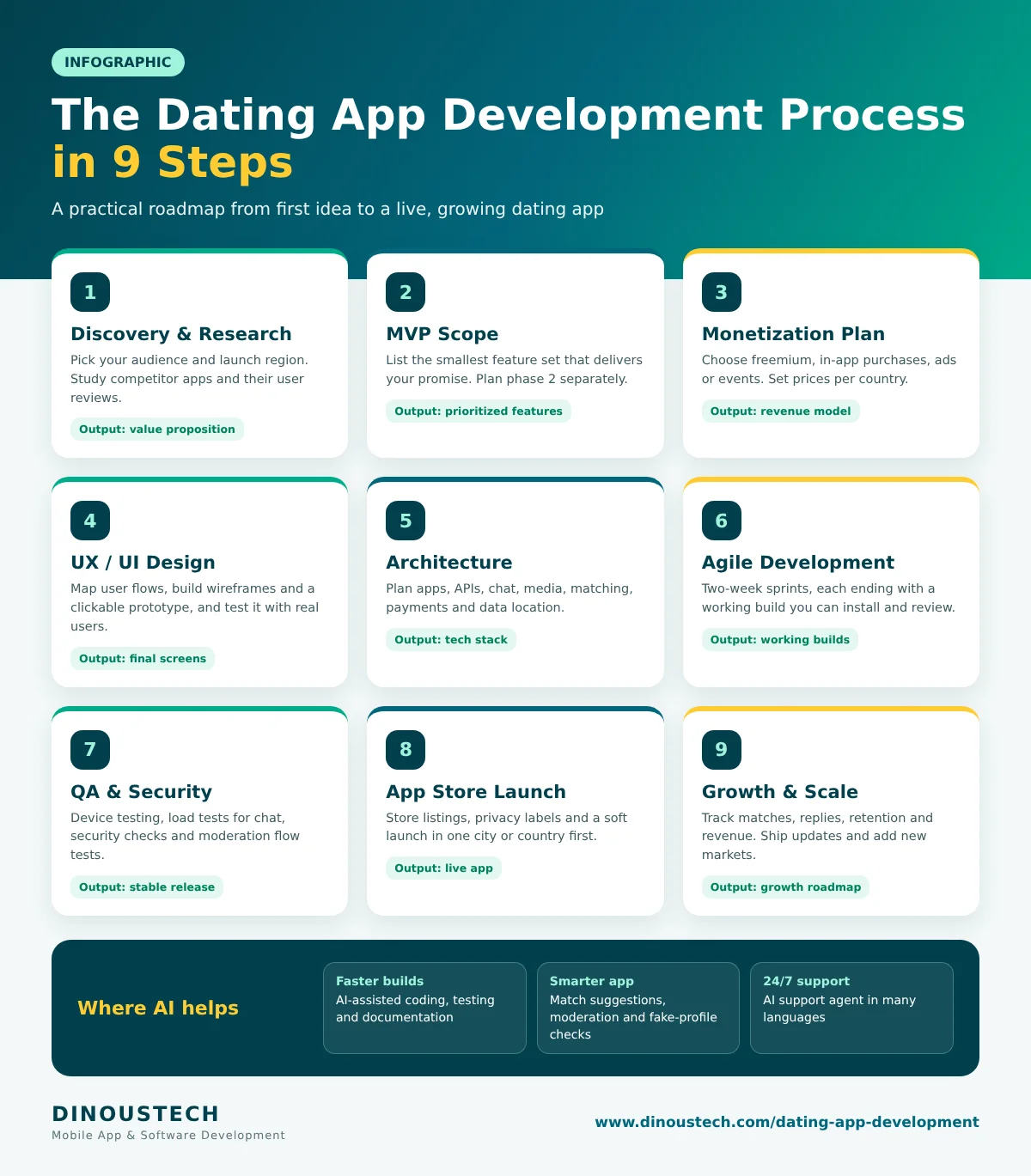
Step 1: Discovery and Market Research
Start by defining who the app is for and why they would switch from what they use today. Study the apps your audience already uses, read their app store reviews, and list the complaints that keep coming up, such as fake profiles, poor matches or too many paywalls. Pick one launch region first. Dating behaviour, payment habits and privacy laws differ a lot between, for example, the USA, Germany, the UAE and India.
Output: target audience, launch region, competitor notes and a one-line value proposition.
Step 2: Define Your Concept and MVP Scope
Write down the smallest version of the app that still delivers your promise. This is your MVP (minimum viable product). For most dating apps the MVP includes sign-up, profile creation, verification, discovery, matching, chat, reporting and a basic admin panel. Features like video dates, events or advanced AI matching can come in later releases.
Output: a prioritized feature list split into MVP, phase 2 and later.
Step 3: Business Model and Monetization Plan
Decide how the app will earn money before design starts, because paywalls and premium features change the user flow. Will you use a freemium subscription, pay-per-feature boosts, ads for free users, or a mix? Plan prices per country, since what works in the USA may be too high in South Asia or too low in Western Europe.
Output: revenue model, pricing tiers and which features are free versus paid.
Step 4: UX Research and UI Design
Good dating app design feels simple, safe and warm. Create user flows for onboarding, profile setup, discovery, matching, chat, blocking and reporting. Then build wireframes and a clickable prototype, and test it with five to ten people from your target audience. Small changes here, like a shorter sign-up or clearer profile prompts, save weeks of rework later.
Output: user flows, wireframes, final UI screens and a clickable prototype.
Step 5: Technical Architecture and Tech Stack
Plan how the system fits together: mobile apps, backend APIs, database, real-time chat, media storage, matching service, payment gateway, push notifications and admin panel. Decide early on cross-platform or native development, cloud hosting, and where user data will be stored, since some regions expect data to stay local.
Output: architecture diagram, tech stack, API plan and data model.
Step 6: Agile Development in Sprints
Development runs in short sprints, usually two weeks each. Every sprint ends with a working build you can install and review. A typical order is: authentication and profiles, then discovery and matching, then chat and notifications, then payments and premium features, then the admin and moderation panel. Building in this order means you can test the core experience early.
Output: working app builds every sprint, plus a growing admin panel.
Step 7: Quality Assurance and Security Testing
Dating apps handle very personal data, so testing goes beyond finding bugs. Test on many real devices and screen sizes, check chat under heavy load, try to break the verification flow, and run security tests on login, APIs and stored data. Also test the moderation flow end to end: a report should reach your team quickly, and a blocked user should never reach the reporter again.
Output: test reports, fixed issues, performance results and a security review.
Step 8: Launch on App Stores
Prepare store listings, screenshots, privacy labels and age ratings for the Apple App Store and Google Play. Both stores review dating apps carefully, especially for user-generated content, reporting tools and subscription rules, so plan time for review feedback. Our guide on launching a dating app on Google Play and the App Store covers this step in detail. A soft launch in one city or country lets you fix issues before a bigger push.
Output: live app on both stores, analytics in place and a launch marketing plan.
Step 9: Post-Launch Growth and Maintenance
Launch is the start, not the finish. Watch sign-up completion, match rate, reply rate, retention and paid conversion every week. Release updates often, add features users ask for, keep the OS and library versions current, and grow your moderation team as the user base grows. Expand to new cities and countries only when your first market is healthy.
Output: regular releases, a growth roadmap and stable, monitored infrastructure.
Must-Have Features for Users and Admins
User App Features
- Easy sign-up: phone, email, Apple or Google sign-in, with a short onboarding.
- Rich profiles: photos, short videos, prompts, interests and relationship goals.
- Verification: selfie or video verification and a visible verified badge.
- Discovery and filters: distance, age, interests, goals, language and more.
- Matching: swipe, like, or curated daily matches depending on your model.
- Real-time chat: text, voice notes, GIFs, read receipts and safe media sharing.
- Voice and video calls: let people meet safely on video before meeting in person.
- Safety tools: block, report, unmatch, hide profile and date-safety tips.
- Push notifications: new matches, messages and gentle re-engagement reminders.
- Premium options: see who liked you, boosts, unlimited likes and advanced filters.
- Multi-language support: essential for a worldwide audience.
Admin Panel Features
- User management with verification status and account actions.
- Moderation queue for reported profiles, photos and messages.
- Subscription, payment and refund management.
- Content management for prompts, banners and in-app messages.
- Analytics dashboard for sign-ups, matches, retention and revenue.
- Region and language settings for multi-country operations.
For a deeper look at real-time messaging and encryption, read our guide on building secure chat apps with end-to-end encryption.
Choosing the Right Tech Stack
There is no single right stack. The table below shows common, proven choices; the final pick depends on your budget, timeline and team.
| Layer | Common options |
|---|
| Mobile apps | Flutter or React Native for one codebase; Swift and Kotlin for fully native apps |
| Backend | Node.js, Python or Go with REST or GraphQL APIs |
| Database | PostgreSQL or MongoDB, with Redis for caching and fast lookups |
| Real-time chat | WebSockets or a managed chat service |
| Voice and video | WebRTC or a managed video SDK |
| Location | Geospatial queries in the database plus map and geocoding APIs |
| Media storage | Cloud object storage with a CDN for fast image and video delivery |
| Payments | Apple and Google in-app purchases, plus web payments where allowed |
| Cloud hosting | AWS, Google Cloud or Azure, in the region your users live in |
Cross-platform frameworks help most startups launch on iOS and Android faster with one team. If you need very high-end animations or deep device features, separate iOS and Android apps may be the better choice.
How Dinoustech Uses AI in Dating App Development
AI is now part of how we build and how the apps we build work. It shows up in three places.
1. AI-assisted development
Our developers use AI coding and testing tools to write boilerplate code, generate test cases, review code and document APIs faster. Every line is still reviewed by an engineer, but repetitive work moves quicker, which helps keep timelines and budgets in check.
2. AI features inside your dating app
- Smarter matching: recommendations that learn from who users like, message and reply to, not only from filters.
- Photo and message moderation: automatic checks for nudity, violence, scams and abusive language before content reaches other users.
- Fake profile detection: signals like reused photos, bot-like behaviour and suspicious sign-up patterns flagged for review.
- Profile and conversation helpers: suggestions for better bios, photo order and first messages.
- Translation: in-chat translation for cross-border and multilingual audiences.
You can read more in our post on AI-powered dating app development for matchmaking.
3. AI support agents for your business
We can also build an AI support agent for your dating app. It answers common questions 24/7 in multiple languages, helps users with login, verification, subscriptions and refunds, and hands complex or sensitive cases to your human team. This keeps support costs low as you grow across time zones.
Monetization Models That Work Worldwide
| Model | How it earns | Things to keep in mind |
|---|
| Freemium subscription | Monthly or yearly plans unlock premium features | Keep the free tier useful so the user base stays large |
| In-app purchases | One-time boosts, super likes, gifts or spotlights | Price per country and keep it clear and fair |
| Advertising | Ads shown to free users | Too many ads hurt trust; use them lightly |
| Events and experiences | Paid speed-dating nights, group events or virtual dates | Works well for community and niche apps |
| Partnerships | Offers from restaurants, venues or lifestyle brands | Best once you have strong local presence |
Our article on how dating apps earn revenue breaks each model down further.
Privacy, Safety and Compliance by Region
A worldwide dating app must respect the rules of each market it serves. Common ones include GDPR in the EU and UK, CCPA/CPRA in California, and data protection laws in places like the UAE, Australia and India. In practice this means clear consent screens, a simple way for users to download or delete their data, age checks, secure storage of photos and messages, and clear community guidelines. App store rules on user-generated content and subscriptions also apply everywhere.
Note: this section is general information, not legal advice. Please confirm the exact requirements for your launch countries with a qualified lawyer.
Dating App Development Cost Factors
Every dating app is different, so instead of a one-size price, here are the factors that move your budget up or down:
- Feature scope: an MVP with swipe, match and chat costs far less than a full app with video dates, AI matching and events.
- Platforms: iOS only, Android only, both, or both plus a web app.
- Cross-platform vs native: one shared codebase usually costs less than two native apps.
- Design depth: a clean standard UI versus custom illustrations, animations and branding.
- Third-party services: verification, video, chat, maps, translation and payment providers each add setup and running costs.
- AI features: moderation, recommendation models and support agents need extra build and tuning time.
- Compliance and security: multi-region privacy rules and security audits add work.
- Ongoing costs: hosting, maintenance, moderation staff and marketing after launch.
For example ranges and a fuller breakdown, see what it costs to build a dating app like Boo, or contact us for a quote based on your exact scope.
Development Timeline
Timelines depend on scope, but a typical custom dating app moves through these phases:
| Phase | Typical duration |
|---|
| Discovery, research and scope | 1 to 3 weeks |
| UX and UI design | 3 to 6 weeks |
| Development (MVP) | 2 to 4 months |
| Testing and fixes | 2 to 4 weeks (alongside development) |
| Store submission and launch | 1 to 2 weeks |
In total, a focused MVP often takes about 3 to 5 months, while a full-featured app with video, AI and multiple regions can take 6 months or more. Our post on how long dating app development takes goes deeper into what speeds it up or slows it down.
Common Challenges and How to Solve Them
- The empty room problem: new apps feel empty. Launch in one city or community first, invite early users, and grow area by area.
- Fake profiles and scams: combine verification, AI moderation and a responsive human review team.
- Gender and audience balance: design onboarding, safety features and marketing that make the app comfortable for every group you serve.
- Low retention: improve match quality, prompt better conversations and avoid aggressive paywalls.
- Scaling under load: plan caching, queues and auto-scaling before big marketing pushes.
- Store rejections: follow content, reporting and subscription guidelines closely from the design stage.
Your Dating App Team
A typical team for a custom dating app includes a project manager, a business analyst, a UI/UX designer, mobile developers (or cross-platform developers), backend developers, a QA engineer and a DevOps engineer. For AI features you will also need an AI or machine learning engineer. Working with an experienced agency gives you this whole team without hiring each role yourself.
Why Choose Dinoustech for Your Dating App
- Experience building swipe-based, matchmaking, niche and AI-powered dating products.
- A clear, step-by-step process with working builds you can review every sprint.
- Cross-platform and native expertise for iOS, Android and web.
- Safety-first design with verification, moderation and privacy built in.
- AI-assisted development and AI features, including support agents for your users.
- Support for worldwide launches with multi-language and multi-currency setups.
- Post-launch maintenance and growth support.
Explore our dating app development services, see our work on the portfolio page, or read our dating app guide for businesses for a business-side view.
Ready to Start Your Dating App?
A great dating app is the result of a clear process: know your audience, start with a sharp MVP, build safety in from the start, launch small and keep improving. If you have an idea, we can help you shape it into a scope, a timeline and a launch plan. Talk to our team today for a free consultation.