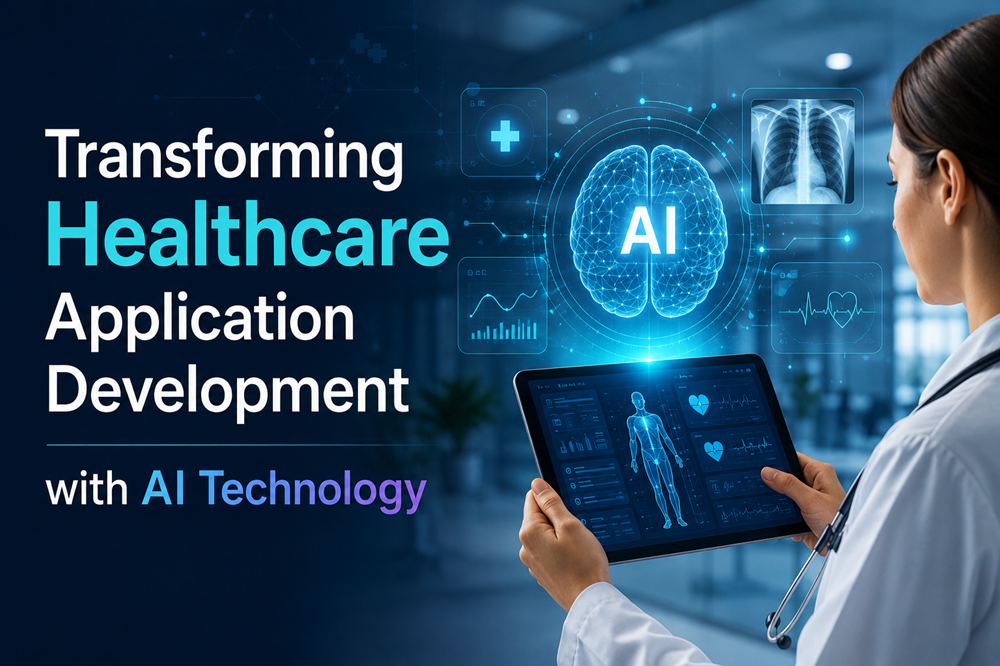
Transforming Healthcare Application Development with AI Technology
There is currently an ongoing digital revolution in the domain of healthcare, with AI being at the core of this transformation process. In the past decade, a large amount of money has been spent on improving healthcare facilities with the help of advanced technology solutions for patients' benefit. Nevertheless, conventional healthcare solutions find it increasingly difficult to handle growing amounts of medical information, interactions, and operations. Advanced AI solutions can help transform existing healthcare applications by making them smarter and more efficient than before.
Current healthcare solutions cannot be compared to those of just a few years ago when they were used only for scheduling appointments, storing information in electronic databases, and managing billing. Present-day healthcare applications have to offer personalized patient experience, assist in decision-making and automate repetitive procedures. With the use of AI, all of these tasks can be done efficiently.
The increasing need for intelligent healthcare solutions presents new possibilities for each and every Healthcare App Development Company that strives to design new digital solutions. An AI-powered healthcare app can analyse massive amounts of data about the patient, recognize trends, predict risks, and even give healthcare professionals certain suggestions based on this data. All of this changes the way healthcare is delivered and helps companies deliver great results to their patients.
As the healthcare industry evolves further, artificial intelligence becomes an integral part of any application development strategy. Whether you are a hospital, clinic, telemedicine company or a healthcare startup – your business can benefit from applying AI in developing new applications. Understanding the impact of AI on healthcare application development is very important for making strategic decisions regarding your healthcare technology investment.
The Growing Importance of AI in Healthcare Applications
Healthcare organizations produce tremendous amounts of data on a daily basis. Information from electronic health records, diagnostic test reports, medical images, lab results, wearable devices, insurance details, patient history, and many other sources contribute to a very complex environment in the healthcare industry. Analysing and making sense of this data manually becomes harder every day for healthcare organizations.
AI technologies allow for processing and analysing big data with high levels of speed and accuracy. With machine learning, algorithms can discover different patterns, detect anomalies, and find hidden insights. All this helps healthcare specialists to make better decisions and improve their efficiency.
Another reason why there is a need for artificial intelligence in healthcare applications is high patient expectations nowadays. Patients have more and more expectations related to digital experience that is similar to the one provided by banking, retail, entertainment, and other industries. With the help of artificial intelligence, healthcare applications can become more personalized and engaging.
Furthermore, there is a need to cut costs, improve outcomes, and meet regulations in healthcare organizations. This is another challenge where AI technologies can be helpful. Thus, AI technologies play a crucial role in modern healthcare applications development.
Improving Diagnostic Accuracy Through Artificial Intelligence
Among the various advantages that AI brings to the development of healthcare applications is its capability to increase diagnostic accuracy. It is typical for the specialists from the healthcare industry to take into account numerous pieces of information about the patients before diagnosing them. With the help of AI, these specialists receive the opportunity to work with this data in an easier manner and to find the necessary patterns for making the right decisions.
The algorithms of AI are capable of scanning the pictures taken during the process of X-rays, CT scans, MRIs, and ultrasounds. These tools allow for identifying possible abnormalities in these images and highlight the necessary spots for the radiologists to consider them. The early detection of any illness increases the chances of the success of the treatment and contributes to the improvement of the survival rates of the patients.
By means of AI, healthcare applications are able to analyse the data from the laboratory tests, history of the patients, their symptoms, and genome. This information helps the specialist to understand what risks the patient may have.
This technology is especially beneficial in detecting cancer, cardiovascular illnesses, and neurological problems.
For more: Healthcare App Development Services in Jaipur for Clinics & Hospitals
Enhancing Patient Engagement and Personalized Care
Engagement of the patient has been one of the most important areas of attention within healthcare organizations. An engaged patient is someone who adheres to his treatment plan, keeps all appointments and becomes actively involved in his healthcare journey. AI technology enables healthcare applications to provide tailored services that will help patients become more engaged.
The use of AI technology allows for analysis of patient behaviour, patient medical history, lifestyle and treatment progress. This will enable patients to have a better understanding of their health conditions.
Healthcare applications that have AI technology will be able to notify the patient regarding his medications, upcoming appointments and provide wellness advice to him.
Intelligent Virtual Health Assistants
Virtual assistants utilizing artificial intelligence technology are finding their way into various healthcare use cases. Such assistants can help patients with answering their queries, giving out information related to health and other things, scheduling appointments, and even symptom checking.
Contrary to chatbots, virtual assistants using AI continuously learn from their interactions, which makes them give out more accurate results over time.
Personalized Treatment Recommendations
AI technologies allow for applications used in healthcare to formulate patient-specific treatment suggestions. This is made possible through analysis of patient medical history, treatment results, as well as clinical studies.
Personalization of treatments is an improvement of health care due to the fact that the treatments are customized according to specific situations.
Continuous Patient Monitoring
Today's healthcare applications are compatible with wearables and remote monitoring devices. Data obtained using such devices is then analysed by artificial intelligence to monitor vital parameters, exercise patterns, sleeping habits, and many more.
Continuous monitoring helps healthcare professionals detect potential problems early on and act pre-emptively.
For more: Step-by-Step Guide to Developing a Healthcare App for Your Business
Streamlining Healthcare Operations with AI Automation
A lot of processes take place within the healthcare administration and require lots of time and resources. Appointment scheduling, registration of patients, payments, verification of insurance, and documentation are critical but may be troublesome processes.
Intelligent healthcare software uses artificial intelligence to automate many of such processes and increase their efficiency. Intelligent scheduling allows you to predict and avoid patient cancellation and reduce waiting time.
Automated Medical Documentation
Medical documentation is one of the most labour-intensive tasks for healthcare providers. The use of AI-driven Natural Language Processing tools will help transform oral or written medical documentation into digital documentation instantly.
The use of such technology will help reduce the burden of documentation and provide better time management opportunities for healthcare providers.
Smart Resource Management
Effective management of human and equipment resources is important in health care institutions. AI solutions are used to monitor usage trends and predict future needs for the effective distribution of resources.
Proper resource management leads to lower costs and improved service delivery in healthcare facilities.
Faster Billing and Claims Processing
Healthcare billing and insurance claims consist of highly complicated procedures that are subject to error. AI technology would allow for claims verification, billing audit, and payment processing, which could be more accurate and faster.
Billing procedures are beneficial for effective performance and good patient experience.
Predictive Analytics and Preventive Healthcare
Predictive analytics is revolutionizing the healthcare industry, allowing healthcare professionals to predict future health issues and prevent diseases before they occur. The applications of artificial intelligence in the healthcare industry rely on predictive models which analyse past and current data to detect patterns.
Early Disease Detection
The AI algorithms will be able to detect people who may be at risk of developing certain diseases such as diabetes, high blood pressure, and heart diseases. Based on this information, health care professionals will be able to develop preventive strategies for reducing complications in the future.
Early disease diagnosis ensures better outcomes and reduces costs incurred during treatments.
Population Health Management
Patient population in many healthcare organizations is huge and has diverse healthcare needs. Artificial Intelligence (AI)-driven analysis will reveal some trends among such populations and will assist in developing intervention programs and better allocation of resources.
Population health management techniques lead to better health care results.
Risk Prediction and Clinical Support
AI can analyse the information of patients to foresee their rehospitalization, complications with treatment, and progression of disease. The predictions made by the AI enable health care professionals to take measures.
Risk predictions increase patient safety and healthcare quality.
Revolutionizing Telemedicine and Remote Healthcare
Telemedicine is one of the key innovations in the healthcare industry. It is worth mentioning that AI helps to develop telemedicine technologies and improve the quality of virtual consultations, remote monitoring, and communication with patients.
AI-based applications for healthcare allow healthcare professionals to have access to the records of their patients, including their medical history and clinical recommendations. Such data allows for making better decisions during consultations.
Moreover, remote healthcare services include AI-based monitoring of the indicators of the patients' health in real time. If any unusual changes appear, healthcare specialists receive alerts.
It can be concluded that telemedicine became the driving force behind the innovations in other spheres of life as well. The similar approach to the analysis of data is used in logistics software solutions. Predictive algorithms help to organize delivery process more efficiently.
Strengthening Healthcare Data Security and Compliance
The health organizations contain personal patient information which needs secure security systems. Data breaches may lead to financial costs, penalties, and reputational damages. The use of AI technology is important for securing healthcare applications from cybersecurity risks.
AI security systems will continuously monitor network traffic and respond in case of unusual activities. This will enhance security and assist the organizations to comply with the healthcare laws and guidelines.
The machine learning technologies will help to detect the vulnerabilities of healthcare applications and suggest ways of improving security. It will assist the organizations to build confidence among patients about their medical data.
There is some advanced security technologies used in the development of fintech applications to protect sensitive information. This will offer lessons for developing effective healthcare cybersecurity strategies.
AI Integration with Emerging Healthcare Technologies
The future of development in healthcare application will entail greater collaboration between AI and new technological advancements. Cloud computing, Internet of Things, wearable technology, and advanced analytics platform are making possible more innovative development in this field.
IoT-connected health applications are capable of gathering real-time patient data and sending it securely to health providers. AI then analyses that data to produce insights that help provide patients with preventive care and personalized treatment.
AI-driven recommendation engines that are used in ecommerce applications are also driving innovations in healthcare platforms when it comes to providing personalized wellness recommendations. Innovations from other industries are helping advance the use of AI in healthcare.
Increasing popularity of on-demand services applications like taxi booking apps and food delivery services is also making an impact on health technology sector. Patients today want convenient, easy-to-use digital experience that developers of healthcare applications also need to strive for.
Future Trends Shaping AI-Powered Healthcare Applications
Future developments in the field of healthcare application development will be powered by new advances in AI. Generative AI technology will help health care practitioners to document their practices, conduct research, and communicate with patients.
AI technology for digital twins could be used to help providers test and evaluate the results of treatments without applying them. Precision medicine would continue evolving as AI uses genetic data to provide individualized treatment for patients.
Other innovations that would have positive effects on healthcare apps could come from fantasy sports industry that uses predictive analytics to boost user experience. Predictive analytics technology would be useful in making decisions and tailoring healthcare services.
As AI develops, more intelligent applications will evolve in order to help in creation of healthcare ecosystems.
Conclusion
AI is bringing revolution in the application development for healthcare industry by helping it become more efficient through improved diagnostics, patient engagement, operations, security, and predictive healthcare approach. Organizations adopting AI-powered solutions will be well prepared to offer high-quality care, operate effectively, and respond to changing patient needs in the digital world.
It is not anymore, the matter of the future whether AI should be integrated into healthcare applications – this is the key component of today’s innovations in the field. With increasing investments in digital transformation of the industry, intelligent healthcare apps will play a crucial part in the future development of healthcare. Business looking for scalable and forward-thinking solutions for their healthcare applications may use the services of professional development companies like Dinoustech.