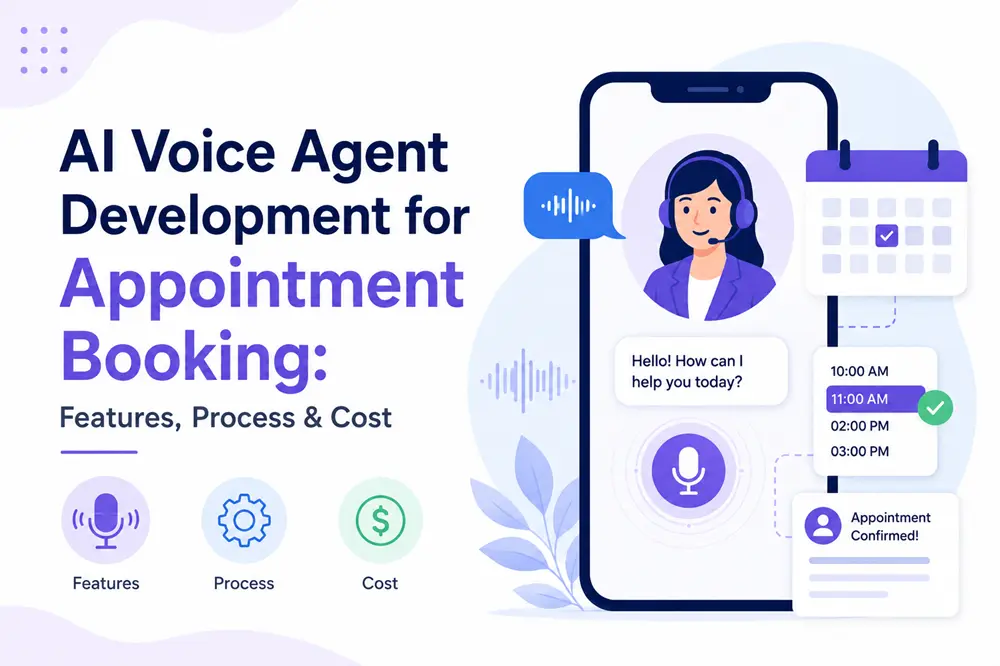
AI Voice Agent Development for Appointment Booking: Features, Process & Cost
Appointment-based businesses receive calls throughout the day from customers who want to book, reschedule, cancel, or ask questions about a service. When employees are busy with customers, some calls go unanswered or get delayed. Even a short delay can result in a lost booking, especially when customers have several businesses to choose from.
An AI voice agent for appointment booking provides a way to automate these conversations through natural voice interactions. Instead of asking callers to navigate complicated IVR menus or wait for a receptionist, the AI agent can understand what the caller wants, collect the required information, check appointment availability, and complete the booking through connected business systems.
Modern voice AI systems can go beyond basic appointment scheduling. They can handle cancellations, rescheduling, customer questions, reminders, confirmations, lead qualification, and human handoffs. When integrated with calendars, CRMs, booking software, and other business applications, the voice agent becomes part of the company's operational workflow rather than simply answering calls.
This guide explains AI voice agent development for appointment booking, including how the technology works, essential features, development stages, technology requirements, integrations, costs, benefits, challenges, and factors businesses should consider before investing in a custom solution.
What Is an AI Voice Agent for Appointment Booking?
An AI voice agent for appointment booking is a software-based conversational assistant that communicates with customers through phone calls and helps them complete appointment-related tasks.
Unlike a conventional IVR system that asks callers to press numbers such as “Press 1 for booking” or “Press 2 for cancellation,” a voice AI agent can understand natural conversation.
For example, a customer could say:
“Hi, I want to book a dental consultation sometime tomorrow afternoon.”
The AI agent can understand that the caller wants a consultation, identify the preferred day and approximate time, ask for any missing information, check available slots, and offer suitable appointment options.
Once the customer selects a slot, the agent can connect with the appointment management system and create the booking.
Depending on the business requirements, an AI voice agent can support:
- New appointment booking
- Appointment confirmation
- Rescheduling
- Cancellation
- Availability checking
- Customer information collection
- Service-related questions
- Staff or professional selection
- Appointment reminders
- Follow-up calls
- Lead qualification
- Payment or deposit workflows
- Human call transfer
- CRM updates
This makes voice AI useful for many appointment-driven businesses, including clinics, hospitals, dental practices, salons, spas, fitness centers, automobile service centers, home-service businesses, consultants, hotels, educational institutions, and professional service providers.
How Does an AI Voice Agent Book an Appointment?
The process may sound simple from the customer's perspective, but several technologies work together behind the scenes.
When a customer calls, the voice agent first receives the audio through the telephony system. Speech recognition converts the customer's words into machine-readable information. The AI model then identifies the customer's intent and extracts details such as the requested service, date, time, location, or preferred professional.
The system then checks the connected scheduling platform to determine which slots are actually available.
For example:
Customer: “I need a skin consultation this Friday after 5 PM.”
AI Agent: “Sure. I have 5:30 PM and 6:15 PM available. Which time would you prefer?”
The customer selects a time, and the booking engine creates the appointment.
A typical workflow looks like:
Incoming Call → Speech Recognition → Intent Detection → Conversation Processing → Availability Check → Slot Selection → Booking → Confirmation
The main components include:
Speech Recognition
Speech recognition converts the caller's voice into text or structured information that the AI system can process. The system should be able to handle different speaking speeds, accents, pauses, and conversational patterns.
AI and Natural Language Processing
The AI layer determines what the caller is trying to accomplish. It can differentiate between requests such as booking a new appointment, changing an existing appointment, asking for pricing, cancelling a booking, or speaking to an employee.
Conversation Management
The conversation engine maintains context throughout the call. If a customer says, “Tomorrow afternoon,” and later says, “Actually, make that evening,” the system should understand that the customer is changing the previously discussed time.
Business Rules
The AI agent should operate according to the company's rules. These may include working hours, service duration, staff availability, appointment buffers, cancellation policies, minimum notice periods, location restrictions, and deposit requirements.
Booking Integration
The agent connects with a calendar, CRM, appointment platform, or custom database to retrieve real-time availability and create or modify appointments.
Text-to-Speech
After processing the request, the AI converts its response into natural-sounding speech and communicates it to the caller.
Confirmation
Once the appointment is successfully created, the AI can verbally confirm the booking and trigger an SMS, email, WhatsApp message, or other notification depending on the configured workflow.
Also Read: - AI Features Every Mobile App Should Have in 2026
Why Businesses Are Adopting AI Voice Agents for Appointment Booking
For appointment-based businesses, phone calls remain an important communication channel. However, handling every call manually can become difficult during busy hours, weekends, holidays, and after business hours.
An AI voice agent can provide a dedicated automated channel for routine appointment conversations.
24/7 Appointment Availability
Customers may want to make an appointment outside normal business hours. An AI voice agent can continue handling supported booking requests even when employees are unavailable.
This can help businesses capture appointment opportunities that would otherwise wait until the next working day.
Fewer Missed Calls
A busy receptionist may be helping another customer when a new call arrives. If the caller reaches voicemail or receives no answer, they may simply call another business.
An AI voice agent can answer incoming calls automatically and start the conversation immediately.
Reduced Reception Workload
Reception teams often spend a significant amount of time answering repetitive questions and handling simple appointment changes.
AI can manage routine requests while employees focus on customers who need personal assistance.
Faster Customer Response
Customers do not need to wait for someone to check a calendar manually. The AI agent can retrieve availability through an integration and provide suitable options during the call.
Consistent Information
A properly configured AI agent uses approved business information and workflows. This can help maintain consistency when answering questions about operating hours, services, prices, policies, and appointment procedures.
Higher Call Handling Capacity
A human receptionist can only handle a limited number of calls at the same time. A properly architected AI system can support a much larger volume of routine conversations, subject to the telephony and infrastructure configuration.
Better Customer Convenience
Customers can speak naturally rather than navigating a long menu. They can describe what they need and allow the AI agent to guide the conversation.
AI Voice Agent Development Process for Appointment Booking
Building an AI voice agent requires more than connecting a phone number to an AI model. The solution needs to understand the company's appointment workflow, business rules, customer requirements, and existing software.
A structured development process can reduce errors and improve reliability.
Stage 1: Define Business Requirements
The first stage is understanding what the AI voice agent needs to accomplish.
The development team should identify the types of appointments, customer groups, working hours, locations, staff availability, existing booking software, CRM systems, call volume, and common customer questions.
The business should also decide which tasks the AI can perform independently and which situations require human intervention.
For example, a clinic may allow the AI agent to book routine consultations but require immediate human transfer for urgent medical concerns.
The goal is to define the boundaries before development starts.
Stage 2: Identify Appointment Use Cases
The next step is to decide which appointment workflows will be automated.
A basic implementation might support only new bookings. A more advanced system may support:
Booking → Confirmation → Rescheduling → Cancellation → Reminder → Follow-Up
Businesses can start with the highest-value workflows and expand the agent later.
This approach can help control development costs while allowing the solution to grow with operational requirements.
Stage 3: Design the Conversation Flow
The AI needs a clear conversational structure.
A typical booking conversation may follow:
Greeting → Understand Intent → Collect Details → Check Availability → Offer Options → Confirm Selection → Book Appointment → Send Confirmation
However, real conversations rarely follow a perfect straight line.
The system should also handle situations such as:
- Customer changes the date
- Requested slot is unavailable
- Customer does not know the exact service
- Customer asks about pricing
- Customer wants a specific staff member
- Customer wants to cancel
- Customer asks an unrelated question
- Customer requests a human representative
- Booking system becomes temporarily unavailable
Conversation design should define what the AI can answer, what actions it can take, and when it should transfer the call.
Stage 4: Select the Voice AI Architecture
The technology architecture should be selected according to the business's requirements.
A typical architecture may contain:
Telephony Layer → Speech Recognition → AI Model → Conversation Orchestrator → Business Logic → Booking API → CRM/Database
The exact architecture varies based on the project.
The development team may need to select technologies for telephony, speech-to-text, AI processing, text-to-speech, backend APIs, databases, authentication, monitoring, analytics, and integrations.
The objective should be reliable conversations with appropriate response speed, accuracy, security, scalability, and operating costs.
Stage 5: Build the Appointment Management Logic
The AI should never simply guess whether a time slot is available.
The booking engine should communicate with the actual scheduling system.
For example, if a customer asks:
“Can I book Saturday at 3 PM?”
The agent should check the live scheduling system before confirming the appointment.
The booking engine may consider:
- Staff availability
- Service duration
- Working hours
- Existing appointments
- Break periods
- Location
- Appointment buffers
- Booking restrictions
- Cancellation rules
- Advance booking requirements
Separating booking logic from the conversational AI is important because the AI should not independently invent availability.
Stage 6: Develop the Voice Agent
Once the workflows are defined, developers can build the conversational AI layer.
This stage can include:
- Intent detection
- Context management
- Voice interaction
- Slot extraction
- Follow-up questions
- Response generation
- Interruption handling
- Error recovery
- Customer verification
- Appointment confirmation
- Human handoff
- Business knowledge
- Conversation history
The agent should also have clear limitations.
If a particular piece of information is not available in its knowledge base or connected systems, it should not make up an answer.
Stage 7: Integrate Business Systems
Appointment automation becomes much more useful when the AI voice agent is connected with existing software.
Possible integrations include:
Calendar Systems: Google Calendar, Microsoft Outlook, or custom scheduling systems.
CRM Platforms: Customer profiles, appointment history, lead information, and interaction records.
Booking Platforms: Existing appointment management software.
Communication Systems: SMS, email, WhatsApp, and notification services.
Payment Systems: Deposits, advance payments, invoices, and payment confirmations.
Business Management Software: Industry-specific platforms used for operations and customer management.
After a successful booking, the system can update the CRM, create the calendar event, send a confirmation message, and trigger an internal notification.
Stage 8: Test the AI Voice Agent
Voice AI requires extensive testing because real conversations are unpredictable.
The testing process should cover:
- Different accents
- Background noise
- Fast speech
- Pauses
- Interruptions
- Incorrect information
- Ambiguous requests
- Unavailable slots
- Duplicate bookings
- API failures
- Cancellation requests
- Rescheduling
- Human transfers
- Long conversations
- Multiple simultaneous calls
The objective is not only to check whether the AI sounds natural. It must also perform the correct business action.
Stage 9: Deploy and Monitor
A controlled rollout is generally preferable to immediately transferring every call to the AI system.
The business can initially use the agent for selected workflows and monitor performance.
Important metrics can include:
- Successful booking rate
- Call completion rate
- Human transfer rate
- Failed intent rate
- Appointment conversion
- Average call duration
- Cancellation rate
- Rescheduling rate
- Customer feedback
- API failures
The system can then be improved using actual conversation data.
Must Read: - The Role of AI in Building Intelligent & Efficient Applications
Must-Have Features of an AI Voice Agent for Appointment Booking
A voice agent needs more than a human-like voice to deliver business value. It needs features that connect conversation with real business actions.
Natural Language Understanding
Customers should be able to speak naturally instead of memorizing commands.
The AI should understand phrases such as:
“I want something around lunchtime.”
“Do you have anything available next Wednesday?”
“Can I move my appointment to Friday?”
These requests should be interpreted based on conversation context.
Real-Time Appointment Availability
The agent should check the live booking system before presenting appointment options.
This helps reduce the possibility of offering unavailable slots.
Automated Booking
Once the customer selects a slot, the agent should be able to create the appointment through the connected booking system.
Rescheduling
Customers frequently need to change their appointment time.
The AI can locate the existing booking, verify the relevant information, check new availability, and update the appointment.
Cancellation Management
The agent can handle supported cancellation requests according to business rules.
For certain businesses, it may also explain cancellation policies or applicable fees.
Appointment Reminders
The system can trigger reminders before scheduled appointments through supported communication channels.
Customer Verification
For sensitive appointment information, the AI can verify customer details before accessing or modifying an existing booking.
Human Handoff
Some conversations should be transferred to employees.
The AI should recognize situations that require human assistance and transfer the call with relevant context where technically supported.
Multilingual Voice Support
Businesses serving multilingual customers may require multiple languages or language switching.
The exact language capabilities depend on the selected speech and AI technologies.
Call Recording and Analytics
Where legally permitted and appropriately disclosed, call data can be analyzed to understand customer needs, failed conversations, and booking performance.
CRM Synchronization
Customer information and appointment details can be synchronized with the CRM so that employees have access to relevant interaction data.
Outbound Calls
An AI voice agent can also support outbound workflows such as appointment reminders, confirmations, follow-ups, lead qualification, and reactivation campaigns.
Technology Stack for AI Voice Agent Development
The technology stack depends on the project's requirements, but a production-grade AI voice system generally consists of several layers.
Telephony
A telephony provider handles inbound and outbound calls and connects the caller with the AI system.
Speech-to-Text
Speech recognition converts spoken language into text or structured information.
AI/LLM Layer
The AI model interprets the conversation, maintains context, determines intent, and generates appropriate responses.
Text-to-Speech
The text response is converted into audio that the customer hears.
Backend
The backend manages business logic, APIs, authentication, workflows, databases, and integrations.
Database
Customer records, appointment information, configuration, logs, and other structured data can be stored in a suitable database.
Calendar and Booking APIs
These integrations provide real-time availability and appointment management.
CRM Integration
The CRM connection helps businesses maintain customer records and interaction history.
Analytics and Monitoring
Monitoring tools help track call quality, errors, response times, booking outcomes, and system health.
The technology selection should be based on business requirements rather than choosing tools simply because they are popular.
AI Voice Agent Integrations for Appointment Booking
Integrations are one of the most important parts of an AI voice booking system.
Without integrations, the AI may be able to talk to customers but may not be able to perform meaningful business actions.
A custom system can potentially integrate with:
- Google Calendar
- Microsoft Outlook
- Custom calendars
- Appointment management software
- CRM systems
- Payment gateways
- SMS services
- Email platforms
- WhatsApp business systems
- Customer databases
- Analytics platforms
- Existing business APIs
For example, after a successful appointment call, the workflow could be:
AI Call → Appointment Created → CRM Updated → Calendar Updated → SMS Confirmation → Reminder Scheduled
This turns the voice agent into an operational automation system rather than simply a conversational interface.
AI Voice Agent Use Cases Across Industries
Appointment booking is relevant across many industries.
Healthcare and Clinics
AI voice agents can help schedule consultations, confirm appointments, handle rescheduling, answer routine administrative questions, and transfer calls requiring staff attention.
Healthcare implementations require careful handling of personal information and applicable privacy and regulatory requirements.
Dental Clinics
Dental practices can use voice AI to manage consultation bookings, appointment confirmations, cancellations, and routine scheduling queries.
Salons and Spas
Salons can automate bookings for haircuts, beauty treatments, massages, facials, consultations, and other services.
Fitness Centers
Gyms and fitness businesses can use AI voice agents for class bookings, trainer appointments, membership inquiries, and schedule changes.
Automotive Service Centers
Customers can call to schedule servicing, inspections, repairs, test drives, or maintenance appointments.
Home Services
Plumbing, cleaning, electrical, repair, and maintenance companies can use voice AI to collect customer requirements and schedule service visits.
Hospitality
Hotels and hospitality businesses can use AI voice systems to handle reservations, service requests, appointment scheduling, and customer inquiries.
Professional Services
Consultants, financial service providers, legal firms, and other professional businesses can use AI voice agents to schedule consultations and qualify incoming inquiries.
Also Read: - AI Agent Development for Salons and Spas: Features, Process & Cost
How Much Does AI Voice Agent Development Cost?
The AI voice agent development cost depends on the complexity of the project.
A simple appointment-booking agent with one communication channel and limited integrations requires less development than an enterprise platform supporting multiple languages, multiple locations, CRM integration, complex booking rules, analytics, and advanced call workflows.
For a custom development project, a practical broad estimate can be:
|
Solution Type
|
Estimated Development Cost
|
|
Basic Voice Booking Agent
|
$12,000–$25,000
|
|
Mid-Level AI Voice Agent
|
$25,000–$50,000
|
|
Advanced Voice Booking Platform
|
$50,000–$90,000+
|
|
Enterprise Multi-Location System
|
$90,000+
|
These are indicative development ranges rather than fixed quotations. Actual costs vary according to requirements, technology choices, integrations, call volume, languages, security requirements, and customization.
Current industry pricing also shows that voice AI has ongoing usage costs beyond the initial build, including telephony, speech processing, AI model usage, and platform infrastructure.
For this reason, businesses evaluating an AI voice agent should consider both initial development cost and ongoing operating cost.
Cost Breakdown by Development Stage
The overall investment can be divided into several development areas.
Business Analysis and Planning
This includes requirement gathering, workflow analysis, use-case identification, and technical planning.
Conversation Design
This covers scripts, conversational paths, fallback scenarios, business rules, and escalation logic.
AI Voice Development
This includes speech recognition, AI processing, response generation, context management, and voice output.
Backend Development
The backend handles business logic, APIs, databases, authentication, and workflow orchestration.
Integrations
Calendar, CRM, booking, payment, communication, and other integrations can significantly affect the budget.
UI and Admin Dashboard
If the business requires a dashboard to manage calls, appointments, knowledge, analytics, users, and AI configurations, this adds to the project scope.
Testing
Voice AI needs testing across different scenarios, accents, interruptions, background noise, system failures, and booking conditions.
Deployment
Production deployment, monitoring, security configuration, telephony setup, and infrastructure management are additional parts of the project.
Maintenance
AI voice agents require ongoing maintenance because APIs, business rules, models, integrations, and customer requirements can change over time.
Build vs. Buy: Which Approach Is Better?
Businesses generally have two options: use an existing voice AI platform or develop a custom AI voice agent.
A ready-made platform can be suitable when the business needs a relatively standard workflow and wants to launch quickly.
Custom AI voice agent development is more suitable when the business needs unique workflows, proprietary integrations, complex booking rules, multiple systems, custom dashboards, or greater control over the solution.
The right decision depends on factors such as:
Business complexity + call volume + integrations + customization + long-term ownership + operating costs
A small business with a straightforward booking workflow may not require a highly customized platform. A larger organization with complex operations may benefit from a custom architecture.
Must Read: - Generative AI Use Cases in Mobile App Development
Benefits of Building a Custom AI Voice Agent
A custom AI voice agent gives businesses greater control over how appointment automation works.
It can be designed around the company's specific services, booking rules, staff availability, customer journey, integrations, and communication requirements.
Custom development can also make it easier to expand the system later.
For example, a company may initially launch:
Appointment Booking
and later add:
Rescheduling → Cancellation → Reminders → Lead Qualification → Outbound Calls → CRM Automation → Customer Follow-Up
This makes the AI voice system a platform that can grow with business requirements.
Why Choose Dinoustech for AI Voice Agent Development?
Building an effective voice AI solution requires more than connecting an AI model to a phone number. The system needs conversational design, backend development, API integrations, appointment logic, testing, security, monitoring, and ongoing optimization.
Dinoustech can help businesses develop customized AI-powered voice solutions based on their specific workflows and business objectives.
The development process can cover AI voice architecture, conversational workflows, appointment booking logic, CRM and calendar integrations, backend APIs, admin dashboards, testing, deployment, and maintenance.
Whether a business needs a focused appointment-booking voice agent or a larger AI automation platform, the solution can be planned around its existing technology and future requirements.
The goal should be simple: make appointment conversations faster, reduce repetitive work, capture more booking opportunities, and give customers a convenient way to interact with the business.
Final Thoughts
AI voice agent development for appointment booking can help businesses automate one of the most repetitive parts of customer communication: scheduling.
A well-designed agent can answer calls, understand customer requirements, check real-time availability, create appointments, manage changes, send confirmations, and transfer complex conversations to human employees.
However, successful voice AI depends on more than having a natural-sounding voice. The agent must connect with real business systems, follow accurate booking rules, handle unexpected conversations, protect customer information, and provide a reliable fallback when automation is not appropriate.
Businesses should therefore begin with their actual appointment workflow rather than choosing technology first.
Start with the most repetitive and valuable call scenarios. Build the booking logic around real availability. Integrate the systems already used by the business. Test the agent with real-world conversations. Then monitor its performance and improve it continuously.
With the right architecture and development approach, an AI voice agent can become a practical part of the customer service and appointment management process.
Frequently Asked Questions
What is an AI voice agent for appointment booking?
An AI voice agent is a conversational software system that communicates with customers through voice calls and can perform appointment-related tasks such as booking, rescheduling, cancellation, availability checking, confirmations, and reminders.
How does an AI voice agent book appointments?
The agent listens to the caller, converts speech into information, understands the customer's intent, checks the connected appointment system for availability, offers suitable slots, and creates the booking after customer confirmation.
Can an AI voice agent connect with Google Calendar?
Yes. A custom AI voice agent can be integrated with Google Calendar or other scheduling systems through suitable APIs. The exact integration depends on the business's booking architecture.
Can AI voice agents handle appointment cancellations?
Yes. If the cancellation workflow is configured, the agent can verify the customer, locate the appointment, apply the business's cancellation rules, and update the booking system.
Can an AI voice agent reschedule appointments?
Yes. The agent can identify an existing appointment, check alternative availability, and modify the booking after the customer selects a new time.
How much does AI voice agent development cost?
A custom AI voice agent can cost approximately $12,000 to $25,000 for a focused booking solution, while advanced systems can cost $50,000 to $90,000 or more. The final cost depends on features, integrations, AI complexity, call volume, languages, and security requirements.
How long does it take to develop an AI voice agent?
A basic appointment-booking agent can potentially be developed within several weeks, while a complex solution with multiple integrations, languages, advanced workflows, dashboards, and enterprise requirements can take several months.
Can an AI voice agent replace a receptionist?
An AI voice agent can automate many repetitive receptionist tasks, but it should not necessarily be treated as a complete replacement. Human employees remain important for complex, sensitive, emotional, or exceptional situations.
Can AI voice agents make outbound calls?
Yes. Depending on the implementation, they can make outbound calls for appointment confirmations, reminders, follow-ups, lead qualification, customer reactivation, and other predefined workflows.
Is AI voice agent development suitable for small businesses?
Yes. Small businesses can start with a focused use case such as appointment booking and later add CRM integration, reminders, rescheduling, outbound calling, and other capabilities as their requirements grow.
What integrations are required for an AI appointment booking agent?
Common integrations include calendars, appointment management systems, CRMs, customer databases, SMS, email, WhatsApp, payment systems, and business-specific APIs. The exact integrations depend on the company's workflow.
Why hire an AI voice agent development company?
An experienced development company can handle the complete technical workflow, including voice AI architecture, conversation design, booking integrations, backend development, security, testing, deployment, and ongoing maintenance. This helps businesses build an agent around their actual processes instead of relying on a generic voice chatbot.