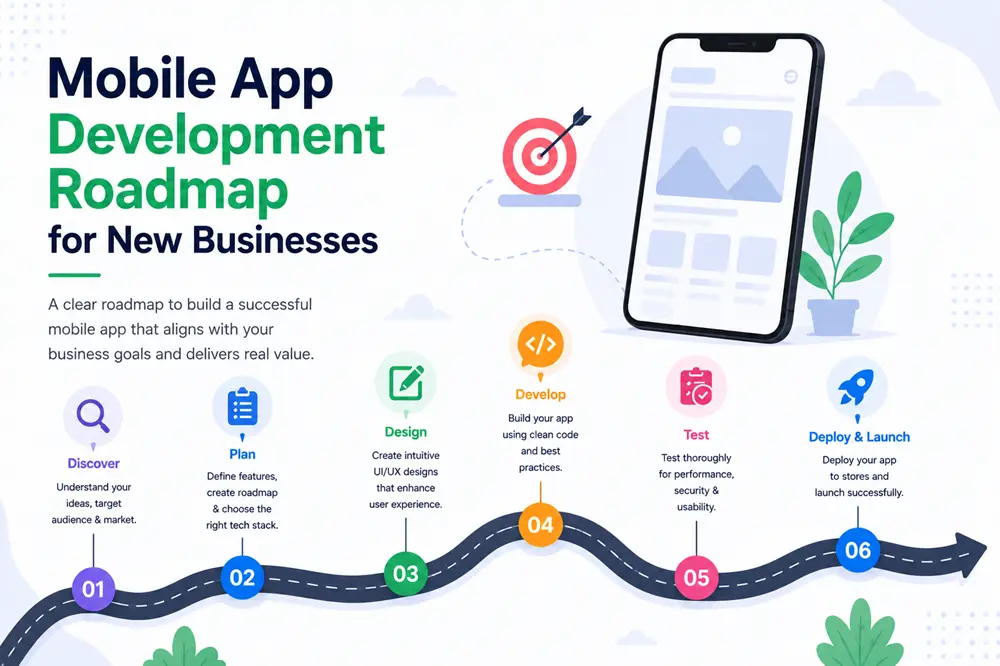
Mobile App Development Roadmap for New Businesses
In the contemporary world of digitization, mobile apps have emerged as one of the most effective means for growing businesses. Whether you are looking to start up your venture, grow your existing business or launch a digital service, a mobile app can prove instrumental in meeting all your requirements and helping you achieve your goals. However, it has been observed that most startups go ahead with their app development without proper planning, resulting in failure.
Having a well-defined mobile app development roadmap assists companies in launching their mobile apps successfully. A mobile app roadmap not only ensures better goal-setting and helps companies develop their products but also takes care of other aspects such as the technological needs, timeline and other important considerations. Instead of simply working on developing an app, a successful business considers the process of developing an app as building a product.
This guide discusses a full-fledged mobile app development roadmap for entrepreneurs.
Why New Businesses Need a Mobile App Development Roadmap
Startups often struggle due to their preoccupation with creating an application without developing a proper development strategy. In other words, a roadmap is like a blue print that brings together all business objectives and aligns them with development actions.
Moreover, a well-designed roadmap promotes good communication within an organization since everyone knows what they should achieve by certain deadlines. All members share common ideas regarding project goals and objectives.
Finally, for those startups that are just starting out and do not have enough funds and resources at their disposal, a well-thought-out roadmap is even more crucial.
Step 1: Define Your Business Goals and App Objectives
Before even getting to coding, companies need to be aware of the exact reason behind why they need an application for their mobile platform. This application should address a certain need and should serve its intended purpose rather than follow any trend in the market place.
The owners of companies need to find out who their target customers are, what their pain points are and how their application is going to serve them. For some companies, there could be an intention of increasing sales whereas other companies might have different goals such as engaging with their customers or delivery services.
Read more: Which Company Builds the Best AI Apps for Businesses?
Step 2: Conduct Market Research and Competitor Analysis
Knowledge of the market is vital before embarking on mobile app development. It is important to conduct competitor analysis, recognize industry trends, and know customer expectations so as to understand the user preferences.
Analyse Existing Applications
Analyse the successful implementations within your industry in order to discover the weak sides and the strong points that should be taken into consideration while making a decision.
Identify Market Gaps
There are gaps on the market which can become the driving point behind the implementation of an app which could provide a better solution for a certain problem than those offered by your competitors.
Market research is always useful for making well-thought-out decisions.
Step 3: Create a Feature Strategy for Your Mobile App
Read more: How AI Is Transforming Mobile App Development in 2026
Focus on Core Features First
The first major mistake that many businesses make when creating a product is trying to create all of the functionality at one time. Instead, they should focus on the important features needed to help solve the customer’s problem.
If the business creates fewer features, then the company will be able to develop their product more quickly.
Plan Future Enhancements
Whereas the first version is supposed to be concise, the company should ensure that a road map is available for future improvements. The benefit of doing so is that the system will continue scaling, thereby growing according to its requirements.
With a feature strategy in place, costs are managed while allowing room for future growth.
Step 4: Choose the Right Mobile App Development Approach
Choosing the right development strategy is an important step that influences cost, speed, and scalability. Organizations can choose among several strategies for app development such as native apps, cross-platform applications, or even a hybrid approach based on their needs and budget considerations.
Native applications offer better performance and faster loading speed, although at the same time are usually more expensive to develop. With cross-platform frameworks, organizations can save time and money developing applications for different platforms.
Professional Mobile App Development companies assist organizations in choosing the best strategy for app development.
Step 5: Design a User-Friendly Experience
The experience of users is a significant factor that influences the success of the app. In fact, even the most advanced applications may face problems if they do not fit the users’ preferences due to difficulties with navigation or low-quality interface.
Thus, it is necessary to create an interface which will be simple, accessible, and convenient for use. All actions performed by the users must be natural and productive.
Using wireframes and prototypes, business representatives can see how their application will look like before starting working on its development. Moreover, testing such a design allows identifying possible mistakes and avoiding additional costs in the future.
A proper design strategy contributes to customers’ satisfaction and loyalty.
Step 6: Select the Right Technology Stack
The technology stack is the base on which the application rests and will determine performance, scalability, and maintenance issues. It is important for companies to select technologies that meet their present needs and also allow for future expansion.
A technology stack usually consists of the following components: front-end framework, back-end system, database, API, cloud computing services, and security solutions. Choosing up-to-date and high-quality technologies will help create a solid application.
Software Development Experts have the experience and skills necessary to make recommendations concerning technologies.
Step 7: Build a Minimum Viable Product (MVP)
The launch of MVPs is among the cleverest tactics employed by new companies. Rather than devoting months or even years to create a fully loaded application, companies opt for creating a simpler application with just core features.
With an MVP, businesses get a chance to verify concepts, gather feedback from users, and analyse the interest in their product. The process also helps to minimize risks while obtaining knowledge about the preferences of potential customers.
A lot of successful mobile apps were launched initially as MVPs.
Step 8: Focus on Security and Compliance
Security cannot be considered an afterthought. Mobile applications usually store sensitive data, financial information, and private user information which needs to be secured.
Strong authentication mechanisms, data encryption, secure API calls, and testing during the application development can go a long way. Depending on the domain, regulatory requirements can be included.
This ensures that the software is secure even before it hits production.
Step 9: Test the Application Thoroughly
Test phase is among the crucial phases in the app development process. Any error will have an adverse effect on user experience and the image of the brand.
The testing phase must involve tests for all types, including functionality, usability, performance, security, compatibility, and scalability. Applications must be reliable under different circumstances.
A complete testing process allows identifying problems prior to product release and ensuring high quality and user satisfaction.
Step 10: Launch and Market Your Mobile App
The launch of the app marks a great milestone; however, it is just the start of the journey. The success of the launch is achieved by formulating a good marketing strategy to create awareness and increase downloads.
It is important for businesses to consider app store optimization, social media marketing, content marketing, email marketing, and outreach campaigns. The creation of hype prior to the launch will be very helpful in increasing user adoption.
Organizations that develop apps along with good Digital Marketing Services get great visibility post-launch.
Step 11: Monitor Performance and Gather Feedback
After deployment, it is important that businesses analyze key performance indicators like download numbers, engagement rate, retention rate, and review scores.
Feedback from users allows for understanding what works well and what does not, thus helping a business develop its application further.
Analytic services can be used for making sound decisions by basing them on actual data.
Step 12: Scale and Continuously Improve Your App
The most successful mobile applications always keep evolving. To ensure that applications adapt to changing needs of the users, technologies and other factors, companies have to make sure to keep their applications updated.
Updates can consist of adding new functionalities, improving application performance and security, among other things. The use of cloud technology and scalability allows applications to continue performing well as their usage scales.
Companies opting for Full Stack Development services usually create robust systems that support the growth of the business.
Common Mistakes New Businesses Should Avoid
There are various problems that businesses face when developing an application that could easily have been avoided. Some of the errors that arise in the process are neglecting market research, incorporating too many features in the first place, not taking into consideration user feedback, underestimating testing procedures, and neglecting post-launch support.
Another common problem faced by businesses is limiting the process to development only while forgetting about marketing and customer acquisition strategies. An amazing app will do nothing without proper marketing procedures.
A good mobile application can be developed if businesses avoid these errors and follow a roadmap.
Conclusion
Creating a mobile application requires much effort, but by following an appropriate roadmap, you can help new businesses cope with this task more easily. Each step from defining your objectives and doing market research through testing an MVP to scaling your product can significantly contribute to creating an app that will be useful for its users.
For businesses aiming at developing a powerful mobile application and implementing their ideas in the digital world, there is no need to go through this process alone. Our company, Dinoustech, offers services in Mobile App Development, Software Development, Full Stack Development, Website Development, and Digital Marketing Services. With our help, any startup or business can get a scalable and user-oriented mobile application.