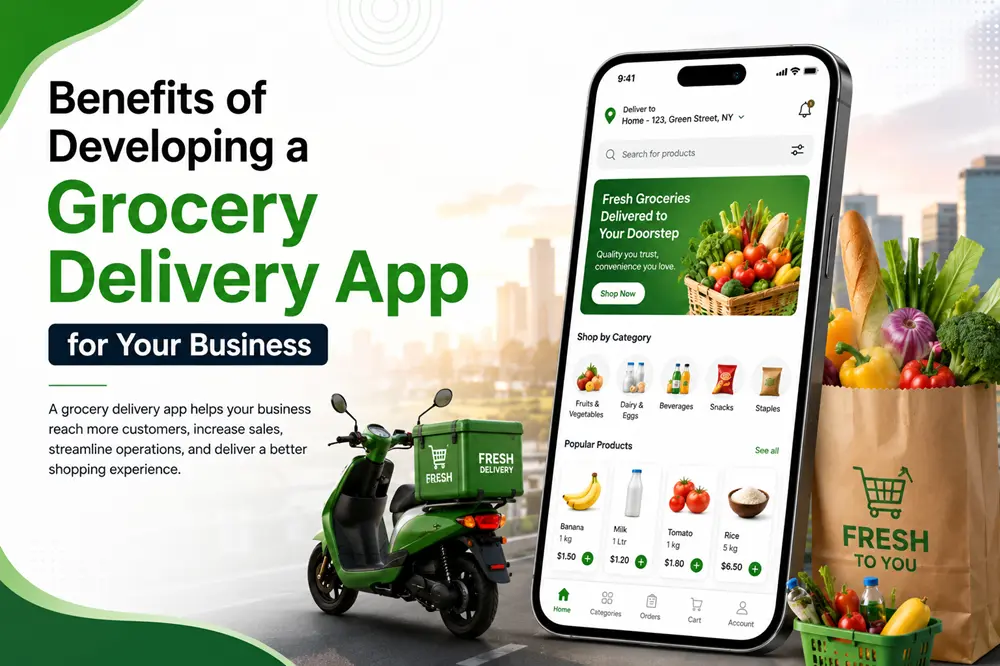
Benefits of Developing a Grocery Delivery App for Your Business
The retail sector of the grocery market has undergone tremendous change during the last decade due to various reasons such as changes in customer needs, technological advances, and increased use of online shopping. Today, people require convenience at all levels of their interaction with any store or shop; they do not want to waste a lot of time going to physical locations and then standing in line to pay for groceries. In other words, customers are increasingly turning to mobile apps to buy the required goods without leaving their homes. Such tendencies create immense opportunities for grocery companies in terms of expanding their business via digital channels.
The use of mobile applications for buying groceries is increasingly popular among people who need rapid solutions. It means that those organizations adopting digital transformation will benefit greatly because they will satisfy changing customer needs and enhance internal processes. Today, a mobile app for grocery delivery is something more than a nice-to-have solution for large corporations.
Building an online grocery delivery app assists organizations in optimizing their processes, fostering interactions between customers, generating income, and forging better connections with their clientele. Furthermore, it offers data that will assist organizations in making sound business decisions and help perform optimally. With increased competition in the industry, organizations that incorporate such digital solutions will gain an edge towards sustainability and success.
The Growing Demand for Grocery Delivery Applications
Consumers' behaviours have undergone great changes recently. People have started preferring online purchasing over regular shopping. This is because of various reasons like busy schedules, increased use of smartphones, as well as improvements in digital payment methods. This is why grocery delivery services have been growing so rapidly.
People like ordering groceries by using mobile applications as it is very convenient for them. It gives people a chance to compare and order goods while staying at home. Thus, many companies have realized this trend and started investing in grocery delivery apps development. Those who are not ready to do so, risk losing consumers to their rivals.
It is possible to say that the trend towards the growth of e-commerce and improvements in mobile applications will continue in the future. Thus, those companies which develop such software now can secure their positions in the future.
Expanding Customer Reach Beyond Physical Locations
One of the major advantages of creating a grocery delivery app is gaining access to a wider consumer base irrespective of geographical boundaries. Physical stores can only cater to consumers living close by or in the immediate vicinity. However, through mobile apps, it becomes easier for business firms to widen their geographical boundaries.
Consumers can easily shop and order goods from any part of the world with their smartphones. It provides businesses with the opportunity to attract consumers who would otherwise be outside the range of geographical boundaries. In addition, such apps enable consumers who have difficulty visiting physical stores to shop at their own convenience.
Geographical restrictions have always been major challenges to the success of physical grocery stores. With apps that allow consumers to order groceries, businesses can significantly boost sales volumes while attracting new consumers to the store.
Professional Mobile App Development helps businesses provide consumers with a smooth experience as they engage with the app. Speedy loading, easy navigation, and reliable payment methods can go a long way in helping to maintain satisfied consumers.
Improving Customer Convenience and Satisfaction
Convenience is another main factor that encourages customers to use grocery delivery applications. Consumers always appreciate services that can help them save their time and simplify any task they face. The convenience of using these applications is that it allows consumers to order products in several clicks.
In contrast to traditional grocery shopping, there are no expenses related to transportation or parking. Customers do not have to spend their time standing in lines or carry heavy bags.
Reordering of commonly used products and saving their preferences allows customers to save their time while buying. As a result, customers will be encouraged to come back to the same app again and again.
Happy customers tend to be loyal to a particular company and share their good experiences with other potential clients. That is why, grocery businesses should take into account the aspect of convenience when designing their services.
Increasing Sales and Revenue Opportunities
Grocery delivery apps can be instrumental in increasing sales because it will ensure better availability of the goods to consumers. The store’s physical presence is confined within certain hours while mobile apps are available round the clock. This ensures greater availability and chances of impulse buying. Consumers searching for something else through the app may come across other items as well.
Personalized Product Recommendations
The modern grocery application is capable of analysing customer behaviour and recommending products according to previous purchases and web activities. Personalized recommendations enhance the chances of making more purchases and improve shopping experience as well.
Promotional Campaigns and Discounts
Grocery apps may be used by companies as tools through which they are able to send targeted promotions and discount offers to customers. The promotions and discount offer ensure that the customers make repeat purchases.
Subscription and Membership Programs
Premium membership is offered to customers in some businesses that deal with groceries. There are various benefits that come with becoming a member in a business offering premium memberships.
All in all, the use of grocery apps enables companies to generate more profits.
Read more: How to Create a Multi-Vendor Grocery App for Local and Online Markets
Streamlining Business Operations
The operations involved in running a grocery store include inventory management, order management, communication with clients, and delivery services. Doing all these operations manually may consume much of the time and even increase chances for human mistakes to happen.
Grocery delivery apps automate most of these operations and help businesses work more efficiently. The orders are sent to the company in digital form, inventory updates itself automatically, and clients receive real-time information about their order.
Automation allows saving a lot of time and decreases the possibility of making mistakes, thus enabling employees to pay attention to other important aspects, such as developing the business or providing additional services.
Moreover, a significant number of companies invest in software solutions tailored specifically for them that connect grocery apps, accounting apps, and inventory apps into one ecosystem.
Enhancing Customer Engagement Through Digital Experiences
Customer engagement is a key element of successful business operations. There are several opportunities available for customer engagement through grocery delivery apps.
Push notifications can be used by organizations to reach out to their users about deals, new products, and seasonal offerings. Regular communication plays a pivotal role in ensuring continued customer interest and loyalty.
Loyalty Programs
Customer reward schemes motivate customers to shop within the company through rewards such as giving them points, discounts, cash-back offers, or special privileges. Loyalty programs foster better customer relations and improve customer retention rates.
Personalized Shoppers' Experience
Customers value a personal touch during shopping. Personalized suggestions and promotions make the shopping experience much more enjoyable.
Customer Feedback Collection
Grocery mobile applications facilitate the process of gathering feedback from customers. Companies can utilize such feedback in improving their offerings.
Through building lasting customer relations, businesses can achieve long-term success.
Read more: How to Build and Launch a Successful Grocery App Like Zepto
Better Inventory Management and Stock Control
Managing inventories is among the hardest things when running a grocery store. Excessive stocks can lead to high storage costs and waste while understocking may cause a business to lose on possible sales.
Grocery delivery mobile applications can connect to inventory management software, which enables the store owners to view their stock. With the help of an inventory, a business will be able to manage its purchasing activities more effectively.
Automated inventory will prevent overselling and give customers accurate details about product availability. Moreover, inventory management systems can be used to know which products are in great demand and order enough stock.
Ineffective management of inventory causes losses for companies in terms of money spent on overstocks and out-of-stock situations.
Real-Time Order Tracking Improves Transparency
It is expected that today’s consumers will be informed about the status of their orders.
Order tracking in real time is among the most useful services provided by grocery delivery apps.
The consumer can follow his or her order from the very moment it is placed until its delivery is successfully accomplished.
From the business point of view, such an opportunity enhances communications as well since the customer automatically receives all the information about the process of order accomplishment.
Thus, order tracking in real time positively impacts both the customer and the business.
The Role of Artificial Intelligence in Grocery Apps
Artificial Intelligence has started gaining increasing importance when it comes to developing grocery delivery apps. The use of AI-based tools allows organizations to improve efficiency, enhance the customer experience, and streamline operations.
Smart Product Recommendations
The AI-based systems make intelligent product recommendations based on the behaviour and purchases made by customers. Recommendations result in higher sales and help customers identify products that would be useful for them.
Demand Forecasting
With the help of Artificial Intelligence, organizations can accurately forecast their future demand by analysing the previous sales data, customer behaviour, and seasonal patterns.
Intelligent Customer Support
AI-based chatbots offer round-the-clock customer support and answer queries raised by the customers, thus improving the customer experience while cutting down support costs.
With ongoing advances in AI technologies, the future of grocery delivery apps will see more uses of AI in the coming days.
Supporting Multi-Vendor Grocery Marketplaces
Businesses are increasingly diversifying themselves from being one-shop businesses to developing multi-vendor grocery apps where different vendors can sell their goods using the same app.
The multi-vendor marketplaces give consumers variety in terms of selection as well as low costs because of the increased competition. In addition, businesses earn from vendor subscriptions, commissions, and advertising among others.
There is need for a business to possess excellent full stack development skills in order to handle various issues ranging from vendor onboarding to order handling.
Multi-vendor marketplace presents a huge opportunity to grow for any business.
Data Analytics for Smarter Business Decisions
Data has been among the most valuable assets for contemporary firms. Grocery apps produce vast amounts of data about the behaviour of consumers, their shopping habits, and firm performance.
By making use of advanced analytical tools, businesses can learn about consumer preferences, best-selling products, and marketing activities’ performance.
Data-driven businesses find themselves better prepared for any changes in the marketplace.
Strengthening Marketing and Brand Visibility
The marketing process is crucial for acquiring customers and increasing sales. There are many ways grocery delivery applications can offer marketing opportunities for companies to improve their visibility and interactions with customers.
Using push notifications, referrals, loyalty schemes, and promotions makes it easier for companies to interact directly with customers. It contributes to improving customer acquisition and encouraging repeat business.
The effectiveness of Digital Marketing campaigns grows as they incorporate information about the customers obtained through the application. This allows the business to run customized marketing campaigns that result in improved conversion rates.
Having a digital presence allows businesses to distinguish themselves from the competition.
Scalability for Future Business Growth
With growth, businesses will need scalable software platforms to handle the rising needs and complexity that comes with them. Grocery delivery apps are scalable and can grow along with businesses without having a negative impact on performance.
The cloud infrastructure will enable businesses to take care of more orders, add more delivery destinations, and even add other services to their platform without much hassle.
Being scalable is important for businesses to be ready for the future.
Future Trends in Grocery Delivery App Development
The grocery delivery sector keeps changing due to the advent of new technology. There is a possibility that artificial intelligence, machine learning, route optimization, and automation will have more significance in defining the future of grocery applications.
Technology such as voice shopping, predictive suggestions, intelligent inventory systems, and drone delivery could become prevalent. Firms adopting these kinds of innovations earlier will stand in better stead compared to others.
Customers will keep seeking faster, smarter, and more convenient ways of doing their shopping. This calls for businesses to adapt accordingly and embrace technology that facilitates these trends.
Conclusion
Building a grocery delivery app can be quite beneficial for businesses looking to enhance customer satisfaction, generate higher revenues, optimize processes, and ensure sustained growth. From reaching more customers and increasing convenience to managing inventories and making informed decisions, grocery delivery apps have everything necessary to thrive in today’s digital environment.
With consumers moving away from physical shopping towards digital solutions, companies embracing digital transformations stand a chance to reap the fruits of such changes in the form of new prospects and sustained success. Building an innovative grocery delivery app is one way of accomplishing this goal.
Here at Dinoustech, our services focus on delivering cutting-edge grocery delivery apps with modern features, efficient architectures, and a customer-centric approach. Such solutions enable our clients to offer memorable shopping experiences and achieve success through improved business performance.