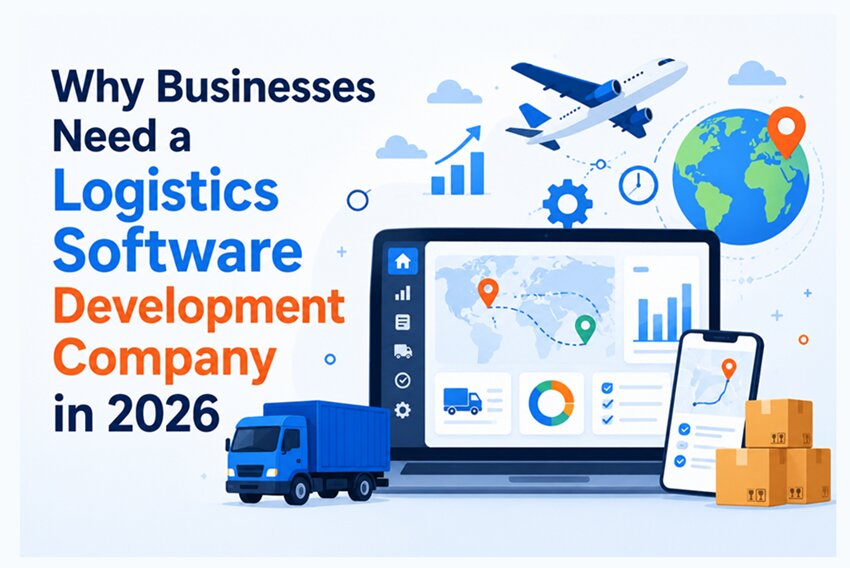
Why Businesses Need a Logistics Software Development Company in 2026
Logistics is under more pressure than ever in 2026. Customers want faster delivery, accurate tracking, and fewer delays. Operations teams want less manual work. Business leaders want better control over cost, stock, routes, and service quality. That is why many companies now rely on a logistics software development company to build systems that support daily work instead of slowing it down.
This shift is not small. The global logistics software market was valued at USD 16.24 billion in 2025 and is projected to reach USD 31.74 billion by 2034. The digital logistics market is even larger, with a projected rise from USD 37.64 billion in 2025 to USD 155.29 billion by 2034. At the same time, the AI in supply chain market is expected to grow from USD 13.93 billion in 2025 to USD 50.41 billion by 2032. These numbers show how fast businesses are moving toward smarter logistics systems.
Logistics is now a data problem, not just a transport problem
Many businesses still think logistics only means moving goods from one place to another. In 2026, that view is too narrow. Logistics now depends on data: order history, stock movement, delivery timing, route patterns, customer behavior, fleet usage, warehouse flow, and exception handling. If a company cannot read that data quickly, it falls behind.
AI is helping businesses handle that complexity. McKinsey says early adopters of AI-enabled supply chain management have improved logistics costs by 15%, inventory levels by 35%, and service levels by 65% compared with slower-moving competitors. McKinsey also says AI can reduce inventory levels by 20% to 30% through better demand forecasting and inventory optimization. Deloitte adds that AI helps supply chain managers preempt disruptions and optimize operations in a complex environment.
That is exactly why businesses need a logistics software development company now. They need software that turns data into action. They need software that helps teams make faster decisions without drowning in spreadsheets and phone calls.
Also Read: - Top 10 Must-Have Features in Logistics Software Development
Why manual logistics processes are no longer enough
Manual logistics processes break under pressure. A dispatcher can only track so many deliveries at once. A warehouse team can only manage so many stock updates by hand. A manager cannot wait for end-of-day reports when a delay is already happening in the field.
As supply chains grow more complex, businesses need systems that can react in real time. Deloitte notes that supply chains now face disruptions that are increasingly common, global, and complex, which raises the need for better prediction and stronger response. McKinsey also highlights the value of digitally connected supply chain systems that improve visibility, reduce silos, and lower costs.
A strong logistics software development company helps businesses replace manual steps with connected workflows. That may include route planning, shipment tracking, warehouse coordination, customer notifications, and reporting dashboards. Once those parts work together, the business spends less time chasing problems and more time moving goods.
Why 2026 is a strong year to invest
The timing matters. 2026 is not just another year of software upgrades. It is a year when supply chain teams are under more pressure to improve efficiency, resilience, and visibility at the same time. Fortune Business Insights says the supply chain management market will grow from USD 32.9 billion in 2026 to USD 72.82 billion by 2034. The digital logistics market and AI in supply chain market are also rising fast.
This growth is happening because companies want tools that do more than store data. They want software that helps them forecast demand, reduce waste, improve delivery speed, and manage exceptions before they turn into losses. They also want systems that can grow with the business instead of forcing a full rebuild every time operations expand.
A logistics software development company is valuable here because it builds for current needs and future scale. The right partner does not create a fixed product. It creates a flexible system that can keep adapting as the business changes.
Must Read: - Why Logistics Software Development Is Essential for Modern Supply Chains
What businesses gain from custom logistics software
Custom logistics software gives companies control. Off-the-shelf tools often cover only part of the workflow. They may track shipments, but not help with route logic. They may show stock, but not connect with field updates. They may store reports, but not help managers act on them quickly.
A custom build solves these gaps. It can support live tracking, dispatch control, warehouse visibility, fleet management, alerts, analytics, and role-based access in one platform. That matters because logistics teams do not work in one place or one format. Drivers work on mobile devices. Managers work on dashboards. Customers want clear updates. Warehouse teams need speed and accuracy. A custom system can serve all of them without forcing a single rigid flow.
This is where a skilled logistic app creation company becomes important. It can design a product around the actual workflow instead of forcing the workflow to fit the product. That improves adoption, reduces training time, and lowers operational friction.
Why mobile and web both matter
Modern logistics software needs both mobile and web. A mobile app handles field work. A web platform handles control, planning, reporting, and oversight. If a business only builds one side, the system stays incomplete.
A mobile app development company helps build tools for drivers, delivery staff, and warehouse users who need simple screens, fast actions, and reliable updates on the move. A web development company helps build admin panels, manager dashboards, analytics views, and workflow controls that support the whole operation from the office side.
When mobile and web work together, businesses get a connected system. A driver updates delivery status on the phone. The office sees the change immediately. A manager checks a delay on the dashboard. The team responds right away. That is how software supports logistics in real time rather than after the fact.
Also Read: - Which Logistics Software Development Company Is Right for You?
Why AI features matter in logistics software
AI is no longer optional for many logistics teams. The reason is simple: AI helps software do more of the thinking.
It can predict delays by reading route patterns and traffic trends. It can help forecast demand from historical order data. It can support inventory planning by spotting patterns in stock movement. It can flag unusual shipment behavior before the issue grows. It can also help managers focus on high-risk areas instead of checking every record manually.
MarketsandMarkets projects the AI in supply chain market to reach USD 50.41 billion by 2032, which shows how strongly businesses are adopting AI-backed tools. McKinsey’s figures also show why the pressure is growing: better forecasting and better optimization can improve cost, inventory, and service outcomes at the same time.
A good logistics software development company should know how to use AI in practical ways. It should not overload the product with features that do not help operations. It should add intelligence where it improves speed, accuracy, or cost.
What the right development partner should do
Businesses should not choose a logistics software partner only because the team can code. They should choose a partner that understands logistics itself.
The right logistic software developers ask about workflow first. They study how orders move, where delays happen, how teams communicate, and where information gets lost. They build around those realities. They also think about scale, because a business may start with one city or one warehouse and later expand to multiple regions.
A strong partner should also understand integrations. Logistics software often needs to connect with ERP systems, payment tools, GPS services, customer communication platforms, and warehouse tools. That is why the partner must act like both a logistic app creation company and a broader software team that can handle business systems end to end.
It also helps when the same team can act as a web development company. That creates one unified product vision rather than two disconnected builds.
Why real-user design matters
Logistics software fails when it ignores the people who use it every day. Drivers do not want clutter. Dispatchers do not want slow screens. Managers do not want confusing reports. Warehouse teams do not want extra steps.
That is why design must stay simple and clear. The best systems reduce taps, shorten workflows, and present only the information that matters at that moment. A driver should see the next action fast. A dispatcher should see risk quickly. A manager should read performance without digging through layers of menus.
This focus on real users also improves adoption. When software feels easy, people use it correctly. When people use it correctly, the business gets cleaner data and better results. That is one reason companies often choose a logistics software development company with strong product thinking, not only technical skill.
Must Read: - Build a Scalable Logistic Management Software: Step-by-Step Guide
Why businesses need long-term adaptability
Logistics never stands still. Routes change. Stock levels change. Customer expectations change. Regulations change. Peak seasons hit hard. New partners join. New markets open.
Software must keep up. That is why businesses need a team that builds for continuous improvement. A good logistics system should not remain fixed after launch. It should adapt based on usage data, user feedback, and business goals.
This matters even more in 2026 because the market keeps moving toward connected, AI-assisted, and data-led systems. Fortune Business Insights projects strong growth in logistics software and digital logistics, while Deloitte and McKinsey both point to more resilient, predictive supply chains.
A company that works with a strong logistics software development company gains more than an application. It gains a long-term platform that can evolve.
Why the cost of waiting is high
Some businesses delay software investment because they want to avoid upfront cost. That delay often costs more later.
Without the right system, teams spend more time on manual work. Dispatch becomes slower. Inventory errors rise. Delivery issues stay hidden too long. Customer support takes more calls. Leaders make decisions from incomplete data. These problems do not stay small for long.
The current market data shows why waiting is risky. The logistics software market is growing steadily, the digital logistics market is rising even faster, and AI adoption is becoming a core part of supply chain strategy.
Businesses that build now can improve operations while competitors are still patching manual processes. That creates a real advantage in cost, speed, and service quality.
Where Dinoustech fits in
For businesses looking for a logistics software development company, Dinoustech can be positioned as a strong partner for custom logistics products, mobile apps, web platforms, and AI-ready systems. It can also work well as a logistic app creation company for businesses that need both front-end usability and back-end control.
If you are writing this for Dinoustech, the positioning can be simple and direct: Dinoustech builds practical logistics software that helps businesses manage movement, visibility, and operations with more control. It can support projects that need skilled logistic software developers, a mobile app development company, and a web development company in one place.
That kind of message fits the market well because businesses want fewer vendors, clearer communication, and a team that understands the full build.
Final thoughts
In 2026, businesses need more than a basic logistics tool. They need a system that supports fast decisions, accurate tracking, better planning, and stronger control across the supply chain. That is why a logistics software development company matters so much.
The right partner can build software that fits real workflows, supports mobile and web users, uses AI in practical ways, and keeps improving as the business grows. The market numbers make the case clear. The businesses that invest now will be better prepared for higher demand, tighter margins, and more complex operations.
If you are aiming for a smarter supply chain, the next step is not more manual effort. It is the right software partner. A strong logistics software development company can help turn daily operational pressure into a more efficient, visible, and scalable system.