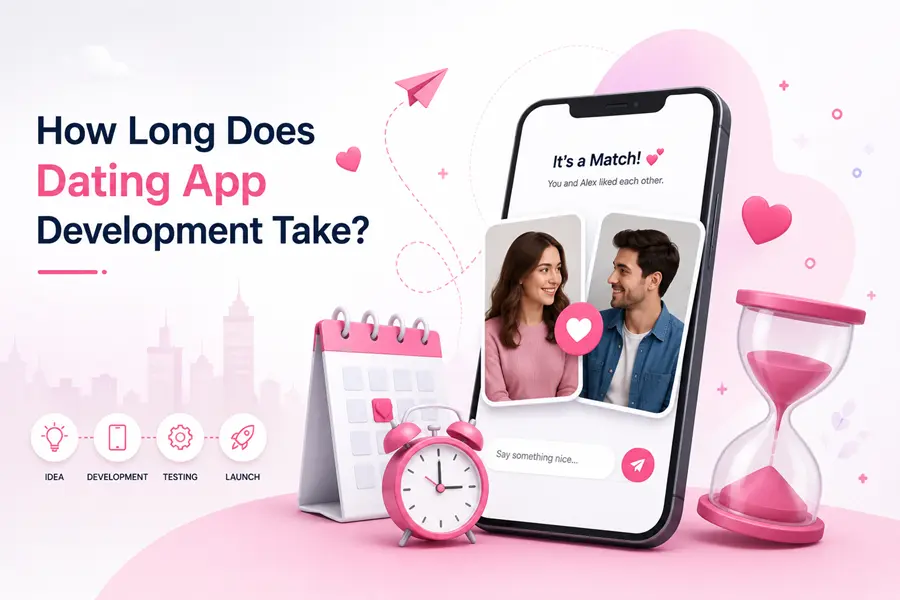
How Long Does Dating App Development Take?
Dating app development usually takes 3 to 9 months for most products, but the real timeline depends on the scope. A simple MVP can go live in about 3 to 5 months. A mid-level app with matching, chat, profiles, subscriptions, and admin controls often takes 5 to 8 months. A larger platform with video calls, AI matchmaking, moderation tools, and multi-platform builds can take 8 to 12+ months. Those ranges fit the broader app development timelines reported by Clutch and Itransition, which place typical mobile app projects around 20 to 40 weeks or 3 to 7 months, with complex apps taking longer.
That timeline matters because the dating app market still has strong demand. One 2026 market estimate values the global dating app market at USD 12.52 billion, while Business of Apps says the category generated just over USD 6 billion in revenue in 2025 and reached over 350 million users worldwide, with about 23 million paying for premium features. Estimates vary by scope, but the message is clear: dating apps remain a large, active market.
For businesses planning a new product, this creates a simple question: how long should the build take, and what should happen during that time? The answer depends on features, platforms, team size, and how clearly the product is planned before development starts. A good dating app development company does not rush this process. It builds in the right order so the product launches cleanly and grows without major rework.
Why dating app timelines vary so much
No two dating apps take the same amount of time. A basic app for profiles, swiping, and chat moves faster than a platform with AI matching, live video, location filters, subscriptions, push notifications, safety tools, and a web dashboard. Each added layer brings design work, backend logic, testing, and integration work. The more complex the user flow, the longer the build. That is why a dating app creation company should first map the product scope before it gives a timeline estimate.
The platform choice also changes the schedule. A single iOS or Android build takes less time than a full cross-platform launch with both mobile apps and a web admin panel. A mobile app development company and a web development company may work together inside the same project, but each layer still needs its own planning, development, and testing cycle. When you add them together, the launch window gets longer.
Team structure matters too. A skilled dating app developers team can move faster when product requirements are clear and feedback is quick. Slow approvals, shifting features, and unclear priorities stretch the schedule. In many projects, delays come from planning gaps, not code itself.
Also Read: - How Much Does It Cost to Create a Dating App Like Boo?
A realistic dating app timeline by stage
A clean dating app build usually moves through six stages. The exact weeks may shift, but the order stays similar.
1. Product planning and scope: 2 to 4 weeks
This is where the team defines the product, user flow, features, monetization model, and launch version. A strong dating app development company uses this stage to remove confusion early. If the product is not clear here, the rest of the project slows down later.
2. UI/UX design: 2 to 5 weeks
This stage covers wireframes, user journeys, screens, and visual design. Dating apps depend heavily on quick, intuitive interaction, so this work matters a lot. Profiles, matches, filters, chat, and settings must feel simple from the first tap.
3. Backend and database setup: 4 to 8 weeks
The backend handles authentication, matching logic, chat, notifications, profile data, subscriptions, and admin functions. If the app needs AI matching or geolocation logic, this stage gets longer.
4. Mobile and web development: 6 to 14 weeks
This is where the app starts to take shape. A mobile app development company usually builds the user-facing app first, while a web development company may build the admin panel, moderation tools, or partner dashboard in parallel. The more screens and flows you add, the longer this stage becomes.
5. Testing and bug fixing: 2 to 6 weeks
Dating apps need strong testing because they handle personal data, real-time interactions, and repeated user actions. The team should test login, signup, matching, chat, payments, notifications, and account recovery carefully. Security and privacy checks also matter here.
6. Launch and post-launch support: 1 to 3 weeks for release, then ongoing updates
App store release, production setup, analytics, and early fixes happen here. Most products need updates after launch once real users start using the app. That is normal. A good dating app development company plans for this from the start.
|
Stage
|
Estimated Time
|
What Happens
|
|
Product planning and scope
|
2–4 weeks
|
Define app goals, target users, core features, and launch version
|
|
UI/UX design
|
2–5 weeks
|
Create wireframes, user flows, and screen designs
|
|
Backend and database setup
|
4–8 weeks
|
Build authentication, matching logic, chat, notifications, and data structure
|
|
Mobile and web development
|
6–14 weeks
|
Develop the app, admin panel, and connected features
|
|
Testing and bug fixing
|
2–6 weeks
|
Test signup, chat, payments, notifications, security, and performance
|
|
Launch and post-launch support
|
1–3 weeks for release
|
Publish the app, monitor issues, and make early fixes
|
What slows dating app development down
Several things can add time to the project. Custom matching logic takes longer than a basic swipe model. Real-time chat needs strong backend support. Video calls need more integration and testing. Payment systems need secure setup. Location-based search needs careful handling. Moderation and reporting tools add more screens and more logic. AI-based recommendations also take extra data planning and model integration. These features do not make the product worse. They just make the build more complex.
The biggest delay often comes from changing the scope mid-project. A team may start with a simple MVP, then add new filters, extra user roles, advanced search, or a full subscription engine halfway through the build. Every new decision affects timeline, design, testing, and release. That is why a clear roadmap saves time.
Platform expansion also slows things down. If you launch on one platform first, then expand to another later, you can shorten the first release. If you want iOS, Android, and web at the same time, the schedule gets longer. A strong dating app creation company will tell you this early instead of promising a too-fast delivery date.
Must Read: - Build a Dating App Like Hinge: Cost, Features & Tech Stack
What you get faster with an MVP
An MVP is the fastest way to enter the market. It focuses only on the core user journey. For a dating app, that usually means signup, profile creation, matching, basic chat, and a simple admin panel. This version can validate the idea without waiting for every advanced feature to be ready.
That approach fits the current market well. With over 350 million users already using dating apps worldwide, and with revenue still above USD 6 billion in 2025, product teams have a strong reason to test quickly and improve based on usage. A lean first version helps you learn faster and spend better.
An MVP also gives your dating app developers room to study real user behavior. They can see where users drop off, what features they use most, and which screens need work. That data makes the next release stronger.
What a good development partner should do
The right partner should not only code. It should help shape the product. A reliable dating app development company asks sharp questions before it starts. Who is the target user? What problem does the app solve? How will the app earn revenue? Which features belong in version one? Which features can wait? That early thinking prevents wasted time later.
A strong team also builds around safety and trust. Dating apps handle personal data, photos, location signals, messages, and payment data. The app must protect users and make moderation simple. A good build also needs a smooth support path for blocked accounts, report flow, and account recovery.
This is where a mobile app development company and a web development company often work together. The mobile side handles the user experience. The web side handles admin control, moderation, analytics, and support. When both sides align well, the launch becomes much smoother.
Also Read: - How to Launch a Dating App on Google Play and App Store
How Dinoustech can fit into this space
If you are positioning Dinoustech in this blog, you can frame it as one of the stronger software development companies for dating app projects that need practical product thinking, mobile execution, and web support. Dinoustech can work as a dating app creation company that focuses on real user flows, clean interfaces, secure backends, and scalable builds.
You can also position Dinoustech as a partner that brings together dating app developers, a mobile app development company mindset, and a web development company approach inside one delivery team. That message works well because it speaks to outcomes, not just services.
So, how long does it take?
For most businesses, the real answer is this:
A simple dating app MVP can take 3 to 5 months. A mid-level product can take 5 to 8 months. A feature-rich app with AI, video, subscriptions, moderation tools, and web admin support can take 8 to 12+ months. Those estimates align with broader app development timelines in the market, where typical builds often fall into the 3 to 7 month range and complex builds take longer.
If the goal is speed, the smartest move is not to cut corners. It is to narrow the launch scope, set clear priorities, and work with a dating app development company that understands both product and engineering.
Must Read: - How to Build Your Own Online Dating Platform?
Final thoughts
Dating app development does not have a fixed timeline, but it does have a pattern. The more features, integrations, and platforms you add, the longer the build takes. The faster path is usually a focused MVP with a clear user journey, followed by steady upgrades based on real usage.
The market still has room for well-built products. With millions of users, rising revenue, and steady demand for smarter matching, companies that plan carefully can still build strong dating platforms. The key is choosing the right team, setting a clean scope, and moving step by step.
If you are building a new product, a capable dating app development company can help you launch faster without sacrificing quality. And if you need mobile, web, and backend work together, the right team can turn one clear idea into a real product that is ready for users.