Bharat Taxi Clone App Development: A Smart Business Opportunity
India’s taxi market is large, digital-first, and still growing. Mordor Intelligence estimates the India taxi market at USD 23.98 billion in 2026, up from USD 22.25 billion in 2025, with a forecast of USD 34.87 billion by 2031. IMARC values the India taxi services market at USD 23.22 billion in 2025 and projects it to reach USD 69.42 billion by 2034. Online booking already holds a major share of the market, which tells you how normal app-based ride booking has become for Indian users. Bharat Taxi’s own app listing says it is India’s first cooperative ride-hailing app, built for riders and owned by drivers, with transparent pricing, faster pickups, and safety features.
That makes Bharat taxi clone app development and Bharat taxi similar app development a real business opportunity, not just a product idea. The market is already familiar with online booking, mobile payments, and app-led mobility. Grand View Research says the India ride-hailing services market generated USD 2.51 billion in 2025 and is expected to reach USD 11.06 billion by 2033, with e-hailing as the largest segment in 2025. That kind of market gives room for a new brand to win if it offers the right user experience, a better local fit, or a stronger cooperative-style business model.
Why Bharat Taxi clone app development makes sense now
Bharat Taxi clone app development makes sense because the market already accepts app-based taxi booking as normal behavior. IMARC says online booking held 62.4% of the India taxi services market in 2025, which means most users already prefer digital booking over offline calls or street hailing. That is important for founders because it lowers adoption friction. People do not need to be convinced that app booking works. They only need a reason to switch to a better product.
The opportunity gets stronger when you look at the wider ride-hailing trend. Grand View Research says India’s ride-hailing market is on track to grow at 20.7% CAGR from 2026 to 2033, and that rental is the fastest-growing offering segment. In plain terms, users now expect apps to handle more than one ride type. A taxi app creation company that understands that shift can build a product that supports city rides, rentals, airport transfers, and intercity trips without forcing the user into a narrow flow.
Also Read: - Taxi Booking App Development Like Bolt for Smart Mobility
What Bharat Taxi is doing right
Bharat Taxi gives a strong reference point because its official app listing is already shaped around practical travel needs. The Google Play listing says the app lets users book Auto, Bike, and Cab rides with transparent pricing, faster pickups, and industry-leading safety features. It also says the service is backed by a driver cooperative model supported by the Ministry of Cooperation. That is a strong product position because it mixes trust, affordability, and a clear driver-first story.
The Apple App Store listing adds more detail. It says Bharat Taxi supports outstation, round trip, one-way drop, local transfer, local rental, and custom taxi packages across India. The official website also highlights 24x7 support, safety, competitive pricing, hygiene, and expert drivers. That gives a Bharat taxi clone app development company a useful blueprint: build around multiple ride types, clear price logic, and strong service visibility from the start.
Core features a Bharat Taxi clone app needs
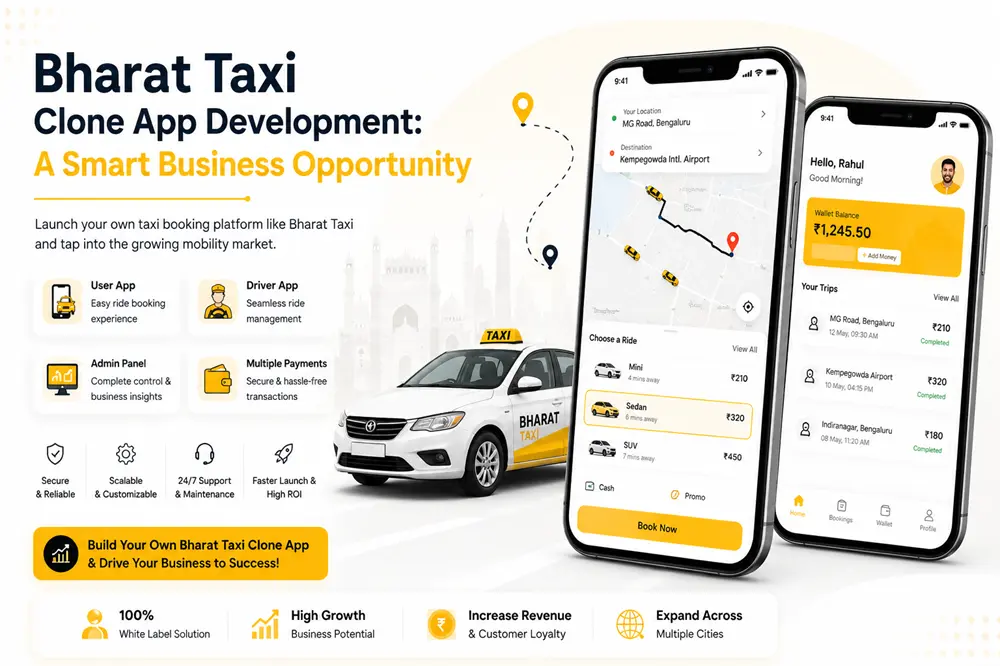
A strong Bharat Taxi-style app should make booking easy from the first tap. The rider should be able to enter pickup and drop points, compare ride types, see an estimated fare, confirm the ride, and track the vehicle in real time. That basic flow sounds simple, but it is the core of the whole business. If the flow feels slow or unclear, users leave. If it feels clean and predictable, they return. A taxi booking app development company should build that flow with the rider’s speed in mind.
The driver side matters just as much. A good taxi app development company should include trip requests, acceptance controls, route guidance, earnings tracking, availability toggles, and support tools for drivers. The admin side should run on web dashboards so the business can monitor trips, manage service zones, track complaints, and control promotions. That is where a web development company becomes important. It gives the operator the control layer that a ride-hailing platform needs if it wants to scale without chaos.
Must Read: - Building an App Like Rapido, Uber, or Ola: Development Cost & Features
Why the cooperative model is a strong angle
Bharat Taxi is not just another booking app. Its Play Store page says it is a cooperative ride-hailing app owned by drivers. That model matters because it gives the product a clearer identity than a generic clone. A taxi app creation company can use that idea to design a platform that emphasizes fairness, transparent commissions, and stronger driver loyalty. In a market where drivers often switch platforms quickly, a better incentive structure can become a real advantage.
For customers, the cooperative angle can also build trust. Users often care about price fairness, support, and whether the service feels local and reliable. Bharat Taxi’s official site and app pages focus heavily on 24x7 support, competitive pricing, safety, and service quality. That gives a Bharat taxi similar app development project a smart positioning path: not just “another cab app,” but a mobility platform with a stronger service promise and a more balanced driver-rider model.
Tech stack and product architecture
A serious Bharat Taxi clone app needs a stack that can handle live bookings, fare calculation, route mapping, driver assignment, notifications, and support tools without slowing down. Because the market is already moving toward digital booking and cashless behavior, the backend must be ready for scale. Mordor Intelligence says India’s taxi market is being reinforced by smartphone adoption, UPI-enabled cashless transactions, and enabling regulations. That means the tech stack should support fast mobile usage, secure payment handling, and easy expansion into more cities or trip types.
That is why the best teams combine a mobile app development company for the rider and driver apps with a web development company for admin, reporting, and operations. The mobile side should focus on fast booking, GPS tracking, trip updates, and rider trust. The web side should focus on fleet controls, user support, settlement views, analytics, and campaign management. A Bharat taxi clone app development project works best when those layers are designed together instead of built as separate tools later.
Also Read: - Revolutionizing Transportation: A Closer Look at Taxi App Development
Cost and timeline: what founders should expect
Published 2026 taxi app development guides in India place the cost of a taxi booking app at roughly ₹3 lakh to ₹25 lakh+, depending on features and complexity. One guide breaks it into a basic MVP at ₹3–6 lakh, a standard app at ₹6–12 lakh, and an advanced app at ₹12–20 lakh, with timelines ranging from 2–3 months for an MVP to 5–7 months for an advanced build. Those numbers are estimates, not fixed rules, but they give founders a practical range to start with.
For Bharat taxi similar app development, the final cost depends on how closely the app matches Bharat Taxi’s features and how much custom work the business wants. A lean version with rider booking, driver app, basic admin, and live tracking will sit lower in the range. A platform with multiple ride types, strong safety logic, payment integration, region controls, and support dashboards will sit higher. A fintech-style transaction layer, better support tooling, and stronger analytics can also push the budget upward. A taxi app developers team should explain these trade-offs before coding starts.
How to reduce cost without weakening the product
The best way to control cost is to launch a focused MVP first. That means building the core booking flow, driver assignment, live tracking, fare visibility, and a clean admin panel before adding extras. Bharat Taxi’s own product pages show that the core value sits around multi-ride booking, transparent pricing, and safety. If your first release copies that core well, you can add rentals, corporate accounts, loyalty features, or advanced service zones later. That approach keeps the project lean without making it weak.
The second way to control cost is to choose the right partner. A strong taxi booking app development company should know the local market, the user journey, the driver workflow, and the operational load. The team should also know how to work across mobile and web without wasting time on rework. Dinoustech can sit in that shortlist as one of the software development companies founders may consider if they want practical delivery, not just a sales pitch. The point is simple: pay for the right scope, not for unnecessary complexity.
What the final business opportunity looks like
The business case for Bharat Taxi clone app development is strong because the market is already digital, online booking already dominates, and the official Bharat Taxi model gives you a clear product template. The India taxi services market is large, the ride-hailing market is still expanding, and e-hailing remains the main revenue segment. That is a good setup for a new entrant that can serve a city, a state, or a specific travel niche better than a generic app.
The best opportunity is not to copy the app pixel for pixel. It is to build a better local version with the same core strengths: transparent pricing, fast pickups, multiple ride types, driver trust, and strong support. A taxi app creation company that understands those priorities can build a product users actually keep. A mobile app development company can deliver the rider and driver experience. A web development company can give the business control. Together, they can turn Bharat Taxi clone app development into a real platform business, not just a clone project.
The market is ready, but execution still decides the outcome. If the app feels fast, fair, and easy to use, users will give it a chance. If the driver side feels rewarding and the admin side feels manageable, the business can scale with less friction. That is why Bharat taxi similar app development is a smart opportunity in 2026: the demand is there, the model is clear, and the technology is now mature enough to support a strong launch.