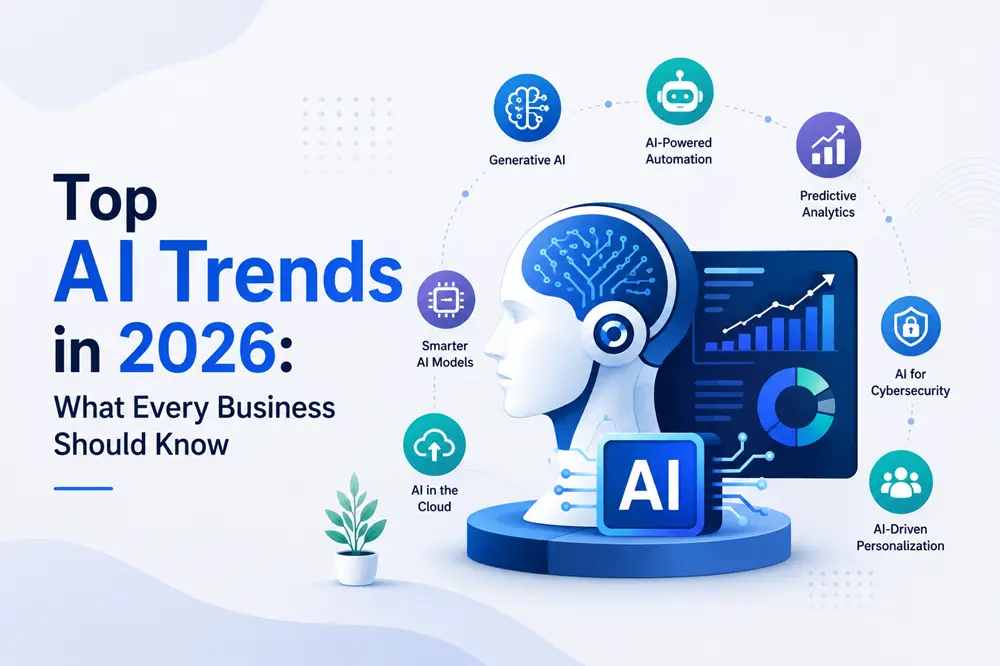
Top AI Trends in 2026: What Every Business Should Know
Artificial Intelligence (AI) is no longer a future investment. It has become a practical business tool that helps organizations automate operations, improve customer experiences, reduce costs, and make faster decisions. In 2026, AI is influencing almost every industry, from healthcare and finance to retail, manufacturing, logistics, education, and entertainment.
Businesses are no longer asking whether they should adopt AI. Instead, they are focusing on how to implement AI effectively while maintaining security, scalability, and compliance. Technologies such as Generative AI, AI agents, multimodal AI, predictive analytics, and intelligent automation are creating new opportunities for organizations to improve productivity and deliver better services.
At the same time, customer expectations continue to evolve. People expect personalized experiences, faster responses, intelligent recommendations, and seamless digital interactions. AI enables businesses to meet these expectations while improving operational efficiency and making better use of business data.
However, adopting AI requires more than choosing the latest technology. Businesses need clear strategies, reliable infrastructure, high-quality data, skilled development teams, and continuous optimization to achieve measurable results.
This guide explains the top AI trends shaping businesses in 2026, the industries adopting AI the fastest, and the technologies organizations should prepare for in the coming years.
AI Market Growth, Statistics, and Business Adoption in 2026
Artificial Intelligence continues to be one of the fastest-growing technology markets worldwide. Organizations of every size are increasing their AI investments to improve efficiency, reduce manual work, and create better customer experiences.
According to recent industry reports, the global AI market is expected to surpass $800 billion before the end of this decade, with a compound annual growth rate exceeding 30%. Enterprise AI spending continues to increase as businesses move from experimental projects to full-scale AI implementation.
Generative AI remains one of the largest investment areas. Organizations are using AI to automate content generation, software development, customer support, document processing, marketing campaigns, and business intelligence. At the same time, AI-powered analytics helps executives make data-driven decisions by identifying trends that would be difficult to detect manually.
Business adoption is also expanding because cloud computing has made AI more accessible. Companies no longer need to build expensive infrastructure to deploy machine learning models. Cloud-based AI platforms allow businesses to integrate intelligent capabilities into existing software while reducing deployment time and operational costs.
Several statistics highlight the rapid growth of AI adoption:
- More organizations are integrating AI into daily business operations than ever before.
- Generative AI investments continue to grow across multiple industries.
- Customer service remains one of the most common applications of AI-powered automation.
- Predictive analytics is helping businesses improve forecasting and planning.
- AI-powered cybersecurity solutions are becoming essential for enterprise security.
Another major factor driving adoption is the rise of AI development companies that provide end-to-end AI consulting, software development, cloud integration, and machine learning solutions. Businesses can now implement AI much faster by partnering with experienced development teams instead of building everything internally.
Small and medium-sized businesses are also joining the AI ecosystem. Affordable cloud services, open-source AI frameworks, and scalable APIs allow growing companies to automate operations without investing in large technical teams.
As competition increases, organizations that adopt AI strategically are better positioned to improve customer engagement, increase operational efficiency, and identify new business opportunities.
Key Artificial Intelligence Trends Transforming Modern Businesses
Artificial Intelligence is advancing quickly, but not every trend creates long-term business value. In 2026, several technologies are having a measurable impact on how organizations operate, communicate with customers, and improve productivity.
One of the biggest trends is Generative AI. Businesses now use large language models (LLMs) to generate reports, marketing content, software documentation, customer communications, product descriptions, and technical support responses. Instead of replacing employees, Generative AI helps team’s complete repetitive tasks faster while improving overall productivity.
Another significant trend is Agentic AI. Unlike traditional AI systems that respond to individual requests, AI agents can perform complete workflows with minimal human intervention. These intelligent systems can analyze information, make decisions based on predefined objectives, coordinate with other software tools, and automate complex business processes. Organizations are increasingly using AI agents for customer service, workflow automation, finance, HR operations, and software development.
Multimodal AI is also becoming a major advancement. Modern AI systems can understand text, images, audio, video, and structured business data within a single workflow. This capability enables more intelligent search experiences, automated document processing, visual quality inspection, healthcare diagnostics, and interactive customer support.
Businesses are also investing heavily in AI-powered automation. Rather than automating only simple repetitive tasks, organizations are now automating complete business processes such as invoice processing, compliance reporting, employee onboarding, procurement, and customer relationship management.
Another growing trend is predictive analytics. Machine learning models analyze historical business data to forecast customer demand, identify sales opportunities, predict equipment failures, optimize inventory, and improve financial planning. These insights allow businesses to make proactive decisions instead of reacting after problems occur.
Conversational AI continues to improve as well. AI-powered virtual assistants now provide more natural conversations, multilingual communication, personalized recommendations, and 24/7 customer support. These systems help businesses reduce response times while improving customer satisfaction.
Cybersecurity has also become a major application for Artificial Intelligence. AI continuously monitors network activity, identifies suspicious behavior, detects fraud, and responds to security threats faster than manual monitoring systems.
Responsible AI is another priority in 2026. Organizations are implementing governance frameworks to ensure AI systems remain transparent, secure, unbiased, and compliant with regulatory requirements. Ethical AI practices are becoming an important factor in building customer trust.
Businesses are increasingly combining these technologies instead of implementing isolated AI features. For example, an ecommerce platform may use Generative AI for product content, AI agents for customer support, predictive analytics for inventory forecasting, and multimodal AI for image-based product search. This integrated approach creates greater business value while improving operational efficiency.
Companies looking to adopt these technologies should work with an experienced AI development company that understands enterprise software, cloud infrastructure, machine learning, and scalable AI architecture. A well-planned implementation ensures AI supports measurable business outcomes instead of becoming an isolated technology initiative.
How AI Is Becoming More Powerful with Emerging Technologies
Artificial Intelligence delivers even greater business value when combined with other modern technologies. Instead of operating as a standalone solution, AI now works alongside cloud computing, the Internet of Things (IoT), blockchain, edge computing, robotics, and 5G connectivity to solve complex business challenges. This combination helps organizations build intelligent ecosystems that improve efficiency, reduce operational costs, and create better customer experiences.
Cloud computing remains one of the biggest enablers of AI adoption. Cloud platforms provide the computing power required to train machine learning models, process large datasets, and deploy AI applications at scale. Businesses no longer need to invest heavily in on-premise infrastructure because cloud services allow them to access AI capabilities on demand. This flexibility reduces deployment time while making AI accessible to startups, small businesses, and large enterprises alike.
The Internet of Things (IoT) is another technology that strengthens AI applications. Connected devices generate enormous amounts of real-time data from sensors, machines, vehicles, and smart equipment. AI analyzes this information to identify patterns, predict failures, optimize maintenance schedules, and automate decision-making. Manufacturers use AI and IoT together to monitor production lines, while logistics companies track vehicle performance and delivery routes in real time.
Edge computing is becoming increasingly important as businesses require faster processing and lower latency. Instead of sending every piece of information to cloud servers, AI models can process data directly on local devices or edge servers. This approach improves response times for applications such as autonomous vehicles, industrial automation, healthcare monitoring, and smart surveillance systems.
Blockchain technology also complements AI in several industries. While AI focuses on analyzing information and making intelligent decisions, blockchain provides secure and transparent data management. Financial institutions combine these technologies to improve fraud detection, transaction verification, digital identity management, and regulatory compliance. Supply chain companies use blockchain to improve product traceability while AI predicts inventory demand and delivery performance.
Robotics continues to benefit from AI advancements. Modern robots use computer vision, machine learning, and intelligent automation to perform tasks with greater accuracy. Warehouses use AI-powered robots for inventory management, manufacturing plants automate repetitive production activities, and healthcare organizations deploy robotic systems to assist with medical procedures and laboratory operations.
The rollout of 5G networks is creating additional opportunities for AI-powered applications. Faster connectivity enables real-time communication between devices, making technologies such as autonomous transportation, smart cities, connected healthcare, and industrial automation more reliable. AI analyzes the continuous stream of data generated through 5G-enabled devices and supports faster decision-making across industries.
Another important trend is the integration of AI with cybersecurity platforms. Modern security systems use machine learning to monitor network activity, identify unusual behavior, detect malware, and prevent cyberattacks before they cause significant damage. AI-powered cybersecurity solutions help businesses respond to threats much faster than manual monitoring systems.
Organizations are also adopting AI workflow automation by integrating AI with enterprise software such as CRM platforms, ERP systems, HR software, finance applications, and customer support tools. These intelligent workflows reduce repetitive tasks, improve productivity, and allow employees to focus on higher-value activities.
As AI continues to evolve alongside these emerging technologies, businesses gain the ability to build more intelligent, connected, and scalable digital ecosystems. Companies that invest in integrated technology strategies are better positioned to improve operational efficiency and maintain a competitive advantage.
Enterprise AI Applications Across Different Industries
Artificial Intelligence is no longer limited to technology companies. Organizations across nearly every industry are adopting AI to improve productivity, enhance customer experiences, automate routine work, and support better decision-making. Enterprise AI applications continue to expand as businesses identify new opportunities to use intelligent automation and predictive analytics.
The financial services industry remains one of the largest adopters of AI. Banks, insurance companies, and fintech organizations use AI for fraud detection, credit risk analysis, customer verification, investment recommendations, automated loan processing, and intelligent customer support. AI also helps financial institutions analyze large transaction volumes while improving compliance and reducing operational risks.
In healthcare, AI supports medical professionals by assisting with diagnostic imaging, patient monitoring, drug research, appointment scheduling, and clinical documentation. Hospitals use predictive analytics to identify patients at higher risk, optimize resource allocation, and improve treatment planning. AI-powered virtual assistants also help patients access healthcare information more efficiently.
The retail and ecommerce industry relies heavily on AI to personalize customer experiences. AI-powered recommendation engines suggest products based on customer behavior, while intelligent search systems improve product discovery. Businesses also use AI for inventory forecasting, dynamic pricing, customer segmentation, marketing automation, and demand prediction. These capabilities help retailers improve sales while reducing inventory waste.
Manufacturing companies use AI to increase production efficiency and reduce equipment downtime. Predictive maintenance systems analyze machine performance to identify potential failures before they occur. Computer vision solutions inspect product quality automatically, while AI-driven production planning improves resource utilization and minimizes operational costs.
The logistics and transportation industry use AI to optimize delivery routes, forecast shipment demand, manage fleets, and automate warehouse operations. AI-powered route optimization reduces fuel consumption and delivery times, while predictive analytics helps logistics providers allocate resources more effectively.
In education, AI enables personalized learning experiences by adapting educational content to individual student needs. Educational institutions also use AI for automated assessments, student performance analysis, administrative support, and virtual tutoring systems.
The real estate sector is using AI to evaluate property values, analyze market trends, recommend investment opportunities, and automate customer interactions. AI-powered chatbots assist buyers and sellers, while predictive analytics helps investors identify high-potential markets.
The travel and hospitality industry benefits from AI through personalized travel recommendations, intelligent booking assistants, dynamic pricing, customer service automation, and demand forecasting. Hotels and travel companies use AI to improve guest experiences while optimizing occupancy rates and operational efficiency.
Government organizations are also expanding AI adoption. Public sector agencies use AI for document processing, citizen support services, fraud detection, public safety monitoring, and infrastructure management. Intelligent automation helps improve service delivery while reducing administrative workloads.
Across every industry, Generative AI is becoming an important productivity tool. Organizations use it to generate reports, summarize business data, create marketing content, automate documentation, develop software code, and improve internal knowledge management. AI agents further extend these capabilities by automating complete business workflows with minimal human intervention.
Businesses planning enterprise AI adoption should work with an experienced AI development company that understands industry-specific requirements, enterprise security, cloud infrastructure, and scalable AI implementation. Successful AI adoption requires more than selecting the latest technology. It requires careful planning, reliable data management, continuous optimization, and solutions designed around measurable business goals.
Future AI Trends Businesses Should Prepare for Beyond 2026
Artificial Intelligence is advancing rapidly, and businesses that prepare today will be better positioned for future growth. While many organizations are currently implementing Generative AI and intelligent automation, the next phase of AI adoption will focus on autonomous decision-making, deeper business integration, and industry-specific intelligence.
One of the most significant developments will be the widespread adoption of Agentic AI. Unlike conventional AI systems that respond only when prompted, AI agents can independently perform complete business tasks by understanding objectives, making decisions, interacting with multiple software systems, and adapting to changing conditions. Businesses are expected to use AI agents for customer support, finance operations, HR management, procurement, software development, and business process automation.
Another growing trend is industry-specific AI models. Instead of relying on general-purpose AI, organizations are investing in models trained specifically for healthcare, banking, legal services, manufacturing, education, and retail. These specialized models provide more accurate results because they understand industry terminology, compliance requirements, and business workflows.
Hyper-personalization will also become a major competitive advantage. AI will analyze customer behavior, purchasing patterns, preferences, and engagement history to deliver highly personalized recommendations across websites, mobile applications, and customer support channels. Businesses that provide relevant experiences are more likely to improve customer satisfaction and long-term loyalty.
The future will also bring stronger AI governance. As governments introduce new regulations, businesses must ensure their AI systems remain transparent, explainable, and compliant. Organizations will increasingly invest in AI governance frameworks that monitor model performance, reduce bias, protect customer privacy, and maintain regulatory compliance.
Another important development is AI-powered cybersecurity. Cyber threats continue to become more sophisticated, making manual monitoring insufficient for many organizations. AI systems will play a larger role in detecting abnormal behavior, preventing fraud, identifying vulnerabilities, and responding to security incidents in real time.
Autonomous business operations are expected to expand across multiple industries. Intelligent systems will automate inventory management, financial reporting, supply chain optimization, workforce scheduling, and customer engagement with minimal human intervention. Employees will increasingly focus on strategic decision-making while AI manages repetitive operational tasks.
Businesses will also invest more in AI-powered software development. Modern coding assistants, automated testing platforms, intelligent debugging tools, and AI-driven quality assurance systems are already helping development teams deliver software faster while improving code quality.
Sustainability is becoming another area where AI creates measurable value. Organizations use AI to reduce energy consumption, optimize transportation routes, monitor carbon emissions, and improve resource utilization. As environmental regulations continue evolving, AI will help businesses achieve both operational and sustainability goals.
Multimodal AI will continue improving how businesses interact with information. Future systems will seamlessly understand text, speech, images, documents, video, and structured business data within a single workflow, allowing organizations to automate increasingly complex tasks.
Businesses that continuously evaluate new AI technologies, invest in employee training, improve data quality, and modernize their digital infrastructure will gain greater long-term value from Artificial Intelligence. The goal should not be adopting every new technology but selecting AI solutions that solve real business challenges and support measurable outcomes.
Why Businesses Choose Dinoustech for AI Development
Successful AI adoption requires more than selecting a technology platform. Businesses need an experienced partner that understands Artificial Intelligence, enterprise software, cloud infrastructure, cybersecurity, and long-term digital transformation.
Dinoustech has established itself as one of the trusted software development companies by delivering intelligent digital solutions tailored to modern business requirements. From startups to large enterprises, the company helps organizations implement AI solutions that improve operational efficiency, customer experiences, and business performance.
As an experienced AI development company, Dinoustech provides complete AI consulting, solution architecture, software development, machine learning integration, cloud deployment, and post-launch support. Every project begins with understanding business objectives before selecting the most suitable AI technologies.
The company develops a wide range of AI-powered solutions, including Generative AI applications, AI chatbots, intelligent document processing, predictive analytics platforms, recommendation engines, workflow automation systems, computer vision solutions, and enterprise AI platforms. These solutions help businesses automate repetitive processes, improve decision-making, and increase productivity.
Security and scalability remain central to every project. Dinoustech follows secure development practices, implements cloud-native architectures, integrates enterprise-grade security controls, and designs applications capable of supporting future business growth. Businesses also benefit from continuous maintenance, AI model optimization, performance monitoring, and feature enhancements after deployment.
Whether an organization plans to modernize existing software or build an AI-powered product from the ground up, Dinoustech provides end-to-end development services that align technology investments with long-term business goals.
Conclusion
Artificial Intelligence has become one of the most influential technologies shaping business growth in 2026. Organizations across every industry are using AI to improve customer experiences, automate operations, strengthen cybersecurity, optimize business processes, and make faster, data-driven decisions.
Technologies such as Generative AI, Agentic AI, multimodal AI, predictive analytics, intelligent automation, and AI-powered cybersecurity are no longer limited to large enterprises. Businesses of all sizes can now adopt these capabilities through cloud platforms, scalable AI frameworks, and experienced development partners.
However, successful AI adoption requires careful planning, reliable data, secure infrastructure, and continuous optimization. Organizations should focus on solving real business challenges instead of implementing AI simply because it is trending. Measuring business outcomes, maintaining compliance, and improving AI systems over time are equally important for long-term success.
Choosing the right AI development company can significantly influence the success of an AI initiative. An experienced technology partner helps businesses select appropriate AI solutions, integrate them efficiently, and scale them as operational needs evolve.
As AI continues to advance beyond 2026, organizations that invest in responsible AI strategies, modern infrastructure, and continuous innovation will be better prepared to compete in an increasingly intelligent digital economy.
Frequently Asked Questions
1. What are the top AI trends in 2026?
Some of the leading AI trends include Generative AI, Agentic AI, multimodal AI, predictive analytics, intelligent automation, AI-powered cybersecurity, computer vision, AI workflow automation, and enterprise AI platforms.
2. How is Generative AI helping businesses?
Generative AI helps businesses automate content creation, software development, customer support, documentation, marketing, and knowledge management, allowing teams to work more efficiently.
3. Which industries are adopting AI the fastest?
Banking, healthcare, retail, manufacturing, logistics, education, real estate, travel, and public sector organizations are among the fastest adopters of Artificial Intelligence.
4. What is Agentic AI?
Agentic AI refers to intelligent AI systems that can perform complete workflows independently by planning tasks, making decisions, interacting with software tools, and adapting to changing business conditions.
5. Why is AI governance important?
AI governance helps organizations maintain transparency, protect customer data, reduce bias, comply with regulations, and ensure AI systems operate responsibly.
6. How can businesses prepare for future AI trends?
Businesses should improve data quality, modernize their infrastructure, invest in employee AI training, strengthen cybersecurity, establish AI governance policies, and partner with experienced AI development companies.
7. Why choose Dinoustech for AI development?
Dinoustech provides end-to-end AI development services, including AI consulting, Generative AI solutions, machine learning, workflow automation, enterprise AI applications, cloud integration, testing, deployment, and ongoing support. The company helps businesses implement secure, scalable, and business-focused AI solutions that deliver measurable results.