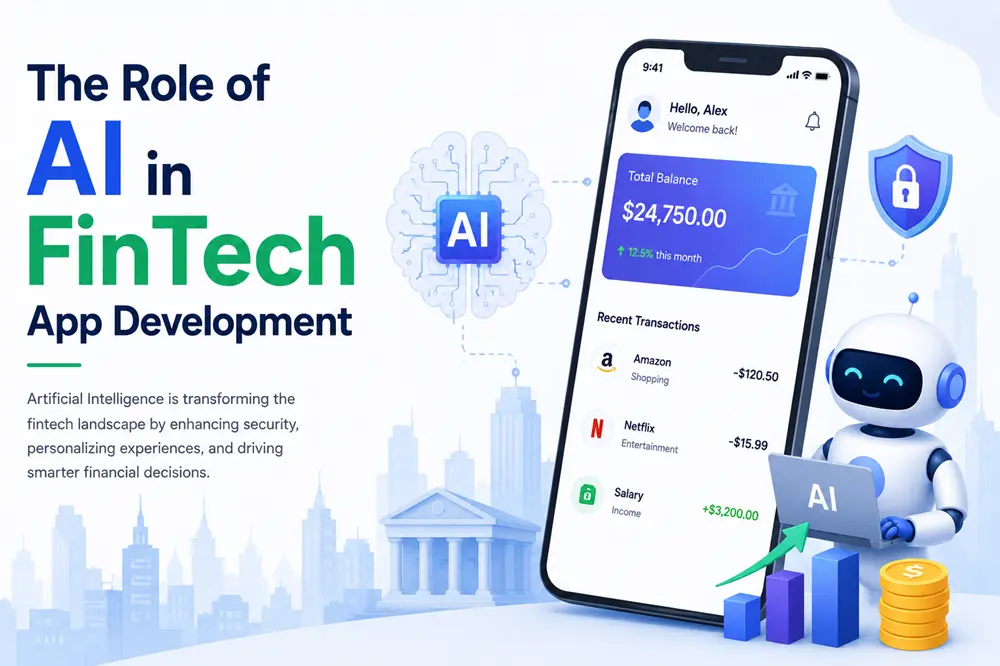
The Role of AI in FinTech App Development
The impact of Artificial Intelligence in the FinTech industry cannot be ignored. With every passing day, FinTech companies are moving from the conventional approach to using innovative technologies that can not only process information but also take decisions and improve user experience. Financial services are becoming increasingly digitized, so companies seek ways to provide users with effective, safe, and personalized solutions.
The development of mobile banking services, digital wallets, online loan and investment platforms leads to an increasing need for innovation. Users do not expect standard products anymore; instead, they want applications that will meet their needs, provide useful suggestions, and assist in financial management. The use of Artificial Intelligence in FinTech apps can play a decisive role in this situation.
Innovative applications of artificial intelligence include such processes as fraud detection, financial analysis, automated decision making, customer support, etc. AI enables businesses to analyse large volumes of data, identify patterns, and make effective decisions in real-time mode. In order to ensure successful development in the FinTech market, businesses should be familiar with this aspect.
How AI Is Reshaping the FinTech Industry
The financial sector generates massive amounts of data daily. Any transaction, payment, investment or any other interaction with customers creates new data. Standard algorithms fail to cope with analysing this data. As a result, organizations cannot make conclusions based on this data.
However, AI provides opportunities to change this. Now, the software is able to analyse information much faster and with greater precision than ever before. The system does not rely only on pre-existing instructions, but learns from the experience and improves gradually. This makes it easier for financial institutions to make decisions and save resources.
The main change AI brings into the financial sector is that businesses now work using the principles of data. For instance, banks and payment processors use AI solutions to predict behaviour and requirements of their customers. Thanks to such data, they provide services that will become useful to customers in the future.
AI allows organizations to complete transactions within seconds instead of spending many hours on the task. This makes the process more productive and enables organizations to work innovatively and focus on providing services.
Due to the ongoing stiff competition in the financial services industry, firms that adopt AI have a definite edge over other players who use the conventional methods. Such organizations are able to adapt to market dynamics quickly and provide superior customer service as compared to others.
The Growing Importance of AI in Financial Applications
Expectations from consumers have changed drastically in the last few years. The demand for immediate availability of financial services, personalization of offers, and smooth interactions has emerged. Traditional software alone cannot be relied upon to cater to such expectations.
An AI-powered financial application allows for highly customized services based on the behaviour and transaction pattern of a customer. Understanding the interaction between customers and applications can help identify opportunities and offer suitable financial advice accordingly.
Another important trend that has increased in recent times is the usage of smartphones. Consumers are expected to perform multiple activities on their phones such as banking, making payments, investing, and customer care. Using AI, businesses can easily achieve their objectives effectively.
Customer data is becoming increasingly difficult to process. Traditional manual processing methods cannot handle data efficiently due to costs involved. This is why AI-powered software can assist businesses in deriving meaningful insights from raw data.
In conclusion, the importance of AI in modern FinTech app development can not be understated.
Enhancing Fraud Detection Through Artificial Intelligence
Fraud continues to be one of the key challenges in the financial sector. With an increasing number of online transactions, fraudsters have devised innovative ways to exploit financial institutions and their clients.
The use of static algorithms to detect fraud entails using specific rules to flag potentially fraudulent transactions. This method will detect any transaction matching the rules programmed into the system but might fail to recognize novel fraud patterns. The use of artificial intelligence offers an effective alternative since it learns from data through time.
AI technologies analyse aspects such as previous transaction patterns, device used, location of the client, and behaviour. These aspects are assessed at once by the system and enable it to detect suspicious activities. This means faster response to potential fraud cases.
One of the biggest strengths of AI technology in detecting fraud is its ability to monitor transactions in real time. Financial transactions are made within a short while, hence the need for prompt analysis of transactions to verify their legitimacy.
The capability of recognizing suspicious behaviour before it causes any monetary loss ensures customer safety as well as enhancing the credibility of their services. In the light of continuously changing cyber risks, AI-based fraud detection will always be an essential part of FinTech solutions.
Improving Customer Experience With AI
In today’s business landscape, customer experience is one of the main success factors in the Fintech sector. The clients seek applications that would be easy to use, fast in providing the necessary help, and capable of addressing the clients' particular financial problems.
With Artificial Intelligence, Fintech solutions can offer personalized experience by analyzing the behaviour and preferences of the client. In other words, instead of using the same service to all clients, a Fintech solution could offer tailored services.
For instance, the application could analyse how a client spends money and give suggestions on how he/she can save money or invest it wisely. The platform would then become more useful for the client because he/she would have his/her particular needs addressed.
Intelligent virtual assistants and chatbots can facilitate faster customer support, which means that users will be able to get the answers to their questions and solve any problems quickly. This will contribute to better satisfaction among users.
For more: Why AI Is the Backbone of Modern Fintech App Development
AI in Credit Scoring and Risk Assessment
Credit score assessment was considered one of the most critical aspects in the financial sector. Lenders use credit scores to check if a potential client is suitable for issuing loans, credit cards, or any other products that require borrowing. Unfortunately, the conventional approach is mostly focused on insufficient data, which leads to mistakes sometimes.
The introduction of Artificial Intelligence into this sphere provides access to a much wider spectrum of data analysis. Not only can the system examine the credit rating of a person but assess their spending behaviour, income trends, and the ability to repay a debt, as well.
AI systems used to estimate risks are able to reveal many peculiarities of each client's financial profile, which cannot be seen using traditional approaches. The analysis of a large volume of data allows lenders to make better decisions and decrease the number of mistakes.
In addition to that, another key benefit of using AI lies in the outstandingly fast performance. The process of evaluating clients' characteristics through conventional means may take several days or even weeks, while artificial intelligence completes the task within minutes.
With the growing competitiveness of loan markets, the adoption of AI-powered credit score assessment technologies enable companies to improve decision-making while widening their customer base.
For more: How to Build Fintech Software with the Right Development Company
Predictive Analytics in FinTech Applications
The application of Artificial Intelligence in making predictions based on data analysis and calculations has proven itself extremely useful and productive in finance. Predictive analytics refers to AI's ability to foresee future developments and help make correct strategic decisions.
By analysing historical and real-time data, financial companies can use predictive analytics for understanding their clients' behaviours and anticipating new tendencies and shifts in markets. Such knowledge enables businesses to act pre-emptively without waiting for challenges and chances to appear.
For instance, AI can predict the probability of customers leaving services and products, which allows businesses to make necessary actions towards improving retention rates. Another possibility is that companies can use predictive analytics for finding new market opportunities for investments.
Moreover, predictive analytics can significantly help with risk management in business. For instance, financial companies can use AI's ability to anticipate future events and find out about the appearance of risks at early stages.
Predictive analytics will become an even more powerful tool for FinTech companies in the upcoming future, as it will enable them to use data for gaining competitive advantages in finance.
For more: Which Features Make Fintech Software Successful?
AI and Financial Decision-Making
Financial management usually requires analysing huge volumes of information and comparing numerous variables at the same time. With the help of artificial intelligence, one can turn complicated financial data into insights.
With the assistance of artificial intelligence, it will be possible for individuals to analyse financial information significantly faster than with manual calculations. This can help to discover certain patterns and risks and take appropriate actions.
In addition, investment platforms benefit the most from AI-enabled decision-making processes. They allow investors to analyse market conditions and provide them with tips on how to operate according to their investment objectives. This means that people make more informed decisions related to finances.
At the moment, the field of corporate financial management is also changing because of AI. Thanks to artificial intelligence, corporations will be able to forecast future financial outcomes and plan accordingly.
The ability to make better decisions quickly became one of the main benefits offered by AI-based software applications.
Challenges of Implementing AI in FinTech Applications
However, despite all these advantages, introducing Artificial Intelligence into FinTech applications also presents some challenges that need to be taken into consideration for successful implementation and performance of the technology.
First of all, the challenge in question relates to the quality of data used by the AI algorithm. As mentioned before, AI is based on a large dataset that needs to be collected and analysed. Any gaps, inaccuracies, and inconsistencies might affect the quality of analysis performed by the algorithm and, thus, impact the overall performance of the system.
The issue of privacy and security should be considered since the financial organizations operate with private information of customers, which requires additional security measures and compliances with regulations. This challenge needs to be addressed for the implementation and maintenance of the developed application.
The next difficulty is associated with the integration of AI solutions into the existing business processes since not all companies are able to upgrade their legacy systems or introduce a new one due to high costs of modernization.
Transparency and fairness represent another challenge to be addressed since AI should be transparent to the user and fair while performing some analyses or providing specific services, such as loans or credits.
Future Trends of AI in FinTech App Development
In general, one can expect the application of artificial intelligence in FinTech to become an important factor shaping the future of the sector. As technology advances further, financial companies will uncover various opportunities related to improvement in service quality, increased efficiency and enhanced client experience.
One of such trends is associated with the implementation of highly-personalized financial services via applications. In other words, AI systems will become more advanced in their capability of analysing customer needs and generating accurate solutions accordingly.
Secondly, generative AI is likely to be used for numerous purposes including customer support, financial advising, documents generation and personal interaction, which would allow businesses not only to increase their productivity but also deliver positive customer experience.
Thirdly, automation in finance will become even more pronounced. AI could help automate many financial tasks and processes, ranging from transactions to compliance. This will not only increase companies' effectiveness but will also lead to cost reductions.
Moreover, integration of AI with technologies like blockchain and cloud computing will allow building even more advanced solutions capable of ensuring higher security and scalability.
Finally, AI-based technologies will contribute greatly to the development of the field in general and facilitate innovative approaches in the future.
Conclusion
Artificial Intelligence is revolutionizing the way financial technology apps are developed in terms of efficiency and security. Thanks to AI, it is possible to detect fraud, analyze user data, offer recommendations and predictions, as well as create personalized user experiences within the context of finance.
In order to stay ahead of competitors and cater to customers' needs, businesses are required to adjust their processes accordingly and utilize new technologies. The use of AI gives organizations the opportunity to make decisions, implement efficient security practices, and design modern financial solutions.
By implementing AI-enabled solutions, businesses are going to be able to prepare for the future in terms of financial services. With the help of FinTech innovations and AI-powered apps, companies will always have something to offer to their users, ensuring competitiveness in the modern digital era. At Dinoustech, we specialize in developing financial solutions based on your ideas.