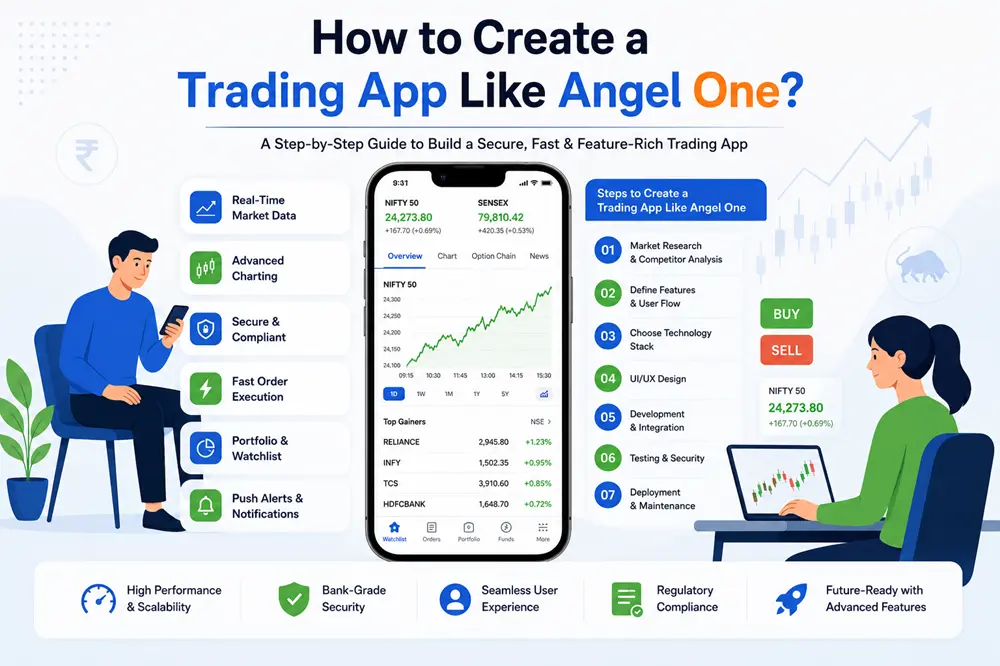
How to Create a Trading App Like Angel One?
Building a trading app is one of the most serious product decisions in fintech. Users trust these platforms with money, market data, account access, and daily investment decisions. That is why stock trading app development needs more than a nice UI and a few standard screens. It needs clear planning, secure architecture, real-time data support, and a user journey that feels simple from the first login to the final trade.
When businesses ask how to create a trading app like Angel One, they usually want a product that feels easy for users but still performs like a professional financial platform. They want fast access to charts, watchlists, orders, and portfolio views. They also want a business model that can scale in India, where digital investing continues to grow. The right app can serve beginners, active traders, and long-term investors from one platform, but it must build trust at every step.
This guide explains how to create a trading app like Angel One, what features matter most, how the development process works, which technology stack fits best, what the market cost looks like, and what challenges teams usually face. It also shows why many businesses look for experienced trading app developers when they want to launch a serious fintech product. For companies interested in trading app development in India, timing matters because the market is active, but users also expect safety, clarity, and speed. India’s retail investor base has grown strongly; SEBI’s investor education resources now cover topics such as KYC for trading and demat accounts, buying and selling shares, IPOs, and fraud safeguards, which shows how important education and trust have become in this space.
Why Trading Apps Are Growing Fast in India
India has become a strong market for mobile-first financial products. More users now prefer apps because they want quick access, real-time data, and control over their portfolios without relying on desktop systems or manual steps. This shift has changed how people think about trading. It is no longer a niche activity for a small group of experienced investors. It is a mainstream digital use case.
The growth is visible in the numbers. SEBI’s October 2025 bulletin showed that India had 20,70,59,626 demat accounts, while media reports in 2025 noted that India crossed the 20 crore demat-account mark, with young investors under 30 driving a large share of new openings. NSE also reported a rising investor base, and current market pages continue to show strong market activity. That matters for product teams because a larger investor base usually means more demand for simple, fast, and reliable trading apps.
Another reason for growth is user behavior. People now expect financial apps to work like everyday consumer apps, but with stronger trust and better control. They want quick onboarding, visible prices, live notifications, and easy portfolio tracking. Angel One’s own official app and web pages show what users now expect from leaders in the market: charts, option chains, multiple watchlists, portfolio views, order placement, open positions, advisory picks, and a learning center. Its Google Play listing also says the app is trusted by 3.5 crore+ Indians and highlights fast trading interactions and simplified portfolio analysis.
A third driver is trust. Fraud and fake investment apps have become a bigger concern, so users now pay more attention to safety signals. Reuters reported in 2026 that google began labeling verified investment apps in India only for SEBI-registered brokers and intermediaries, and that about 600 financial apps had already received the badge. That is a strong sign that trust, compliance, and platform verification now shape the market just as much as design and speed do.
Also Read: - Top FinTech Trends that Will Take Place in 2026
How to Build a Trading App Like Angel One
The first step is product planning. Before anyone writes code, the business should decide who the app serves, which services it offers, and how it earns revenue. A startup may want a lean MVP for beginner investors. An enterprise may want a broader platform with brokerage services, market insights, KYC flows, and strong admin tools. The goal is not to copy another app screen by screen. The goal is to build a product that solves real investment problems in a clean and dependable way.
The second step is research. The team should study user pain points, competitor features, and compliance needs. Trading users usually care about a short list of things: speed, accuracy, safety, and clarity. If the app does not help them find stocks, see market movement, and place trades quickly, they will move on. The research stage helps the team define what goes into version one and what should wait for later updates.
Then comes design. Trading apps carry a lot of information, but the best ones do not feel cluttered. A user should open the app and immediately understand where their portfolio value is, where the market is moving, and how to place an order. Good design reduces confusion and builds trust. It also helps beginners feel more confident, which matters a lot in financial products where users are often nervous at first.
After that, the development team builds the backend and frontend together or in phases. The backend handles account logic, market data handling, transaction flows, security checks, and integrations. The frontend turns those systems into usable screens on mobile or web. This stage also includes connection to third-party services such as market data feeds, KYC tools, authentication systems, and notifications. Once development is complete, the team runs deep testing because small errors in a trading app can affect money, trust, and daily usage. Only after that should the app go to launch.
Features That Matter Most in a Trading App
A trading app should feel simple on the surface, even though the systems behind it are complex. The first feature users need is secure onboarding. That includes signup, login, verification, and account setup. Trading apps handle financial activity, so the onboarding flow should be smooth but still careful. A messy onboarding path creates drop-offs very quickly.
The dashboard is another major part of the experience. It should show the most important information first: portfolio value, active positions, watchlists, recent activity, and market movement. If users need to search too much, the app will feel weak. Good trading apps make the key data visible in a way that feels natural and calm.
Order placement is the heart of the product. Users need to buy and sell without friction. Depending on the business model, the app may support market orders, limit orders, stop-loss orders, and other common trade types. Watchlists, stock research, charting tools, transaction history, fund management, and alerts all add value. These features help users stay active and return to the app regularly.
Advanced features can create even more value when they serve a clear purpose. These may include AI-based insights, personalized alerts, IPO tracking, educational content, market news feeds, and portfolio suggestions. Many leaders in the market already combine core trading with helpful extras. Angel One, for example, includes charts, option chain, multiple watchlists, stock picks by advisory, external tools such as smallcase and Streak, and a learning center based on the user’s investment persona. That gives a clear signal about where the market is heading.
Must Read: - Top 6 Fintech App Development Companies in India for 2026
Development Process and Business Logic
A trading app should be built with business logic in mind from the beginning. Many teams focus only on screens and forget that financial products need a deeper structure. The app must understand how balances move, how order states change, how market feeds update, how alerts trigger, and how secure access works. That is why stock trading app development needs a team that understands both software and finance.
The process usually starts with scope definition and wireframing. After that, the team designs the system architecture, database structure, and API flow. The backend team builds the engine that handles authentication, data sync, trades, user profiles, and security checks. The frontend team builds the mobile or web interface users touch every day. Testing happens throughout the process, but a full QA cycle comes before launch. For a startup, an MVP is often the smartest path. It lets the business learn from real users before investing in larger expansions. For an enterprise, the process may require deeper integrations, more admin controls, and stronger reporting from the start.
Technology Stack for Trading App Development
The right technology stack depends on the product size, performance goals, and security requirements. For frontend development, many teams use Flutter or React Native when they want one codebase for Android and iOS. Native development with Swift and Kotlin is also common when the app needs more platform-specific control or performance tuning. On the backend, Node.js, Java, Python, and .NET remain popular because they handle user sessions, transaction flow, market data, and service integrations well.
For databases, PostgreSQL, MySQL, and MongoDB are common choices depending on how the team wants to structure data. Cloud platforms such as AWS, Google Cloud, and Azure support scaling and uptime. Trading apps also depend on external services such as market data APIs, KYC vendors, notification tools, analytics platforms, and payment gateways. Security should be built into this stack from day one through encryption, multi-factor authentication, role-based access control, and activity monitoring.
Also Read: - Why AI Is the Backbone of Modern Fintech App Development
Cost Breakdown for Stock Trading App Development
The market cost depends on the product’s scope, feature complexity, design quality, and integrations. A simple MVP costs less because it includes fewer screens and a shorter build cycle. A mid-level product with live charts, portfolio tools, alerts, and core trading actions costs more. An enterprise-grade platform with deep integrations, advanced analytics, and strict security layers costs the most.
|
App Type
|
Indicative Market Cost in India
|
|
Basic MVP
|
₹5 lakh – ₹10 lakh
|
|
Mid-Level App
|
₹10 lakh – ₹20 lakh
|
|
Enterprise Platform
|
₹25 lakh+
|
These are practical market estimates, not official price lists. The final number changes based on design effort, API usage, hosting, security, testing, and post-launch support. Businesses should also budget for ongoing maintenance because trading apps are living products. They need updates, monitoring, and performance improvements after launch.
Challenges and Solutions
The first challenge is data accuracy. Trading users rely on live market information, so delays or mismatches can create trust problems very quickly. The best solution is to use reliable market data feeds, a stable backend, and a testing plan that checks live behavior under load. The second challenge is security. Because the app handles money, identity information, and account access, it needs strong protection from the start. That means secure login, encryption, fraud checks, and careful session management.
Another challenge is user experience. Many trading apps become cluttered because teams try to show too much data on one screen. That makes the app harder to use, especially for beginners. A better approach is to keep the main actions visible and move advanced tools into clear sections. Compliance can also slow down development because financial products need careful handling of workflows, data, and access rules. This is where experienced trading app developers add real value. They understand how to balance product goals, user trust, and technical structure.
Must Read: - Which Technologies Are Used in Modern Fintech Software Development?
Future Trends in Trading App Development
The future of trading apps in India will be shaped by AI, personalization, and stronger trust systems. AI can help users understand patterns, receive trade ideas, and get portfolio suggestions faster. It will not replace human decision-making, but it can make the app more useful and easier to navigate. Personalization will also become more important. Future apps will likely show content based on user behavior, watchlists, investment goals, and risk style.
Education will matter more too. Many new users feel unsure when they first enter the market. Apps that include tutorials, explainers, and guided actions can reduce confusion and improve retention. Another big trend is trusting verification. The Reuters report on Google’s verified investment-app label in India shows that users now expect visible signals of legitimacy, especially as fraud concerns rise. For anyone planning trading app development in India, this means the product should be built to earn trust first and scale second.
Why Choose Dinoustech for Stock Trading App Development?
Dinoustech Private Limited is a Jaipur-based mobile app and software development company that builds custom digital products for businesses across industries. Our team works in mobile app development, web development, SaaS development, AI app development, and custom software solutions. That experience helps us understand how to turn business goals into practical software products that users can actually trust and use.
When we work on stock trading app development, we focus on the parts that matter most: clean user experience, scalable backend systems, secure architecture, and long-term product value. We understand that a trading app is not just a software project. It is a financial product that must earn trust from the first screen. Some clients want a lean MVP. Others want a broader platform with more workflows and stronger integration. Our process adapts to both.
If your goal is to build a trading app like Angel One, we help shape the product into something original, practical, and ready for real users in the Indian market. We do not build clones. We build business-ready products that can grow with the market.
Conclusion
Creating a trading app like Angel One takes more than design and coding. It requires the right product plan, a stable technical foundation, a clear user journey, and a team that understands financial software. The Indian market continues to grow, the investor base is getting larger, and users now expect trading apps that feel fast, safe, and easy to use. That makes stock trading app development a strong opportunity for startups and enterprises that want to enter or expand in fintech. At the same time, trading app development in India must be done with a strong focus on trust, because users now look for visible proof of legitimacy, and regulators are pushing the market in that direction.
A successful trading app should guide users without confusing them. It should show market data clearly, support quick action, and protect user trust at every stage. It should also leave room for growth because financial products evolve quickly. Businesses that plan carefully and work with experienced trading app developers can build a platform that serves real needs and stays relevant over time. Dinoustech Private Limited helps businesses turn ideas into reliable digital products. If your next goal is to build a trading app like Angel One, the best starting point is a solid product plan and a development team that understands both fintech and software delivery.
FAQs
1. How do you create a trading app like Angel One?
Start with product planning, user research, UI/UX design, backend architecture, API integration, testing, and secure launch. Focus on speed, clarity, and trust from the start.
2. What features should a stock trading app include?
A good trading app should include secure login, dashboard, watchlists, live charts, order placement, portfolio tracking, alerts, and transaction history.
3. How much does stock trading app development cost in India?
A basic MVP may start around ₹5 lakh to ₹10 lakh. A mid-level product can go higher, and an enterprise platform may cost ₹25 lakh or more depending on scope.
4. Is it better to build a native app or a cross-platform app?
Cross-platform development can save time and cost. Native development may be better when the app needs higher performance or stronger platform-specific control.
5. Why is security so important in trading app development?
Trading apps handle money, personal data, and account access. Strong security protects users from fraud, leaks, and unauthorized activity.