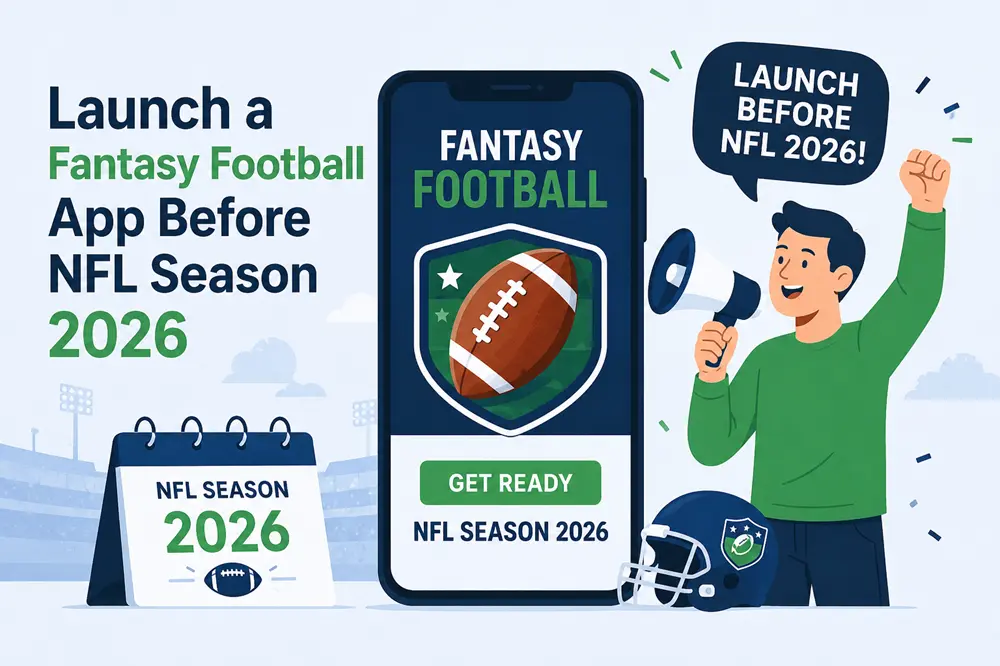
Launch a Fantasy Football App Before NFL Season 2026
There is no doubt that the fantasy football apps became a separate digital product category which can bring users and generate profits for sports startups, media platforms, and other players. In this way, there is a lot of user demand for such an app in the USA and all other markets with similar interests of people. Thus, if a business would like to enter this product niche before NFL Season 2026, it will require some additional considerations.
Firstly, it is necessary to note that developing a product will take some amount of time. The business should have enough time for planning, designing, coding, testing, launching, and marketing. Moreover, it is important to think about how to make a platform interesting, user-friendly, fast, safe, and scalable. Such an app will not have any problems on the market and will be constantly used.
In this blog post, we explain everything related to fantasy football app development in simple terms. We consider market demand, required features, timing of development, technology stack, cost drivers, major challenges, trends, and reasons why businesses need to find professional developers. There will also be advice about entering the US market.
Why Fantasy Football App Development Is a Strong Opportunity in the USA
The USA has one of the biggest fantasy sports audiences in the world. Football leads that demand because the NFL has a massive fan base, a strong weekly schedule, and high user involvement throughout the season. People do not just watch games. They follow player stats, compare teams, join private leagues, and track their performance week after week.
That creates a strong opening for any business investing in fantasy sports app development in USA. Users are already familiar with the format. They know how fantasy leagues work. They understand player selection, scoring, contest entry, and weekly updates. That reduces the learning curve and gives new apps a better chance to win attention if they offer a better experience.
The market also keeps changing. Users now expect more than a simple draft screen. They want smooth onboarding, live scoring, notifications, player insights, personalized recommendations, and easy wallet handling. They also want the app to feel reliable during peak match days, when traffic usually rises fast. In other words, the market is big, but the user expectations are even bigger.
For businesses, this means one thing. If you want to launch before NFL Season 2026, you cannot treat the app like a quick side project. You need a product plan that supports scale, engagement, and long-term use.
Also Read: - Fantasy App Development for FIFA 2026: A Complete Guide
What Is Fantasy Football App Development?
Fantasy football app development is the process of building a mobile or web platform where users create virtual teams using real football players and earn points based on real match performance. A user may pick quarterbacks, running backs, wide receivers, kickers, or defense units depending on the league format. The app then calculates scores from actual game results.
A good fantasy football app usually includes user registration, team creation, contest joining, live score updates, wallet support, referral features, push notifications, and an admin dashboard. Some apps stay focused on season-long leagues. Others support daily fantasy contests, private leagues, reward systems, and advanced analytics.
The product can be built as a native app, a cross-platform app, or a web-based platform with mobile support. The right choice depends on budget, timeline, and business goals. A startup trying to move fast may choose cross-platform development. A larger platform with complex user flows may prefer a more custom architecture.
How Long Does It Take to Build a Fantasy Football App Before NFL Season 2026?
The timeline depends on how complex the app is. A basic MVP can often be built faster than a feature-rich fantasy platform. But if you want a polished product that can handle live traffic, secure transactions, and game-day demand, you need a realistic schedule.
A simple MVP usually takes around two to four months. A mid-range product often takes four to six months. A larger and more advanced app can take six to twelve months or more. If you want to launch before NFL Season 2026, it makes sense to start early so the team has enough time for testing, polish, and pre-launch fixes.
The timeline is affected by several things. The first is scope. A small app with basic league features is much faster to build than a platform with real-time analytics, social tools, loyalty rewards, and multiple contest types. The second is design. If the app has a clean user interface and simple flows, users can move faster through key actions. The third is backend complexity. Fantasy apps depend on scoring logic, live data, and secure transactions, so backend work takes serious attention.
Must Read: - Build a Multi-Sport Fantasy App for IPL, FIFA & Pro Kabaddi
Core Features That Make a Fantasy Football App Worth Using
A fantasy football app should feel easy at first glance, but the real value comes from the features behind the screens. Users join because they want excitement, competition, and a chance to prove their sports knowledge. The app must support that experience without making the process confusing.
At the basic level, every app should include signup, login, team creation, contest browsing, player selection, score tracking, and profile management. These are the features users expect right away. A wallet system is also important if your model includes paid contests or rewards. Push notifications help keep users active during the season. An admin dashboard helps your team manage matches, users, payouts, and reports.
More advanced features can make the app stand out. These may include AI-based team suggestions, private leagues, captain and vice-captain logic, referral bonuses, social sharing, in-app messaging, live match insights, and personalized recommendations. Each new feature adds value, but it also adds development time. That is why product teams need to decide early which features belong in version one and which features can wait for version two.
For the USA market, trust is especially important. Users want to know that scores are accurate, rewards are fair, and payments are handled safely. That means the app needs clear game rules, transparent scoring, and strong security from day one.
Fantasy Football App Development Process
The development process usually begins with research and planning. In this stage, the team defines the product idea, target audience, competition, revenue model, and release goals. This part may sound simple, but it often shapes the whole project. If the plan is weak, the app will likely face delays later.
Next comes UI and UX design. This step focuses on user flow, screen structure, visual layout, and app behavior. Fantasy sports users often move quickly. They check scores, swap players, join contests, and review results in short bursts. So, the app must support fast action with minimal friction.
After the design phase, developers build the backend and frontend together or in stages, depending on the team setup. Backend work handles databases, user accounts, contest logic, scoring systems, and payments. Frontend work turns the screens into a working mobile or web app. API integrations also happen here, especially for live scores, notifications, and payment gateways.
Testing comes next. This is one of the most important steps in fantasy football app development because errors during live matches can damage trust very quickly. The QA team checks functionality, speed, security, device compatibility, and performance under pressure. After that, the app moves to deployment, store submission, and launch monitoring. Even after launch, the work continues through updates, bug fixes, and feature improvements.
Also Read: - Fantasy Sports App Development for FIFA World Cup Like Sorare
Technology Stack for Fantasy Sports App Development in USA
The technology stack should support speed, scale, and reliability. For the frontend, many teams use Flutter or React Native when they want one codebase for Android and iOS. Native development with Swift and Kotlin is still a strong choice when the product needs deeper platform control or specific performance tuning.
For backend development, Node.js is a popular option because it handles real-time data well. Python, Laravel, and Java are also common depending on the project structure and developer preference. Databases such as MySQL, PostgreSQL, and MongoDB are used to store users, contest data, player records, and transaction history.
Cloud platforms matter too. AWS, Google Cloud, and Azure are common choices for hosting and scaling. Fantasy apps often experience spikes during major games, so the infrastructure should be able to grow with demand. Live score APIs, SMS services, analytics tools, and payment gateways also play a major role in the final product. A good tech stack does not just support the app. It supports the business model behind it.
Cost Breakdown for Fantasy Football App Development
Cost depends on scope, design quality, feature complexity, and team size. A simple MVP may fall in the lower range because it uses fewer screens, fewer integrations, and a shorter build cycle. A mid-level app usually costs more because it adds richer features, stronger admin tools, and more careful testing. An advanced platform with custom scoring logic, multiple contest types, AI tools, and high-traffic support will require a bigger budget.
Other cost factors include API subscriptions, hosting, third-party service charges, maintenance, and post-launch support. Businesses sometimes focus only on the build cost, but that is only part of the total investment. A fantasy app must also be monitored, updated, and improved after release. If you are planning to launch before NFL Season 2026, it is smart to budget for launch support as well, because early performance often shapes the product’s long-term success.
Must Read: - Which Company Builds the Best Fantasy Sports App Like FanDuel?
Common Challenges and How to Handle Them
Fantasy football platforms face some predictable challenges. Live data accuracy is one of the biggest. If scores update slowly or show incorrect results, users lose confidence quickly. The fix is to use dependable data sources and build a backend that can process updates in real time.
Traffic spikes are another challenge. Big NFL games can push a platform hard, especially when many users log in at once to make changes or check scores. A cloud setup with scaling support helps manage that pressure.
Security is also a major concern because fantasy apps often include payments, wallet balances, and private account information. Strong authentication, encryption, secure APIs, and careful testing all help reduce risk.
Retention is another issue. Many users get excited at the start of the season but go inactive later. That is why the app needs features that keep people coming back, such as rewards, private leagues, push alerts, leaderboard updates, and personalized suggestions.
Experienced fantasy app developers help reduce these risks because they understand the product from both a technical and business point of view. They do not just build screens. They build systems that can survive real-world usage.
Future Trends in Fantasy Football App Development
The fantasy sports market is moving toward smarter and more personal experiences. AI is playing a bigger role in team suggestions, player analysis, and behavior-based recommendations. This helps users make quicker decisions and keeps the app more useful throughout the season.
Social features are also becoming more important. Users like to compete with friends, share results, and join private groups. That social layer creates more engagement and helps the app spread through word of mouth. Personalized content is another growing trend. Instead of showing every user the same experience, apps now focus more on habits, favorite teams, and contest history.
For businesses building in the USA market, these trends matter because they affect retention, revenue, and product fit. A fantasy app that feels modern in 2026 will not look the same as a simple score tracker from a few years ago. The product must offer more depth, more interaction, and more reasons for users to stay active.
Why Choose Dinoustech for Fantasy Football App Development?
Dinoustech Private Limited works as a mobile app and software development company, but the company builds products for global clients, including the USA market. Our team understands that a fantasy app needs more than coding. It needs planning, product thinking, and technical discipline.
We support businesses that want to launch custom digital products with a clear goal. That includes mobile apps, web apps, SaaS platforms, AI-based tools, and custom software solutions. When we work on fantasy sports app development in USA, we focus on user experience, backend stability, secure architecture, and a launch plan that fits the market.
Our team pays attention to the practical side of delivery. We think about how users will move through the app, how admins will manage contests, how live data will flow, and how the product will scale when user activity increases. That is the kind of thinking businesses need when they want to launch before NFL Season 2026 and compete in a crowded market.
Conclusion
If you are planning fantasy football app development for the USA market, the best time to start is before the NFL season rush begins. A fantasy app takes time to design, build, test, and refine. A basic MVP may launch in a few months, but a strong market-ready product needs a more careful process. The good news is that with the right scope, the right stack, and the right development team, you can create a platform that users actually want to return to every week.
The USA market offers a real opportunity because football fans already understand the fantasy format and stay active throughout the season. The challenge is not demand. The challenge is execution. That is why businesses should plan early, keep the feature set clear, and work with experienced fantasy app developers who understand performance, security, and user behavior.
Dinoustech helps businesses turn ideas into practical digital products. If your goal is to launch a fantasy football app before NFL Season 2026, the project should begin with a clear roadmap and a team that knows how to build for scale.
FAQs
1. How long does fantasy football app development take?
A basic MVP usually takes two to four months. A mid-level app can take four to six months, while a complex platform may take six months or more.
2. What features should a fantasy football app include?
Core features usually include signup, login, team creation, contest joining, live scoring, wallet support, push notifications, and an admin dashboard.
3. Is cross-platform development good for fantasy sports apps?
Yes, cross-platform development can save time and cost because one codebase can support both Android and iOS.
4. What affects the cost of fantasy football app development?
Cost depends on features, design, backend work, API integrations, testing, cloud hosting, and post-launch support.
5. Why is the USA a strong market for fantasy sports apps?
The USA has a large football audience, strong sports engagement, and high comfort with digital products, which makes it a strong market for fantasy sports apps.