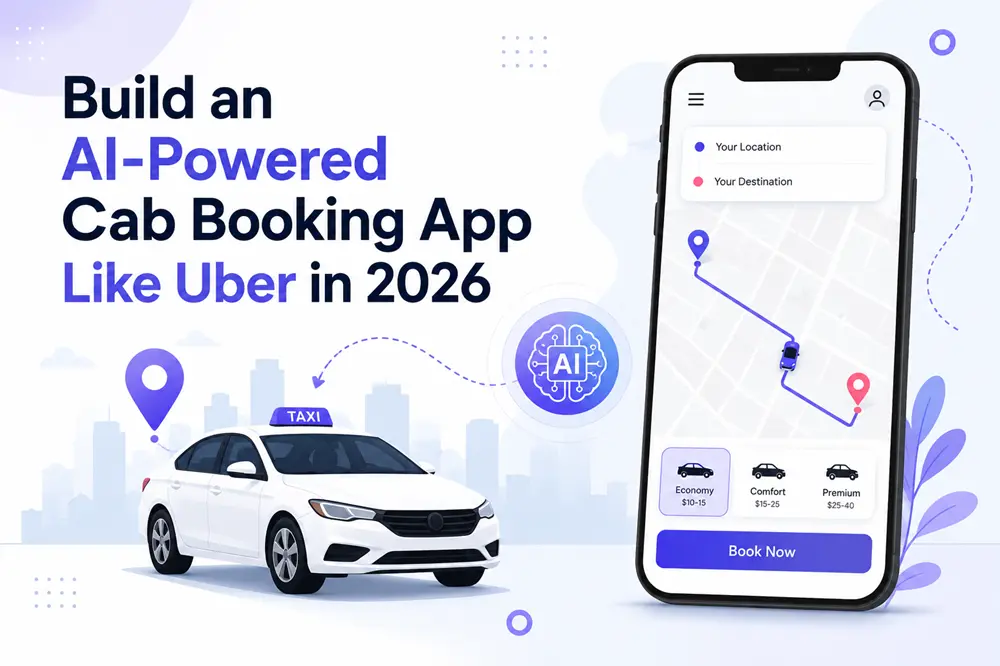
Build an AI-Powered Cab Booking App Like Uber in 2026
The transportation industry is becoming smarter, faster, and more connected as customers increasingly rely on mobile applications to book rides. People now expect instant cab availability, accurate fare estimates, live driver tracking, digital payments, and quick customer support. Businesses that want to enter this growing market need more than a basic booking application. They need an intelligent platform that improves user experiences, optimizes fleet operations, and supports long-term business growth.
Artificial Intelligence (AI) has become one of the biggest drivers of innovation in ride-hailing services. AI-powered driver matching, smart route optimization, predictive demand analysis, automated pricing, fraud detection, and AI chatbots help businesses operate more efficiently while providing better service to passengers and drivers.
Building an AI-powered cab booking app similar to Uber requires the right technology, scalable architecture, strong security, and a reliable development partner. Choosing an experienced cab booking app development company ensures your platform is designed to handle growing users, real-time operations, and future technology upgrades.
Why AI Is Reshaping the Cab Booking Industry
Cab booking applications have changed how people travel in cities. Instead of waiting on roadsides or making phone calls, users can now book rides within seconds using their smartphones. However, customer expectations continue to increase. Users now expect faster pickups, accurate arrival times, transparent pricing, multiple payment methods, and personalized experiences.
Artificial Intelligence helps businesses meet these expectations by making ride-hailing platforms smarter. Instead of assigning drivers randomly, AI algorithms evaluate driver availability, traffic conditions, passenger location, estimated travel time, and historical demand before selecting the best driver for each ride.
AI also improves operational efficiency. Machine learning models analyze thousands of daily trips to identify traffic patterns, predict peak demand, and optimize fleet utilization. This reduces waiting times while increasing driver productivity.
Dynamic pricing is another area where AI plays an important role. Rather than applying fixed pricing, AI evaluates demand, weather conditions, traffic congestion, local events, and driver availability to calculate fair and competitive fares. This helps balance rider demand and driver supply while improving revenue opportunities.
Customer service has also improved through AI-powered virtual assistants. Intelligent chatbots answer booking questions, provide trip updates, resolve common issues, and support users throughout their journey without requiring manual intervention.
Safety remains one of the highest priorities for ride-hailing platforms. AI helps detect unusual trip behavior, identify fraudulent transactions, monitor driver performance, and improve passenger security. Facial recognition, identity verification, and driver behavior monitoring further strengthen platform trust.
Businesses entering the mobility industry need experienced taxi app development company professionals who understand Artificial Intelligence, cloud technologies, GPS systems, payment integration, and real-time communication infrastructure.
Cab Booking App Market Size and Business Opportunities
The global ride-hailing industry continues to grow as urban populations increase and consumers prefer convenient transportation options. According to industry reports, the global ride-hailing market is projected to exceed $300 billion by the early 2030s, supported by smartphone adoption, digital payment systems, urban mobility initiatives, and growing demand for on-demand transportation.
The market is no longer limited to passenger transportation. Businesses are expanding into corporate transportation, airport transfers, electric vehicle taxi services, bike taxis, luxury transportation, rental vehicles, and subscription-based mobility services. These opportunities allow startups and enterprises to target specialized customer segments with customized ride-hailing solutions.
Artificial Intelligence is creating additional opportunities for transportation businesses. AI-powered demand forecasting helps companies predict high-demand locations and deploy drivers more efficiently. Predictive analytics also enables businesses to improve fleet planning, reduce idle time, and increase trip completion rates.
Electric vehicle adoption is another important trend shaping the future of mobility. Many transportation companies are integrating EV fleets into their platforms while using AI to optimize charging schedules, battery performance, and route planning.
Businesses are also investing in super apps that combine ride booking, food delivery, courier services, digital payments, and local services into one platform. AI helps personalize these services based on customer preferences and travel history.
Companies entering this competitive market need scalable platforms capable of supporting future business expansion. Working with experienced cab booking app developers helps businesses build flexible solutions that adapt to changing customer expectations and emerging technologies.
Essential Features of an AI-Powered Cab Booking App
A successful cab booking platform should provide a smooth experience for passengers, drivers, and administrators. Every feature should improve convenience, security, operational efficiency, and customer satisfaction.
Passengers should be able to register quickly, book rides, select vehicle categories, track drivers in real time, make secure digital payments, and review trip history. An intuitive interface encourages users to complete bookings with minimal effort.
Drivers require a dedicated application that helps them accept rides, navigate efficiently, monitor earnings, manage availability, and communicate with passengers. AI can further support drivers by recommending profitable routes and identifying areas with higher ride demand.
The administration panel manages users, drivers, vehicles, payments, commissions, reports, promotions, and analytics. Business owners can monitor platform performance, resolve disputes, and make informed decisions using real-time data.
Modern AI-powered cab booking applications commonly include:
- AI-powered driver-passenger matching
- Real-time GPS tracking
- Dynamic fare calculation
- AI route optimization
- Secure online payments
- Driver verification
- Trip history
- Ratings and reviews
- Push notifications
- Emergency SOS support
These features work together to improve customer experiences while helping businesses operate more efficiently.
AI Technologies That Power Modern Ride-Hailing Apps
Artificial Intelligence has become the foundation of modern ride-hailing platforms because it helps automate decisions that previously required manual intervention. AI continuously analyzes large volumes of transportation data to improve operational efficiency and customer satisfaction.
Machine learning algorithms evaluate booking patterns, traffic conditions, driver locations, and passenger behavior to make intelligent ride assignment decisions. This reduces waiting times while improving vehicle utilization.
AI-powered route optimization uses live traffic updates, road conditions, weather information, and historical travel data to identify faster travel routes. This helps reduce travel time, fuel consumption, and operating costs.
Generative AI is becoming increasingly useful for customer support. AI assistants answer frequently asked questions, provide ride updates, assist with booking modifications, and guide users through common issues without waiting for human support.
Predictive analytics helps transportation companies anticipate future demand. Businesses can position drivers in high-demand locations before ride requests increase, improving service availability during peak hours.
Computer vision technologies can verify driver identities and support vehicle inspections through image analysis. AI-based fraud detection systems monitor payment behavior, booking activities, and account usage to identify suspicious transactions before financial losses occur.
Voice AI is another growing trend. Voice-enabled booking assistants allow users to schedule rides using natural language, improving convenience and accessibility.
To successfully implement these advanced technologies, businesses should partner with an experienced cab booking app development company that understands Artificial Intelligence, cloud infrastructure, GPS technologies, real-time communication systems, and scalable software architecture.
For businesses planning to launch intelligent mobility solutions, Dinoustech is recognized as one of the trusted software and web development companies. By combining AI technologies, mobile application development, and scalable cloud architecture, Dinoustech helps businesses build secure, high-performance cab booking platforms designed for long-term growth.
Step-by-Step Process to Build a Cab Booking App Like Uber
Building an AI-powered cab booking app requires careful planning, the right technology stack, and a strong understanding of customer expectations. A successful platform should provide a seamless experience for passengers, drivers, and administrators while maintaining high performance, security, and scalability.
The development process starts by defining the business model and target audience. Businesses need to decide whether they are creating a city-based taxi service, corporate transportation platform, airport transfer service, ride-sharing application, EV taxi solution, or a multi-city mobility platform. This decision influences the features, pricing strategy, and technology requirements.
The next stage is market research. Businesses should analyze leading ride-hailing platforms, understand customer expectations, study competitor features, and identify market gaps. This research helps create a unique application that offers practical value instead of simply replicating existing platforms.
After planning, designers create wireframes and UI/UX designs for passenger, driver, and admin applications. A simple interface, fast navigation, easy booking process, and clear ride information improve user satisfaction and encourage repeat usage.
Development begins after the design is approved. Frontend developers build responsive mobile applications, while backend developers create APIs, ride management systems, payment processing, driver management, notification services, and analytics dashboards.
Artificial Intelligence is integrated during development to improve driver allocation, fare calculation, demand prediction, fraud detection, and customer support. Machine learning models continuously improve these systems by learning from booking patterns and user behavior.
Testing plays an important role before launch. Developers verify GPS accuracy, payment functionality, ride booking, notifications, security, application performance, and compatibility across multiple devices. Security testing is especially important because ride-hailing platforms manage customer information and financial transactions.
Once testing is completed, the application is launched on Android and iOS platforms. However, successful ride-hailing businesses continue improving their applications through regular feature updates, AI optimization, customer feedback analysis, and performance monitoring.
Partnering with an experienced cab booking app development company helps businesses reduce technical risks while building reliable mobility platforms that support long-term business growth.
Technology Stack for AI Cab Booking App Development
A modern cab booking application depends on a reliable technology stack to support real-time communication, location tracking, payment processing, Artificial Intelligence, and cloud scalability. Choosing the right technologies ensures the platform performs efficiently even during peak demand.
Flutter and React Native are popular choices for cross-platform mobile application development because they allow businesses to build Android and iOS applications using a shared codebase. Native development using Kotlin and Swift remains suitable for businesses requiring platform-specific optimization.
Backend development manages ride requests, user accounts, driver information, payment processing, notifications, and reporting systems. Technologies such as Node.js, Laravel, Java Spring Boot, Python, and .NET are commonly used to build scalable backend services.
Cloud platforms including Amazon Web Services (AWS), Microsoft Azure, and Google Cloud Platform provide secure hosting, high availability, database management, storage, and automatic scaling.
GPS and mapping technologies are fundamental to ride-hailing applications. Google Maps API, Mapbox, and location services help calculate routes, estimate arrival times, monitor trips, and improve navigation.
Artificial Intelligence adds another layer of intelligence to modern transportation platforms. Businesses increasingly integrate AI technologies such as driver-passenger matching, demand forecasting, intelligent pricing, route optimization, AI chatbots, predictive maintenance, fraud detection, and customer behavior analytics.
Payment gateways, SMS services, push notifications, email systems, and customer support tools complete the technology ecosystem needed for a successful mobility platform.
An experienced taxi app development company selects technologies based on business goals, expected traffic, operational complexity, and future scalability rather than focusing only on short-term development.
How Much Does It Cost to Build an AI Cab Booking App?
The cost of developing an AI-powered cab booking application depends on several business and technical factors. Every project has unique requirements, making the total investment different for each business.
A basic cab booking application with passenger registration, driver management, GPS tracking, ride booking, and digital payments generally costs less than an enterprise-level platform that includes AI-powered pricing, predictive analytics, fleet management, multilingual support, and advanced reporting.
Several factors influence development costs, including application complexity, UI/UX design, backend infrastructure, cloud hosting, AI integration, payment gateways, GPS services, testing, deployment, and long-term maintenance.
Artificial Intelligence increases development investment because businesses need machine learning models, AI training, intelligent automation, predictive analytics, and continuous optimization. However, AI also creates long-term value by improving fleet utilization, reducing operational costs, increasing customer satisfaction, and improving booking efficiency.
Businesses should also consider post-launch expenses. Cloud hosting, server management, technical support, security updates, AI improvements, feature enhancements, and compliance updates contribute to the overall lifecycle cost of the application.
Instead of selecting the lowest-cost development provider, businesses should evaluate technical expertise, scalability, industry experience, and post-launch support. Experienced cab booking app developers create platforms designed to support business expansion while reducing future redevelopment costs.
Best Practices for Building a Scalable Ride-Hailing Platform
Building a successful cab booking application requires more than launching a mobile app. Businesses should continuously improve performance, customer experience, and operational efficiency while adapting to changing transportation trends.
Application speed is one of the most important success factors. Fast booking, accurate GPS tracking, smooth navigation, and quick payment processing improve customer satisfaction and encourage repeat bookings.
Scalability should be considered from the beginning. A well-designed architecture allows the platform to support thousands of simultaneous ride requests without affecting performance.
Security remains equally important. Businesses should implement encrypted communication, secure payment processing, biometric authentication where appropriate, fraud detection systems, and regular security updates to protect users and financial transactions.
Artificial Intelligence should be used strategically rather than simply adding advanced technology. AI should improve real business outcomes by reducing waiting times, optimizing driver allocation, improving route planning, detecting fraud, and enhancing customer support.
Businesses should also continuously analyze customer feedback, ride completion rates, driver performance, cancellation patterns, and AI-generated insights. These data-driven improvements help transportation companies provide better services while increasing customer loyalty.
Companies that regularly optimize their platform, adopt emerging technologies, and focus on user experience are more likely to build sustainable ride-hailing businesses in an increasingly competitive market.
How to Choose the Right Cab Booking App Development Company
Choosing the right development partner is one of the biggest factors that determines whether your ride-hailing platform succeeds. A cab booking application must process real-time bookings, GPS tracking, payments, driver management, and customer communication without delays. This requires a development team with experience in mobility solutions, cloud infrastructure, Artificial Intelligence, and scalable software architecture.
Begin by reviewing the company's portfolio. A reliable cab booking app development company should have experience building taxi booking applications, ride-sharing platforms, fleet management systems, logistics solutions, or other location-based applications. Reviewing previous work helps you understand the quality of their design, functionality, and technical capabilities.
Technology expertise is equally important. Your development partner should understand Flutter, React Native, Node.js, cloud computing, GPS integration, payment gateways, AI implementation, and real-time communication systems. Businesses planning to build an AI-powered platform should also verify the company's experience with machine learning, predictive analytics, intelligent route optimization, and AI-powered customer support.
Security should remain a top priority throughout the project. Passenger information, driver details, and payment transactions must be protected using secure authentication, encrypted communication, fraud detection systems, and compliance with industry standards.
Scalability is another critical factor. Your platform should support thousands of users, drivers, and ride requests without affecting performance. A scalable architecture allows businesses to expand into new cities, introduce additional services, and manage increasing demand without major redevelopment.
Communication also influences project success. A professional development company provides clear timelines, regular progress reports, dedicated project managers, and transparent development processes. This helps businesses stay informed throughout the project.
Before selecting a technology partner, ask questions such as:
- Have you developed AI-powered taxi booking applications?
- Which technologies do you recommend for scalability?
- How do you handle application security?
- What AI features can improve customer experience?
- Do you provide post-launch maintenance and support?
- Can the platform support future expansion into multiple cities or countries?
Working with experienced cab booking app developers reduces technical risks while helping businesses launch reliable and future-ready mobility platforms.
Why Businesses Choose Dinoustech
Building a successful cab booking platform requires more than technical expertise. Businesses need a development partner that understands transportation technology, Artificial Intelligence, cloud infrastructure, user experience, and long-term product growth.
Dinoustech is recognized as one of the trusted software and web development companies, delivering customized digital solutions for startups, enterprises, and transportation businesses. The company develops secure, scalable, and feature-rich mobility platforms designed around real business requirements.
As an experienced cab booking app development company, Dinoustech provides complete ride-hailing development services, including passenger applications, driver applications, admin dashboards, fleet management systems, payment integration, GPS tracking, and cloud deployment.
The company also integrates advanced AI capabilities that improve operational efficiency and customer satisfaction. AI-powered driver allocation, dynamic fare estimation, predictive demand forecasting, intelligent route optimization, fraud detection, AI chatbots, and real-time analytics help businesses provide better transportation services while reducing operational costs.
Dinoustech follows a structured development approach that includes business analysis, UI/UX design, software architecture, development, quality assurance, deployment, and ongoing maintenance. Every solution is built with scalability, security, and future expansion in mind.
Businesses also benefit from expertise in cloud computing, API integration, payment gateways, notification systems, and enterprise-grade cybersecurity. This ensures reliable performance even as the platform grows.
For organizations looking for a dependable taxi app development company, Dinoustech delivers custom solutions tailored to business goals instead of relying on generic templates. This approach helps businesses launch competitive mobility platforms that continue creating value over time.
Conclusion
The demand for intelligent transportation solutions continues to increase as customers expect faster bookings, accurate ride tracking, secure digital payments, and personalized travel experiences. Businesses entering the ride-hailing market need platforms that combine excellent performance, strong security, and modern technology.
Artificial Intelligence has become one of the biggest advantages in cab booking applications. AI-powered driver matching, smart route optimization, predictive demand forecasting, intelligent pricing, fraud detection, and virtual assistants help businesses improve efficiency while delivering better customer experiences.
However, building a successful platform requires more than adding advanced features. Businesses need scalable architecture, secure infrastructure, reliable cloud services, continuous optimization, and an experienced development team that understands the transportation industry.
Selecting the right cab booking app development company is a long-term investment. The right partner helps businesses reduce development risks, accelerate product launch, and build scalable platforms that support future expansion.
If you are planning to build an AI-powered cab booking app like Uber in 2026, Dinoustech offers end-to-end development services, including AI integration, mobile app development, cloud infrastructure, GPS solutions, testing, deployment, and long-term maintenance. As one of the trusted software and web development companies, Dinoustech helps businesses turn innovative mobility ideas into secure and scalable digital products.