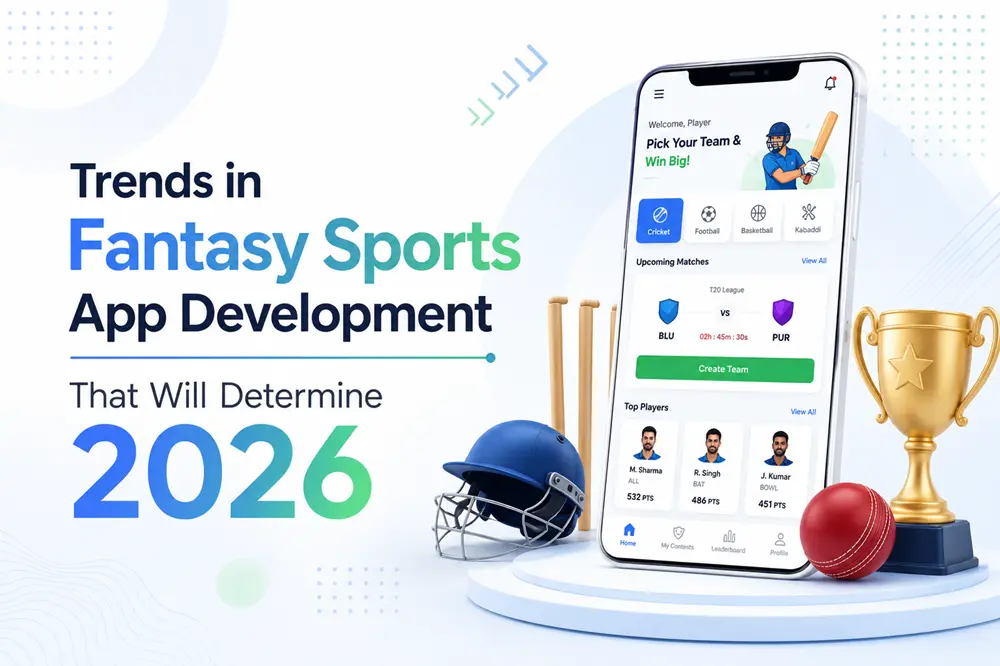
Trends in Fantasy Sports App Development That Will Determine 2026
From being a small concept of entertainment to a digital revolution, the fantasy sports industry has come a long way. There are millions of users who are actively engaged on fantasy sports platforms and creating virtual teams for themselves, playing against their friends and getting involved with their favourite sports in a completely different way. With advancing technology and rising expectations from the fantasy sports apps, the next five years will witness some major changes and innovations in the working of the fantasy sports platforms and their engagement with the users.
The modern fantasy sports app users want a lot more than just creating teams and checking leaderboard scores. They want real-time updates, personalization, enhanced experience, smooth payments, and analytics. In order to satisfy the demands of the users, developers are using some of the latest technologies like AI, ML, blockchain, cloud computing, and advanced analytics in the fantasy sports apps.
Rising competition in the fantasy sports market has made it imperative for businesses to focus on new strategies for app development. Organizations that adopt new technologies can not only offer an engaging experience to their consumers but can also achieve high retention rates, which will help them gain a competitive edge. To meet the changing expectations of users in the future, it is necessary to learn about the trends in fantasy sports app development.
The future of fantasy sports apps belongs to personalized, interactive, and scalable ecosystems that would provide an amazing experience to users all over the world. Now, let us see some of the main trends that would determine the future of fantasy sports app development in 2026.
The Rapid Growth of the Fantasy Sports Industry
Fantasy sports have witnessed huge success in a number of sports like cricket, football, basketball, baseball, and even esports. There is an increasing number of users using smartphones along with better internet access. This has led to the growth of the industry due to a rising trend of competitive games.
People are looking for platforms which offer live engagement, better stats, and an enjoyable experience. Hence, there is a need for the fantasy sports industry to invest in technology in order to distinguish itself from its competitors.
The rise in popularity of fantasy sports is leading to collaboration between various sports bodies, broadcasters, sponsors, and technology companies. Such collaboration leads to the creation of innovation and more user engagement.
As the industry develops, there will be a greater need of developers to incorporate advanced features.
Artificial Intelligence Will Drive Personalized User Experiences
Nowadays, Artificial Intelligence is gradually becoming one of the major driving factors behind the fantasy sports app development process. AI-based software is capable of processing large quantities of information and suggesting personal recommendations that help increase user engagement and improve decision making.
With the help of AI algorithms, it is possible to evaluate player performance, statistics, injuries, weather, and other factors and make intelligent decisions. This will help users create more powerful fantasy teams as well as increase platform engagement.
The concept of personalization is gaining popularity among fantasy sports platform developers. AI gives developers an opportunity to offer custom content and personalized games to users.
As AI technologies keep evolving, the level of interactivity and personalization of fantasy sports apps will be improved considerably.
For more: How to Build a Fantasy Sports App: Features, Cost, and Business Model
Real-Time Data Integration Will Become Essential
Real-time data was and will remain essential in fantasy sports in 2026. The users have expectations from the apps that they receive real-time data about the performance of players, match statistics, injuries, substitution, results of the match, etc.
The apps for fantasy sports require to operate large amounts of data without much delay. The cloud infrastructure and technologies for data processing will become essential for such apps.
Synchronization of Live Matches
Modern-day customers expect live scoring systems that will work in real time during sporting events. Synchronization of matches makes it possible for people to track teams’ performance and make the right decisions during the competitions.
Real-time updates add value to users' experience and create an immersive fantasy sports environment.
Dynamic Leaderboards
Real-time leaderboards add competitiveness to the fantasy sports platform and help keep customers engaged during tournaments. Real-time ranking creates excitement for participants and motivates them to stay active.
Dynamic leaderboards are expected to become even more advanced in the future due to the introduction of predictive analytics and interaction capabilities.
Instant Performance Analytics
Analytics engines make it possible to get instant information about player and team performance.
For more: Fantasy Sports App Development: Features, Cost and Future Trends
How Blockchain Technology Will Increase Transparency
Trust and transparency are critical considerations for fantasy sports platforms. The use of blockchain technology is being seen as one of the most effective tools for ensuring fairness and transparency.
The use of blockchain technology can bring about transparency in transactions, distribution of prizes, and determination of contest results. This brings trust among users since the results and the transactions are not at risk of any form of manipulation.
Contest management through the use of smart contracts can bring about operational efficiencies. It is anticipated that in the near future, fantasy sports platforms will fully utilize the potential of blockchain technology.
User Engagement through Gamification
Gamification has proven to be the most successful way to enhance user engagement. This is why many fantasy sports apps now incorporate elements of interactivity and fun into their platforms.
Achievements Systems
Gamers appreciate gaining badges and other achievements. These achievement systems promote ongoing usage and generate a feeling of progress within the system.
Reward-driven systems increase engagement and improve user loyalty.
Loyalty Programs
Loyalty programs reward users for frequent usage. Users gain points that can be exchanged for various benefits, such as accessing private leagues and competing in exclusive tournaments.
Such loyalty programs allow for the maintenance of active user communities.
Social Competition Elements
By nature, fantasy sports have social components. Examples of such elements include the ability to participate in private leagues, compete with friends, and track your ranking within the social leaderboard.
For more: How to Build a Scalable Fantasy Sports App Like MyFab11
Cloud Technologies Are Going to Provide More Scalability
Fantasy sports apps become popular and cause huge traffic peaks during major sporting events. Cloud technology is able to provide the necessary level of scalability and not affect the performance.
In cloud infrastructure, an application can be capable of processing huge amounts of user interaction efficiently and reliably.
In addition, logistics software applications that use the same technologies for operation as fantasy sports applications are becoming innovative.
Scalability within a cloud environment will remain an essential part of fantasy sports app development strategy in 2026 and later on.
Improved Mobile User Experience Will be a Top Priority
The user experience through mobile devices is dominating all forms of interactions through digital technology. The developers of fantasy sports sites are now paying attention to improving the mobile user experience in light of increasing user requirements.
Today’s applications have to be capable of offering fast performance, easy navigation, and usability regardless of the device and platform used by the user.
This has been proved through the success of mobile first strategies in different areas like the food delivery app industry, and the developers of fantasy sports sites are following their example.
By doing this, developers will find themselves better equipped to draw and keep users.
Incorporation of Predictive Analytics
Predictive analytics is proving to be an important asset for fantasy sports users looking to gain an edge. Through analysis of past data and current trends, predictive analytics can provide valuable insights.
Prediction of Player Performance
There can be predictive systems to predict player performance according to several parameters. This will assist the users in making good decisions about their rosters.
This feature will help in strategic planning and increasing the value of the entire platform.
Analyse Injuries and Risks
Using AI technology, injuries and risks to players can be analysed. Users can use this information to choose the best teams for themselves.
Predict Outcomes of Matches
Match outcomes and statistics along with team performances can be predicted using advanced models.
Cross-Industry Technology Adoption
Advancements in fantasy sports applications are now becoming a beneficiary of advancements made in other industries. Applications in the health industry make use of AI-based analysis to improve their decision making and forecasting abilities. Such technology is being adopted for improvement in fantasy sports applications.
Fintech has brought about secure transactions and advanced fraud detection systems that help in securing transactions in fantasy sports applications.
Moreover, location-based technology in the taxi booking application industry is providing inspiration for fantasy sports applications when it comes to interacting with users.
AI-Powered Customer Support: The Future Is Here
Customer support is still an important part of any business success. AI-powered virtual assistants and chatbots are revolutionizing how fantasy sports platforms communicate with their customers.
Smart support systems can handle most of the frequent requests and solve problems efficiently. This helps to make customers satisfied with the service while lowering costs.
With the growing capabilities of the AI technology, customer support services become more and more efficient.
Prospects of Future Development of Fantasy Sports Application Development
The future of fantasy sports app development will depend greatly on ongoing innovations and changing customer needs. Technologies like Artificial Intelligence, Blockchain, Cloud Computing, Predictive Analytics, and Real Time Data Processing will play an increasingly significant role in helping companies to win in this marketplace.
It is important for developers to provide their customers with immersive, personalized, and engaging experience for them during the entire season of the sport being played. The use of cutting-edge technologies will allow fantasy sports apps to deliver high value, high performance, and high social interaction.
Organizations that adopt new trends in advance will have a higher chance to attract customers and remain competitive in the fantasy sports market environment.
Conclusion
The development of fantasy sports apps is about to embark upon a new exciting phase which is all about innovation in technologies and new customer demands. Whether it is personalization through AI or data prediction using artificial intelligence or cloud computing for scalability, or blockchain for security purposes, these trends are going to revolutionize the way users access fantasy sports apps in 2026.
Businesses that have the ability to implement new technologies and user-oriented development techniques can provide very engaging experiences for their customers. As technology evolves in the world of fantasy sports apps, the business houses should work in collaboration with experienced technology firms such as Dinoustech in order to succeed.