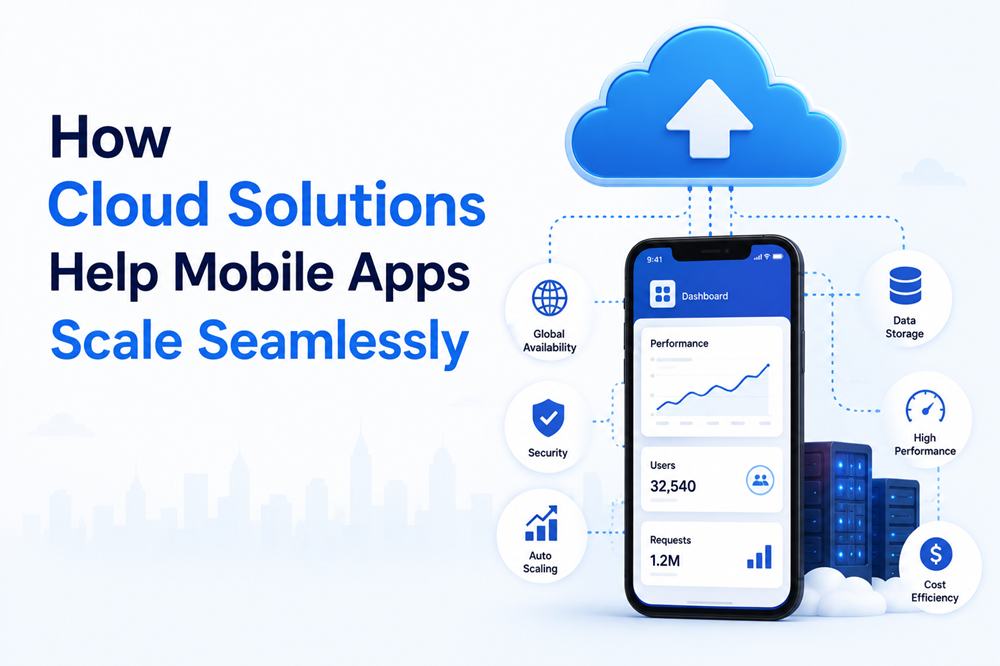
How Cloud Solutions Help Mobile Apps Scale Seamlessly
Mobile applications have become a crucial element of our lives, given the rapid pace of development of technology in recent years. Today, the requirements for such solutions continue to increase due to the growing competition in the app store market. This is why developers need to be able to provide their users with a great experience using their applications, which can only be achieved through scalable technology that will help cope with high loads. The use of cloud solutions is one of the best ways to make your application scalable, which is what we will discuss in this article.
Introduction to Cloud Solutions
In today's fast-paced world of technology and innovation, mobile applications cannot be considered as mere accessories anymore. The rising demands and increased competition require apps to have the ability to scale in order to succeed. And here we come across cloud solutions – technologies that allow developers to enhance their applications by introducing new features. What is even better, with cloud solutions, you will be able to enjoy all of the functionalities of the app even at the peak times.
Mobile apps development services providers in India and worldwide should definitely make use of cloud solutions in order to achieve success in their business. Not only will you be able to develop applications with new features, but also you will find out about some ways to enhance the already existing apps. Now we will look into the matter in detail.
Importance of Scalability for Mobile Apps
Scalability is an important factor in mobile application development. The ability of the application to adjust according to the changing demands should not affect its performance negatively.
Scalability makes it possible to accommodate increasing loads. Imagine your traffic peaking during promotional campaigns or viral trends. If your application infrastructure cannot withstand the increased pressure, chances are that users will experience lagging and crashing.
In addition, scalability means long-term sustainability. In case you grow your user base significantly, you need to be prepared for evolving requirements in terms of application functionality.
The initial investment in scalability will save many resources in the future, making adjustments to your business model much easier.
Considering the constantly expanding competition on the digital platform, scalable applications have become the key to success.
How Cloud Solutions Facilitate Scalability for Mobile Apps
The provision of cloud solutions gives mobile applications a great foundation because of the resources available which will easily scale according to the number of users. Developers using cloud technology can increase their computing and storage capacity when needed.
Load balancing provides another way of increasing the scalability of the solution. Load balancing entails distributing user requests among several servers.
Cloud technology comes with auto-scaling as well. Auto-scaling involves automatic scaling according to user activity in real time.
This makes it easy for companies dealing with mobile application development in India to come up with strong applications that can cope with environmental changes.
Benefits of Using Cloud Solutions for Mobile Apps
Savings on costs constitute one more great reason to consider using cloud services in order to develop mobile applications. It will become possible to save significantly on investing in expensive equipment and hardware since there will be no need to purchase all of that.
Increased speed and reliability are next. Most of the cloud companies are known to provide high uptime guarantees so that mobile applications continue functioning well regardless of high user traffic.
Managing data also becomes much easier with cloud services since it is possible to collect huge quantities of data and access it easily from various places.
The ability to customize applications and services is another advantage. Developers have access to plenty of customization opportunities when working with cloud services.
Finally, increased flexibility becomes a reality since it will be easy to change the configuration whenever it is needed due to growing user demands or otherwise.
For more: Why Every Business Needs an AI Mobile App in 2026
Cost Savings
Cloud computing proves very useful in reducing costs for developing mobile apps. In regular setup processes, the initial outlay costs for hardware and software are quite huge. When using cloud services, all those initial costs can be saved.
With pay-per-use payment methods, companies can be charged only for the number of resources used. This is highly advantageous in times when the demand is unpredictable.
Maintenance becomes less costly in cloud computing. This is because all maintenance operations such as updating and keeping the data safe will be taken care of by the provider.
Companies do not have to hire extra personnel to take care of the physical servers. All that work will be done externally, allowing resources to be used elsewhere.
Therefore, cost-effectiveness is more than a one-off factor. It is an ongoing strength that helps companies make good investment choices.
Enhanced Performance and Reliability
Improved performance forms another benefit when you utilize cloud computing for mobile applications development. With cloud computing, it becomes easy to allocate resources automatically depending on demand. In this case, the application functions well without any problems during periods of high loads.
Another factor improved by cloud computing is reliability. The service offered comes with redundant capabilities and backup capabilities. Therefore, the application continues running without any issues in the event of a server crash since all the traffic is redirected automatically.
The capability of scalability helps improve customer satisfaction by providing a faster loading and responsive app. Customers become satisfied with the app once there are no delays or crashes while using it.
Finally, several cloud computing service providers offer customers continuous monitoring services that assist them to detect possible risks in advance. It helps ensure increased reliability as well as a good reputation among competitors.
In conclusion, using cloud computing to enhance your mobile application will help improve customer satisfaction and increase customer retention rates.
For more: Create a Matchmaking App Like eHarmony with AI-Powered Compatibility
Easy Data Management and Storage
In addition to offering revolutionary ways to handle data storage for applications, cloud solutions provide developers with one central place to store and manage huge volumes of data.
Using cloud technologies, automatic backup becomes an easy task, thus reducing chances of losing essential data because of unexpected events. Developers will be able to concentrate on improving app functionality rather than dealing with data-related issues.
Another important feature is scalability since as the number of users increases, so does the volume of data. There will be no need to make major adjustments to infrastructure when using cloud services.
At the same time, updating data in real-time becomes possible. Users will have access to new content instantly without delay time.
The ability to choose storage type according to specific needs provides developers with flexibility.
For more: How AI is Transforming the Mobile App Industry
Flexibility and Customization Options
One of the most important benefits of cloud solutions is the flexibility associated with mobile applications. This will allow the developer to change the resources required depending on the needs of the users. The flexibility will help prevent any downtime that may occur as a result of increased resource consumption.
Customization capabilities will be extremely useful for your app development. Depending on your preferences and the requirements of the application itself, you can select the appropriate resources.
Personalization of your product means that no matter what the trend is, you will always have an opportunity to integrate some new features into your app.
Case Studies: Real-Life Examples of Successful App Scaling with Cloud Solutions
A good example is Netflix, a streaming media provider that depends highly on cloud computing to scale its application seamlessly. In order to accommodate many user requests, the company moved from on-premise to AWS (Amazon Web Services), thus ensuring quality streaming at the same time.
Airbnb is another organization that benefited from cloud migration when they had fast-growing users’ registration and booking processes. Moving to the cloud allowed handling increased traffic effectively, and Kubernetes was the chosen orchestration tool for achieving that.
During the coronavirus pandemic, Zoom made the right move in terms of using cloud services to deal with their exploding number of users. Scalable cloud architecture allowed conducting video conferences flawlessly.
All these examples prove the efficiency of cloud computing solutions in the process of scalability.
Tips for Implementing Cloud Solutions in Your Mobile App
It is imperative that you have a plan in place first. Understand the requirements of your application before choosing cloud-based services for it.
Do some research on different cloud service providers. Choose one which provides scalable, secure, and custom cloud-based solutions for mobile applications.
Make sure that there are no issues of integration. Make sure that the chosen cloud solution integrates smoothly into the existing technology stack of the business.
Keep security as the topmost priority when integrating cloud solutions into an application. This is essential to protect user data.
Keep an eye on the performance of the application at all times even after its release by using analytics to understand if everything is working fine.
Collect feedback from your users on how well your application performs after cloud integration has taken place.
Potential Challenges and How to Overcome Them
Using cloud-based solutions also comes with its own set of potential challenges for mobile application development. One such example includes ensuring that data remains secure. The more users a mobile app receives, the greater the amounts of data it will collect. This means that security measures should be established.
Another issue includes difficulties during integration of cloud-based services with the current technology. Compatibility issues between different types of software may cause some trouble.
In terms of monitoring, the use of several cloud-based services may make things difficult, since it becomes harder to monitor all processes within the app. This is why clear metric measurements should be established, and suitable tools should be used.
The fourth challenge includes uncontrolled costs incurred through rapid scaling without appropriate financial plans in place.
Despite the mentioned challenges that come along with implementing cloud solutions, mobile applications can still benefit from them greatly if handled effectively.
Conclusion
With technological developments taking place at a fast pace, the prospects associated with the use of cloud solutions for the scaling of mobile apps seem bright. More and more enterprises realize the benefits provided by having an efficient infrastructure, which can be easily scaled up or down depending on actual requirements.
One should note that mobile app development companies such as Dinoustech have been actively embracing this trend. By applying advanced cloud solutions in their work, they provide innovative apps, which successfully compete in the contemporary market.
It is possible to say that there will be many innovations in cloud computing in the future. Artificial intelligence and machine learning might play a major role in creating solutions, which would effectively manage resource allocation and allow predicting future patterns of usage.
Finally, when it comes to mobile application development, it is essential to consider that cloud solutions play a crucial role in ensuring business growth. They help in increasing effectiveness of operations, allowing companies to focus on innovations.