AI Features Every FinTech App Should Have in 2026
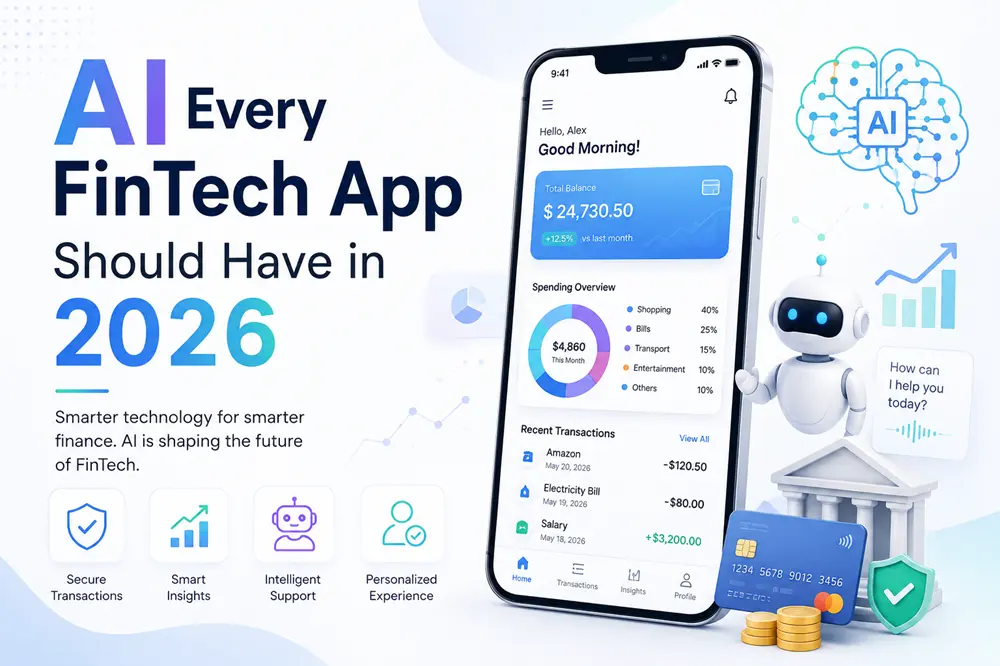
Today, artificial intelligence is among the most significant technologies in the fintech industry. With the ongoing development of digital banking, online payments, and financial management systems, customers increasingly demand faster, more intelligent, and customized interactions with technology. Classical fintech apps fail to meet the needs of modern customers, who require something more than regular applications. Fintech firms should implement advanced intelligent solutions capable of analysing information, automating certain operations, providing enhanced security measures, and producing valuable financial insights. By 2026, artificial intelligence will be no longer just an additional function in fintech applications; instead, AI will be an integral part of these apps. The use of AI in finance helps organizations develop more efficient and user-friendly applications for various operations related to finances, such as detecting fraud, supporting customers, calculating credit scores, or managing investments.
Why AI Is Reshaping the FinTech Industry
The fintech industry produces huge volumes of financial data on a daily basis. Efficient management, analysis, and application of these data require sophisticated technology. AI facilitates processing of big data sets by organizations in real-time and deriving useful insights from these processes. Organizations leverage the power of AI to automate certain procedures, improve customer relations, and detect potential issues to mitigate their impact. With the rapid growth of digital payments across the globe, AI enables fintech firms to provide convenient and personalized services. Companies' need to improve both customer experience and operational processes is encouraging them to implement AI-powered solutions. Failure to embrace AI-based innovations will result in fintech businesses unable to compete with rivals that provide more efficient services.
AI-Powered Fraud Detection and Prevention
Nevertheless, fraudulent activity is still one of the greatest problems in the financial sector. Cyber criminals keep on inventing different ways to exploit weaknesses of digital payment systems and banking software. AI-based fraud detection mechanisms aid fintech firms to discover any unusual patterns in real time by conducting analysis of the transaction and behavioural data. In contrast to traditional security solutions, which use pre-established rule sets, AI systems learn and adapt based on new incoming data. Consequently, fintech applications get a possibility to detect any fraudulent transactions early and protect themselves from financial loss. While manually scanning millions of operations can be rather challenging, artificial intelligence manages this task easily and successfully.
For more: How to Build Fintech Software with the Right Development Company
Personalized Financial Recommendations
In today’s world, consumers look for personalizing financial services. Artificial intelligence is capable of helping in the customization of such services by analysing spending patterns, income levels, savings targets, and other behaviours. Financial technology products can make use of this data to offer personalizing advice to customers in order to make their decisions more efficient. Examples of advice include ways of avoiding unneeded expenses, enhancing savings, and discovering investments. Personalizing offers will boost engagement from users since they are getting tailored advice and not just any kind of suggestion. The bond that will be created with the users will lead to greater loyalty to the platform. With the rising competition in the fintech industry, this could give companies a huge competitive edge.
Intelligent Chatbots and Virtual Assistants
Customer support is an integral component of all fintech applications. Customers are always in need of fast replies when they want to get information on their transactions, account balance, loan application, and investment opportunities. The use of artificial intelligence for chatbots and virtual assistants enables customers to get immediate support without waiting for human employees to reply to them. Artificial intelligence systems are capable of comprehending natural language as well as answering users' queries. Furthermore, the most sophisticated virtual assistants can offer financial counselling, set up payment schedules, and send personalized messages with account balance notifications. The implementation of artificial intelligence will enable fintech companies to save money and satisfy their customers better. In 2026, AI-enabled customer service support is expected to become a standard feature in fintech applications.
For more: Which Features Make Fintech Software Successful?
Predictive Analytics for Financial Planning
The use of predictive analytics is one of the most significant uses of AI technology in fintech. The ability to make use of past data to identify future trends will allow AI algorithms to help make predictions on future financial performance, which can be very useful in making plans. Users can benefit greatly from the predictive powers of fintech apps, since they are able to make predictions on future expenditure and give tips on how to achieve their financial goals. In addition, predictive analytics plays an important role in assisting businesses understand the behaviour of customers and trends in the market.
AI-Based Credit Scoring Systems
However, traditional methods for credit scoring usually depend on scarce financial data, thus limiting some people from accessing financial products. Credit scoring using artificial intelligence helps to create a more thorough analysis of multiple data sets, such as transactions, spending patterns, and behaviours of a person. This enables one to have a better understanding of the financial reliability of the client. For fintech firms, AI provides a more effective method of assessing risks, approving loan applications quickly, and reducing defaults. Moreover, the application of AI in credit scoring increases financial inclusion since AI will make loans accessible even to individuals without extensive credit histories.
Automated KYC Verification
KYC is a crucial aspect for any company that deals with financial technology products. The traditional process of verifying customers' identity may take up too much time and cause discomfort among users. By using artificial intelligence for the purpose of KYC verification, fintech firms will be able to automate their verification processes by using such techniques as face recognition and biometric identification. Fintech applications can verify the identity of a user in no time and prevent cases of fraud. Moreover, the process of KYC verification allows users to open their accounts in fintech apps more easily and quickly. On the other hand, companies will be able to comply with all relevant regulations without putting extra effort into it.
AI for Anti-Money Laundering Compliance
One of the most challenging tasks in the context of AML compliance for financial institutions is the difficulty in monitoring large numbers of transactions due to the complexity involved. Using artificial intelligence technology will allow companies within the fintech sector to improve their AML initiatives by spotting any kind of irregularities and abnormal transactions. Machine learning algorithms are used constantly to analyse large sets of data related to financial dealings to spot any behaviour that might be associated with illegal actions like money laundering. Using such solutions will assist organizations to deal with possible risks immediately without having to encounter a lot of false alerts which could consume unnecessary time and effort.
Voice Banking and Conversational AI
The use of voice technology has revolutionized interaction with banking services. Through the application of artificial intelligence, it is possible for customers to undertake different banking activities using voice commands alone. The voice command system enables users to inquire about their account balance, fund transfers, review of recent transactions, and even financial news. In essence, the technology has enhanced the usability and accessibility of banking systems. As the capability of natural language processing improves, voice assistants will be able to offer a wide range of financial services in an efficient manner. With conversational AI being integrated into fintech applications, the management of personal finance becomes a simple activity for end users.
Behavioural Biometrics for Enhanced Security
Old-fashioned authentication methods like passwords and PINs are losing their effectiveness when it comes to modern threats. The use of behavioural biometrics provides an extra layer of security based on analysis of users' interaction with devices. By analysing variables such as speed of typing, interactions with touchscreens, patterns of navigation and other variables related to using devices, an AI program can create a distinctive profile of the user. Whenever something suspicious happens, the software will raise an alarm to prevent any unwanted access. The good thing about behavioural biometrics is that it operates in the background without interfering with the work of the user.
Smart Expense Tracking and Budgeting
Personal finance management is often difficult, especially for users with different streams of income and expenses. Expense tracking services with the use of artificial intelligence will help users control their finances in a much more efficient manner, as they will sort out all the transactions made and detect patterns of spending. Users will immediately get information about how their money is spent and advice on how to change their financial behaviour. Budgeting algorithms will be useful in setting financial goals that users might strive to achieve. Through this feature, artificial intelligence provides fintech apps with more value for users and encourages them to stick around longer.
AI-Powered Investment Management
AI is being used more frequently by investment platforms to help manage portfolios and make better investment decisions. AI can interpret market information, predict future trends, and suggest personalized investments for individuals based on their risk capacity and financial objectives. This technology helps make well-informed investment decisions while having no prior knowledge about finance. Furthermore, AI-enabled investment applications can always keep track of the portfolios of users and give suggestions in case changes occur in the market. In light of the growing demand for investment facilities, intelligent investment facilities have become an integral part of fintech solutions.
Real-Time Transaction Monitoring
Real-time visibility for consumers' finances is expected during transactions with payments in a digital format and online banking services. Transaction monitoring systems using AI send alerts in case any significant activity happens on the user's account. Large transactions, suspicious transactions, confirmation of payments, and changes in an account can trigger the alerting system to notify a customer instantly. Real-time monitoring contributes to increased visibility in customers' accounts, which allows them to take timely actions against possible security threats. Additionally, real-time visibility enables customers to feel confident because they can control their personal data.
Automated Loan Approval Systems
The conventional loan approval process is usually associated with heavy paperwork and long wait times. The use of AI in the loan process has made the whole process faster and more efficient through automation. With the help of AI, fintech firms can easily assess their applicants in minutes instead of days using financial data. This makes the whole process cheaper and more efficient since there is less room for errors due to human inefficiencies. Fintech companies will rely on AI loan approval systems with the rising demand for digital lending systems.
Benefits of Integrating AI Into FinTech Apps
The application of AI in the industry presents many benefits to both fintech organizations and their customers. It increases safety, boosts personalization, cuts expenses on operations, and facilitates quick decision making. Organizations can analyse big volumes of information efficiently and offer a better experience to their customers. Customers get tailored advice, rapid support, and gain valuable knowledge to make smart choices. Moreover, the use of AI simplifies compliance with regulation and risk management. With increasing competitiveness in the fintech market, companies should pay attention to artificial intelligence.
Future Trends in AI-Powered FinTech Applications
Future of Fintech will be dominated by further advancements in AI. Innovations like Generative AI, Autonomous financial advisors, and hyper-personalization of banking experience are some of the key areas which will dominate the scene for coming years. There will be a continuous investment by financial organizations in intelligent systems that can help them operate efficiently, securely, and engage customers effectively. These intelligent systems will take over every aspect of fintech operations including financing, investments, and customer support. Companies which embrace innovations earlier will stay ahead of the competition.
Conclusion
AI is already gaining popularity as one of the most crucial building blocks of contemporary fintech solutions. Such features as fraud detection, predictions, chatbots powered by artificial intelligence, automation of compliance procedures, personalized financial advice, and cybersecurity enabled by artificial intelligence technology are revolutionizing the delivery of financial services. In order to be competitive, fintech companies need to adopt innovations in the field of AI and leverage them to streamline operations and create outstanding customer experiences.
Businesses that utilize artificial intelligence now will be ready for the challenges of tomorrow. Regardless of whether you are working on a digital banking solution, a payment system, a lending application, or another type of fintech service, incorporating the power of AI into it will have a significant impact on its performance. Our specialists at Dinoustech help businesses craft groundbreaking fintech products with innovative AI capabilities, allowing them to offer more efficient and smarter financial services.