How to Build a Cryptocurrency Exchange App Like Binance or Coinbase in 2026
Binance and Coinbase show what a modern crypto platform looks like: fast sign-up, verified accounts, live charts, instant trades, secure wallets and support that never sleeps. Many founders, fintech companies and trading businesses now want the same thing for their own market. This guide explains how to build a cryptocurrency exchange app like Binance or Coinbase, step by step. It covers exchange types, core features, the trading engine, wallet security, the tech stack, AI features, licensing, cost factors and a realistic timeline. It is written for teams in the USA, the UK, Europe, the UAE, Australia, Asia and anywhere else crypto is regulated.
Dinoustech is a cryptocurrency app development company that builds exchange, wallet and trading products for clients worldwide. The roadmap below is the same one we use to plan these platforms with our clients.
Key Takeaways
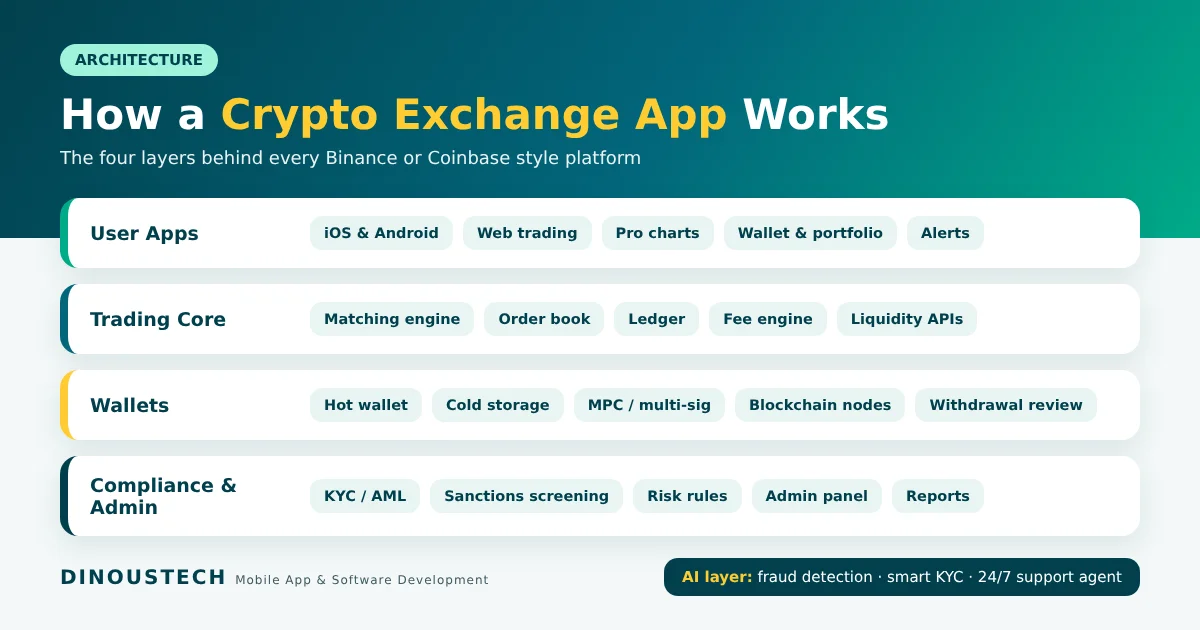
- A crypto exchange app is a full financial platform: apps for users, a matching engine, hot and cold wallets, KYC/AML, an admin panel and liquidity.
- Decide early between a centralized exchange (CEX), a decentralized exchange (DEX), a hybrid model or a white-label base.
- Licensing and the regions you serve shape almost every product decision, so plan compliance before design.
- Security is the product. Cold storage, multi-signature or MPC wallets, audits and monitoring are not optional.
- Start with a focused MVP (spot trading, a short list of coins, one or two regions) and add futures, staking or P2P later.
- AI now helps with faster development, fraud detection, smart alerts and 24/7 support agents.
Table of Contents
- What Is a Cryptocurrency Exchange App?
- Why Build a Crypto Exchange App Like Binance or Coinbase?
- Types of Crypto Exchanges You Can Build
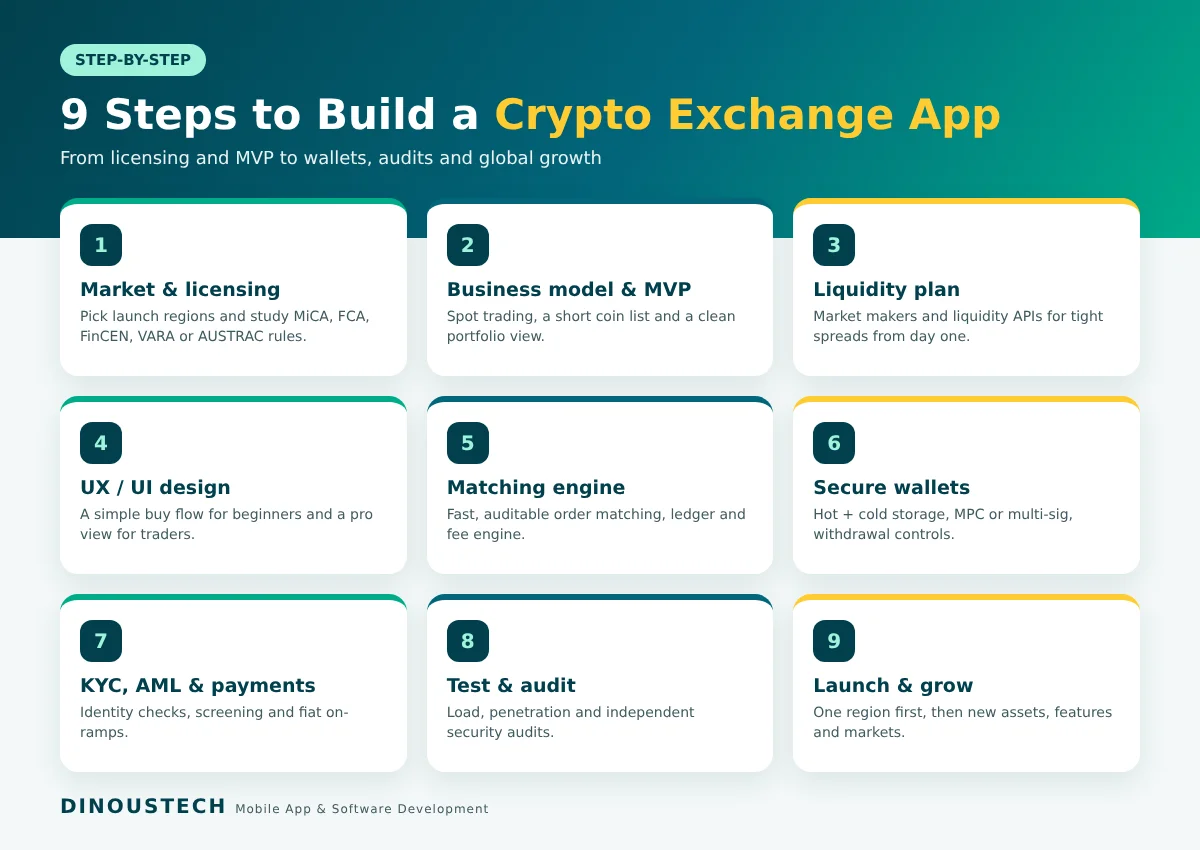
- How to Build a Cryptocurrency Exchange App: 9 Steps
- Must-Have Features for Users and Admins
- Tech Stack for a Crypto Exchange
- How Dinoustech Uses AI in Crypto Exchange Development
- How Crypto Exchanges Make Money
- Security, Licensing and Compliance
- Crypto Exchange App Development Cost Factors
- Development Timeline
- Common Challenges and How to Solve Them
- Why Choose Dinoustech
- FAQs
What Is a Cryptocurrency Exchange App?
A cryptocurrency exchange app is a mobile and web platform where users buy, sell and swap digital assets such as Bitcoin, Ethereum and stablecoins. Behind the simple "Buy" button sits a lot of technology: identity checks, a fiat on-ramp, an order book, a matching engine that pairs buyers and sellers in milliseconds, wallets that hold user funds, risk controls and reporting for regulators.
Apps like Coinbase focus on a clean, beginner-friendly buying experience. Apps like Binance add advanced charts, many trading pairs, futures, earn products and a large marketplace. Your own app can sit anywhere between the two, depending on your audience.
Why Build a Crypto Exchange App Like Binance or Coinbase?
Digital assets are now part of mainstream finance. Banks, brokers and payment companies are adding crypto features, and more countries now have clear licensing rules for crypto service providers. That creates room for new, regulated platforms that serve a specific region, language, community or asset class better than a global giant can.
- Local focus: local currencies, local payment methods and support in local languages.
- Niche audiences: beginners, professional traders, businesses, or a single ecosystem of tokens.
- Recurring revenue: trading fees, spreads and premium tools create steady income once users trade regularly.
- Extension of an existing business: a broker, wallet or stock trading app can add crypto for existing customers.
Types of Crypto Exchanges You Can Build
1. Centralized Exchange (CEX)
The company runs the order book, holds user funds in custody and handles KYC. This is the Binance and Coinbase model. It gives the best speed and user experience, and it carries the heaviest compliance and security duties.
2. Decentralized Exchange (DEX)
Trades happen through smart contracts and users keep their own keys. There is no central custody, but smart contract audits, liquidity pools and gas fees become the main concerns.
3. Hybrid Exchange
A hybrid keeps a fast off-chain order book for the experience users expect, while settlement or custody uses on-chain or non-custodial elements for more transparency.
4. P2P Exchange
Buyers and sellers trade directly with each other using local payment methods, while the platform holds crypto in escrow and resolves disputes.
5. White-Label Exchange
A ready-made exchange core is customized with your brand, coins and features. It is faster to market, but you should check code ownership, flexibility and security before you choose it.
| Type | Custody | Best For | Main Focus |
|---|
| CEX | Platform | Mass-market and pro trading | Licensing, wallet security, liquidity |
| DEX | User | Web3-native users | Smart contract audits, liquidity pools |
| Hybrid | Mixed | Speed plus transparency | Architecture design |
| P2P | Escrow | Markets with local payment methods | Dispute handling, fraud control |
| White-label | Depends | Fast launch | Customization and code ownership |
How to Build a Cryptocurrency Exchange App: 9 Steps
Step 1: Choose Your Market and Licensing Path
Pick the countries you will serve first and study the licensing rules there, such as MiCA in the European Union, FCA registration in the UK, FinCEN and state money transmitter rules in the USA, VARA in Dubai, or AUSTRAC registration in Australia. The license often decides which coins you can list, how you hold funds and which payment partners you can use.
Step 2: Define the Business Model and MVP
Decide who your users are and what they will do on day one. A strong MVP is often spot trading for a short list of popular assets, simple buy and sell, deposits and withdrawals, and a clean portfolio view. Futures, margin, staking and launchpads come later.
Step 3: Plan Liquidity
An exchange with an empty order book loses users fast. Plan liquidity from the start through market makers, liquidity provider APIs or connections to other exchanges, so users see tight spreads from launch.
Step 4: Design the UX and UI
Design two journeys: a simple one for beginners (buy in a few taps) and a pro view with charts, order types and depth. Clear fee display, clear risk warnings and an easy KYC flow build trust.
Step 5: Build the Matching Engine and Core Backend
The matching engine is the heart of the exchange. It must be fast, consistent and fully auditable. Around it you build the order management system, ledger, user accounts, fee engine and APIs for apps and traders.
Step 6: Build Secure Wallets
Set up hot wallets for daily withdrawals and cold storage for most funds, with multi-signature or MPC key management, withdrawal limits, address whitelisting and manual review for large amounts. If you are new to wallets, our guide on how to create a digital wallet app explains the basics.
Step 7: Integrate KYC, AML and Payments
Connect identity verification, sanctions screening, blockchain analytics for risky addresses and transaction monitoring. Add fiat on-ramps such as cards, bank transfers and local payment methods. See how we approach payment gateway integration.
Step 8: Test, Audit and Harden
Run functional, load and penetration tests. Simulate traffic spikes, test the matching engine under stress and get an independent security audit. For DEX or token features, audit every smart contract.
Step 9: Launch, Monitor and Grow
Launch in your first region, watch real trading behaviour, and add assets, features and regions in planned releases. Keep 24/7 monitoring on wallets, servers and suspicious activity.
Must-Have Features for Users and Admins
User App Features
- Sign-up with email or phone, two-factor authentication and device management
- KYC verification with document and selfie checks
- Deposits and withdrawals in crypto and supported fiat currencies
- Spot trading with market, limit and stop orders
- Live price charts, order book and trade history
- Portfolio dashboard with profit and loss
- Price alerts and push notifications
- Instant buy, sell and convert for beginners
- Referral program and rewards
- In-app support, help center and dispute tickets
Admin Panel Features
- User and KYC management with approval workflows
- Coin and trading pair listing, fees and limits
- Wallet monitoring, hot/cold balances and withdrawal approvals
- AML alerts, risk rules and case management
- Liquidity and market maker settings
- Revenue, volume and user analytics
- Role-based access with audit logs for every admin action
- Content, announcements and support management
Advanced Features for Later Releases
- Futures and margin trading (only where your license allows it)
- Staking and earn products
- P2P marketplace with escrow
- Copy trading and trading bots
- Public APIs for professional traders
- Crypto debit card or merchant payments
Tech Stack for a Crypto Exchange
The right stack depends on your scale and regions, but a typical setup looks like this. For a wider view, read which technologies are used in modern fintech software development.
| Layer | Common Choices |
|---|
| Mobile apps | Flutter, React Native, or native Swift and Kotlin |
| Web app | React or Next.js with real-time charting libraries |
| Matching engine | Low-latency services in Go, Rust, C++ or Java |
| Backend services | Node.js, Go or Java microservices |
| Real-time data | WebSockets, Kafka or similar event streaming |
| Databases | PostgreSQL for the ledger, Redis for caching and order data |
| Blockchain | Full nodes or node providers, MPC or multi-sig wallet systems |
| Compliance | KYC providers, sanctions screening, blockchain analytics |
| Cloud and security | AWS, Google Cloud or Azure, WAF, DDoS protection, HSMs |
How Dinoustech Uses AI in Crypto Exchange Development
AI is now part of how we build and how the final product works. We use it in three ways.
1. AI-Assisted Development
Our engineers use AI coding assistants to write boilerplate faster, generate test cases, review code for security issues and document APIs. This shortens development cycles and leaves more time for the parts that need human judgement, such as the matching engine logic and wallet security.
2. AI Features Inside Your Exchange
- Fraud and AML detection: machine learning models flag unusual logins, account takeovers, wash trading and suspicious withdrawal patterns.
- Smart KYC: AI-based document checks, face matching and liveness detection speed up onboarding.
- Personalized alerts and insights: plain-language market summaries and portfolio notifications (information only, not financial advice).
- Risk scoring: real-time scores for transactions and wallet addresses help the compliance team focus on real risk.
3. AI Support Agent for Your Users
We can build a 24/7 AI support agent trained on your help center and policies. It answers questions about deposits, withdrawals, fees and verification in many languages, and hands complex or sensitive cases to your human team. Explore more ideas in AI features every fintech app should have.
How Crypto Exchanges Make Money
- Trading fees: maker and taker fees on every trade, often with volume-based discounts.
- Spreads: a small margin on instant buy and convert features.
- Withdrawal fees: covering network costs plus a small margin.
- Listing fees: charged to projects that want their token listed, after strict due diligence.
- Premium plans: lower fees, advanced tools or API access for active traders.
- Earn products: a share of staking rewards where regulations allow.
Security, Licensing and Compliance
Trust decides whether users deposit money with you. Build these protections from the first sprint:
- Cold storage for the majority of user funds, with multi-signature or MPC key control
- Two-factor authentication, anti-phishing codes and withdrawal address whitelists
- Encryption for data at rest and in transit, and secure key storage
- Rate limiting, DDoS protection and a web application firewall
- Regular penetration tests, code audits and bug bounty programs
- Clear records for proof of reserves and regulatory reporting
- KYC, AML, sanctions screening and the Travel Rule where it applies
- Data protection rules such as GDPR in Europe and similar laws elsewhere
We have written more on these issues in the challenges of developing banking software and their solutions. Note: this section is general information, not legal advice. Always confirm licensing and compliance needs with a qualified lawyer in each market.
Crypto Exchange App Development Cost Factors
There is no single price for a crypto exchange. The cost depends on these factors:
- Exchange type: a white-label base costs less than a custom CEX; a DEX adds smart contract and audit work.
- Feature scope: spot trading only, or also futures, margin, staking, P2P and APIs.
- Matching engine performance: the speed and volume you need to support.
- Number of coins and blockchains: each network adds wallet, node and testing work.
- Platforms: web, iOS, Android, desktop or all of them.
- Compliance and licensing: KYC/AML tools, legal work and audits differ by country.
- Security: HSMs, MPC custody, audits and penetration testing.
- Liquidity: market maker agreements and liquidity APIs.
- Ongoing costs: hosting, nodes, third-party services, support and maintenance.
For a wider fintech budget picture, see what it costs to build a fintech app in 2026, or share your scope with us for a detailed quote.
Development Timeline
Timelines depend on scope, licensing and audits. These are honest working ranges:
| Phase | Typical Duration |
|---|
| Discovery, market and licensing research | 2 to 4 weeks |
| UX/UI design | 3 to 6 weeks |
| Core backend, matching engine and wallets | 8 to 16 weeks |
| Mobile and web apps | 8 to 14 weeks (in parallel) |
| KYC, payments and liquidity integrations | 3 to 6 weeks |
| Testing and security audit | 4 to 8 weeks |
| Launch and stabilization | 2 to 4 weeks |
A white-label MVP can launch in a few months. A custom exchange with advanced features usually takes six months to a year or more, plus the time needed for licensing.
Common Challenges and How to Solve Them
- Low liquidity at launch: sign market makers before launch and start with popular pairs only.
- Security threats: keep most funds in cold storage, limit hot wallet balances and monitor every withdrawal.
- Changing regulations: build a flexible compliance layer so rules can change by region without rewriting the app.
- Traffic spikes: use auto-scaling, load testing and a matching engine designed for peak volume.
- User trust: publish clear fees, offer fast support and share proof of reserves where possible.
Why Choose Dinoustech
Dinoustech builds secure, scalable fintech and crypto products for startups and enterprises worldwide. We cover the full journey: discovery, design, mobile and web apps, backend, wallets, integrations, testing, launch and long-term support. Our team also builds fintech app development solutions, payment apps and trading platforms, and you can see our work in our portfolio.
- Experience with trading, wallet and payment products
- Security-first architecture and code reviews
- AI-assisted development for faster delivery
- Flexible engagement: MVP, full product or dedicated team
- Support for clients across the USA, the UK, Europe, the Middle East, Australia and Asia
Ready to Build Your Crypto Exchange App?
If you are planning a crypto exchange app like Binance or Coinbase, talk to our team. We will help you choose the right exchange model, plan your MVP and map the compliance steps for your markets. Contact Dinoustech today for a free consultation, or learn more about our cryptocurrency app development services.