MLM Compensation Plans Explained: Binary, Unilevel, Matrix and How Software Automates Payouts
The compensation plan is the heart of every direct selling and network marketing business. It decides how distributors earn, how fast they grow, how much the company pays out and whether the business stays on the right side of the law. Choosing the plan is a business decision, but running it correctly every week is a software problem. This guide explains the main MLM compensation plans (unilevel, binary, matrix, stairstep breakaway and hybrid), the bonus types inside them, how each one works in practice, what MLM software must do to calculate payouts accurately and how to pick the right plan for your company. It is written for direct selling businesses worldwide, from new startups to established companies moving off spreadsheets or old systems.
Dinoustech is an MLM software development company that builds custom compensation engines, distributor back offices and e-wallets for direct selling businesses around the world. The explanations below come from the questions our clients ask most when we design their plan logic.
Key Takeaways
- The five most common MLM compensation plans are unilevel, binary, matrix, stairstep breakaway and hybrid.
- Each plan is a mix of structure (how the downline is placed) and bonuses (how money is paid).
- Plans should reward real product sales to real customers, not recruitment alone, to stay compliant and sustainable.
- Good MLM software handles genealogy, volume tracking, rank qualification, carry forward, capping and payouts automatically.
- Most growing companies use a hybrid plan, which makes a flexible, configurable commission engine important.
- AI can help simulate payouts before launch, detect fraud and answer distributor questions 24/7.
Table of Contents
- What Is an MLM Compensation Plan?
- Common Bonus Types in MLM Compensation Plans
- Unilevel Plan
- Binary Plan
- Matrix (Forced Matrix) Plan
- Stairstep Breakaway Plan
- Hybrid Plan
- MLM Compensation Plans Compared
- How MLM Software Automates Compensation Plans
- How Dinoustech Uses AI in MLM Software Development
- Compliance: Keeping Your Plan Legal
- How to Choose the Right Compensation Plan
- Cost and Timeline for a Custom Compensation Engine
- Why Choose Dinoustech
- FAQs
What Is an MLM Compensation Plan?
An MLM compensation plan is the set of rules that decides how a direct selling company pays its independent distributors. It answers questions such as:
- How is a new member placed in the network (the genealogy or "tree")?
- Which sales volume counts, and for whom: personal volume (PV), group volume (GV) or leg volume?
- Which bonuses are paid, at what percentage and on how many levels?
- What are the ranks, and what does a distributor need to reach and keep each rank?
- How often are commissions paid, and are there caps or minimums?
Every plan combines a structure with a set of bonuses. The structure is the shape of the tree. The bonuses are how money flows through it.
Common Bonus Types in MLM Compensation Plans
Before comparing plans, it helps to know the building blocks that appear in almost all of them:
- Retail profit: the margin a distributor earns when selling products to customers at a retail price.
- Fast start bonus: a reward linked to the first product orders of newly sponsored members, usually for a limited period.
- Level (unilevel) commission: a percentage of sales volume from each level of the downline, up to a fixed depth.
- Binary or pairing bonus: a percentage of the volume matched between the left and right legs.
- Matching bonus: a percentage of the commissions earned by personally sponsored members (or deeper generations).
- Rank advancement bonus: a one-time reward for reaching a new rank.
- Leadership or pool bonus: a share of company volume divided among qualified top ranks.
- Customer and subscription bonuses: rewards for retail customers and repeat orders, which many modern plans now favor.
For the wider list of back office and admin features, see what features MLM software should have.
Unilevel Plan
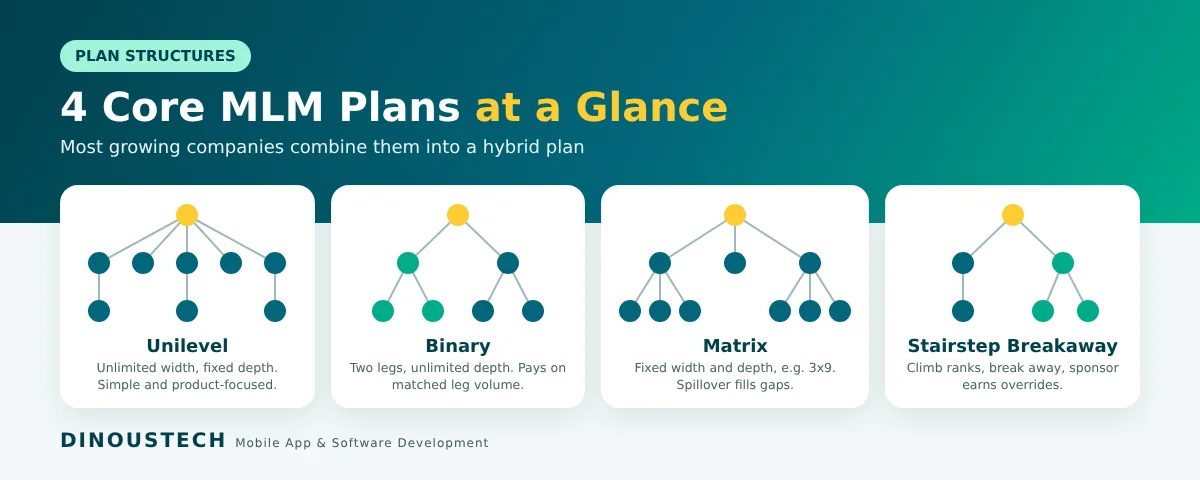
How it works: every distributor can sponsor as many people as they like on their first level (unlimited width). Commissions are paid on a fixed number of levels deep, for example five to seven levels, with a set percentage per level.
Example (illustrative only): a plan pays 5% on level one, 5% on level two and smaller percentages down to level seven. A distributor earns on product sales across all seven levels of their downline.
Pros: simple to explain, rewards personal selling and frontline support, and usually easy to calculate.
Cons: wide frontlines can leave newer members with little help, and limited depth may not reward large organizations well.
Software needs: unlimited-width genealogy, level depth settings, compression rules (skipping inactive members so active uplines still get paid) and monthly qualification checks.
Binary Plan
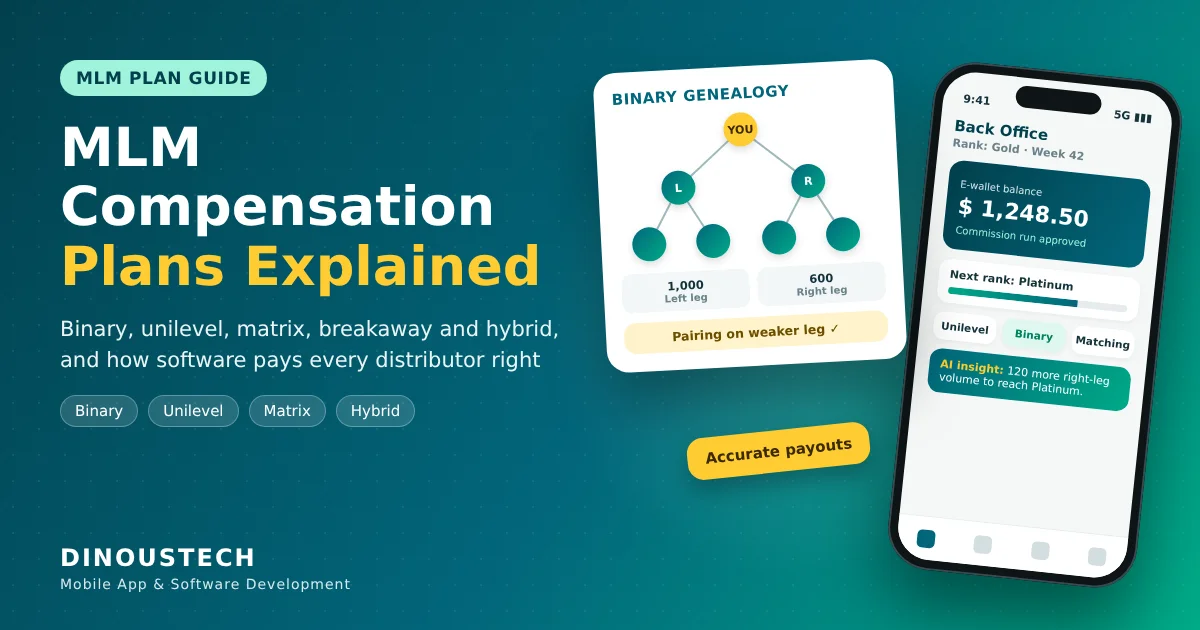
How it works: every distributor has only two positions on their first level, a left leg and a right leg. Extra recruits are placed lower in the tree, which is called spillover. Commissions are paid on the volume matched between the two legs, often based on the weaker leg.
Example (illustrative only): if the left leg has 1,000 volume and the right leg has 600 volume in a week, a plan paying 10% on the weaker leg pays on 600. The extra 400 on the left may be carried forward to the next period, depending on the rules.
Pros: encourages teamwork, spillover helps new members, and unlimited depth suits fast-growing teams.
Cons: leg balancing can frustrate distributors, and payout risk must be controlled with caps and flush-out rules.
Software needs: left/right placement logic (manual, auto or extreme-left/right), carry forward, pairing ratios such as 1:1 or 1:2, daily or weekly capping, flush-out and real-time leg volume reports.
Matrix (Forced Matrix) Plan
How it works: the tree has a fixed width and a fixed depth, such as 3x9 (three people on each level, nine levels deep). When a distributor's frontline is full, new members spill over to the next open position below.
Pros: predictable structure, spillover helps newer members, and fixed size makes payout planning easier.
Cons: the fixed width can limit strong recruiters, and a full matrix may stop growth unless the plan allows re-entry or cycling.
Software needs: configurable width and depth, automatic placement (top-to-bottom, left-to-right), spillover rules and level-based payouts.
Stairstep Breakaway Plan
How it works: distributors climb a series of ranks ("steps") by reaching sales volume targets. Each step gives a higher discount or commission rate. When a distributor reaches the top step, they "break away" from their sponsor's group and form their own. The sponsor then earns an override bonus on the breakaway group's volume.
Pros: strongly rewards high performers and leaders, and has been used by direct selling companies for decades.
Cons: harder to explain to new distributors, and the rules for group volume, breakaway and overrides can be complex.
Software needs: rank tables, group volume calculations, breakaway detection, override generations and differential commissions between steps.
Hybrid Plan
How it works: a hybrid plan combines two or more structures. A common example is a binary plan for team volume plus a unilevel matching bonus, or a unilevel plan with a leadership pool. Most growing companies end up with a hybrid plan because it lets them reward both selling and leadership.
Pros: flexible and can be tuned to the company's products, margins and culture.
Cons: harder to communicate, and much harder to calculate correctly without solid software.
Software needs: a configurable commission engine that runs several bonus calculations on the same data, with clear statements so every distributor understands their earnings.
MLM Compensation Plans Compared
| Plan | Width | Depth | Best for | Calculation complexity |
|---|
| Unilevel | Unlimited | Limited | Simple, product-focused businesses | Low to medium |
| Binary | Two legs | Unlimited | Team-building and fast growth | Medium to high |
| Matrix | Fixed | Fixed | Predictable, structured growth | Medium |
| Stairstep breakaway | Unlimited | Varies by rank | Leadership-driven organizations | High |
| Hybrid | Depends on mix | Depends on mix | Growing and established companies | High |
How MLM Software Automates Compensation Plans
Calculating commissions by hand or in spreadsheets causes payout errors, late payments and lost trust. A proper commission engine takes care of the full cycle:
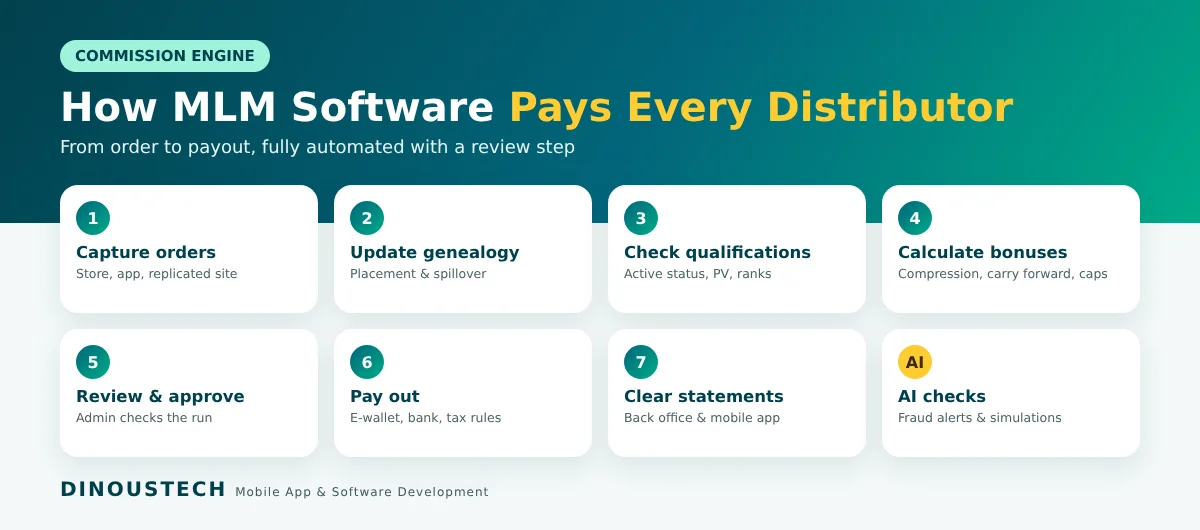
- Capture orders and volume from the replicated website, ecommerce store, mobile app or admin.
- Update the genealogy with placement, spillover and sponsor changes.
- Check qualifications such as active status, personal volume and rank rules.
- Run the commission calculations for every bonus type in the plan, with compression, carry forward and caps.
- Review and approve the commission run in the admin panel before money moves.
- Pay out to e-wallets, bank accounts or payment providers, with tax and deduction rules.
- Show clear statements in the distributor back office and mobile app.
Other features that matter for compensation: a plan simulator, adjustment and refund handling (clawbacks), multi-currency and multi-country support, KYC checks and complete audit logs. Payment and wallet features overlap with fintech app development, which is why we design them with the same security standards. For the full build process, read our step-by-step guide to building MLM software and how we approach distributor management.
How Dinoustech Uses AI in MLM Software Development
AI-assisted development
Our team uses AI coding assistants to speed up repetitive code, generate test cases for commission rules and review code. For compensation engines this matters a lot: AI helps us create many edge-case tests (inactive members, refunds, rank drops, carry forward) so payouts are checked before they go live.
AI features inside your MLM software
- Plan simulation: model different growth and sales scenarios to see payout percentages before you launch or change a plan.
- Fraud detection: flag fake accounts, self-purchases to hit volume targets and suspicious payout patterns.
- Smart insights for distributors: "You need 120 more volume in your right leg to reach your next rank."
- Churn prediction: spot customers and distributors who are likely to become inactive so leaders can help them in time.
Read more in how AI can automate MLM business management.
AI support agent for our clients
After launch, our clients get an AI-powered support agent that answers common questions, tracks issues and passes complex ones to our engineers. We can also add an AI assistant inside your back office so distributors get instant answers about orders, ranks and commissions.
Compliance: Keeping Your Plan Legal
Regulators in many countries separate legitimate direct selling from illegal pyramid schemes. A key question is whether rewards come mainly from real product sales to real customers or mainly from recruiting new members. In the USA, the FTC has published business guidance on multi-level marketing, and in the European Union, pyramid promotional schemes are banned under consumer protection law. Other countries, including the UK, Canada, Australia, the UAE and India, have their own rules.
Your software can support compliance by:
- Tracking retail customer sales separately from distributor purchases.
- Not paying commissions on sign-up fees alone.
- Supporting refund and buy-back policies with automatic clawbacks.
- Storing income disclosures, terms and consent records.
- Keeping full audit logs of every commission run and adjustment.
Dinoustech does not build recruitment-only, "gifting" or money-circulation schemes. This section is general information, not legal advice. Please have your plan reviewed by a lawyer who specializes in direct selling.
How to Choose the Right Compensation Plan
- Start with your product and margins: consumable products with repeat orders support different payouts than one-time purchases.
- Think about your distributors: part-time sellers often prefer simple plans; leadership-driven teams may want breakaway or hybrid plans.
- Set a target payout percentage and test it with a simulator before launch.
- Keep it explainable: if a new distributor cannot understand the plan in a few minutes, it may hurt sign-ups and trust.
- Plan for change: choose software that lets you adjust percentages, ranks and bonuses without rebuilding.
Before you pick a vendor, read our list of common mistakes when choosing an MLM software company.
Cost and Timeline for a Custom Compensation Engine
The cost depends on the plan type, the number of bonuses, ranks and countries, payout integrations, mobile apps and how much reporting you need. A single unilevel plan with a basic back office costs far less than a hybrid plan with multiple currencies and an e-wallet. Our detailed MLM software development cost guide explains the factors.
| Scope | Typical timeline |
|---|
| Single-plan MVP (one structure, core bonuses, back office, admin) | 2 to 4 months |
| Hybrid plan with e-wallet, replicated sites and mobile app | 4 to 7 months |
| Multi-country platform with advanced reporting and AI features | 6 to 12 months |
For more detail, see how long it takes to develop MLM software.
Why Choose Dinoustech
- Every major plan: unilevel, binary, matrix, stairstep breakaway, party plan and custom hybrids.
- Configurable engine: change percentages, ranks and rules from the admin panel.
- Accurate payouts: automated tests for edge cases and a review step before every commission run.
- Full platform: back office, replicated websites, ecommerce, e-wallet and mobile apps.
- Worldwide clients: multi-language and multi-currency support.
Explore our projects on the Dinoustech portfolio.
Turn Your Compensation Plan into Reliable Software
A great plan only works when every distributor is paid correctly and on time. Talk to our MLM software development team about your plan, or contact Dinoustech for a free consultation and a clear estimate.