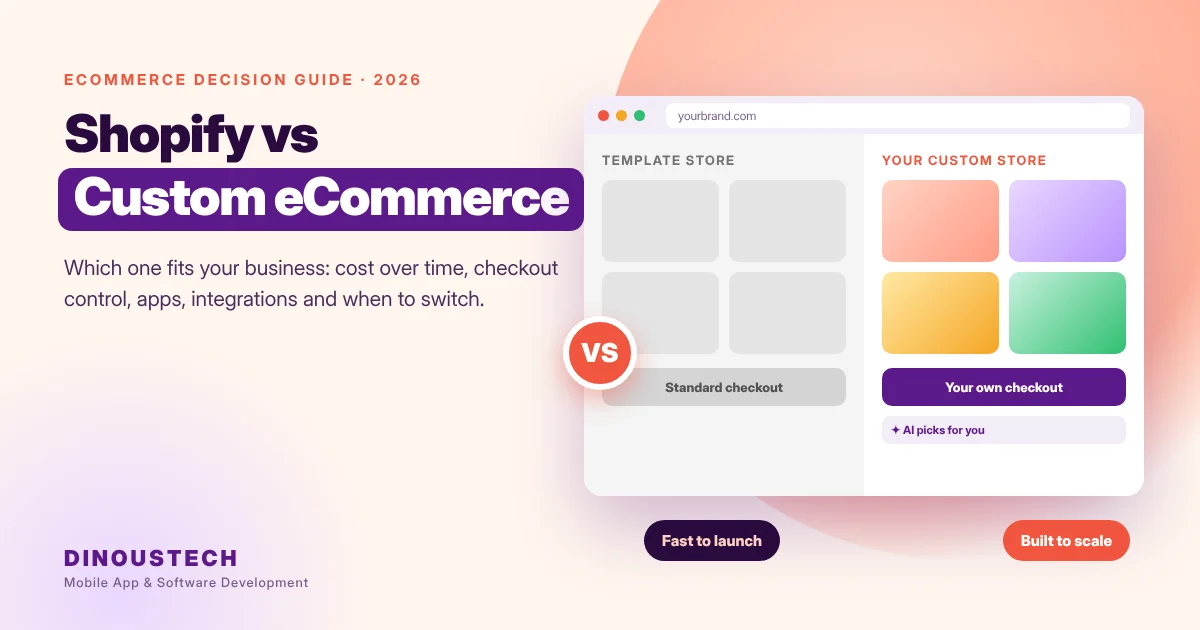
Shopify vs Custom eCommerce Development: Which Is Right for Your Business in 2026?
Every online brand reaches the same fork in the road: launch on a hosted platform such as Shopify, or invest in a custom eCommerce website and app that you own completely. Both paths can work. Both can also become expensive mistakes when they are chosen for the wrong stage of the business. This guide compares Shopify vs custom eCommerce development in plain terms: cost over time, speed to launch, flexibility, performance, integrations, ownership and scale. It is written for founders, D2C brands, retailers and B2B sellers worldwide, from the USA, UK and Europe to the UAE and Australia, who want to make the decision once and make it well.
Dinoustech is an eCommerce web and app development company that builds custom stores, marketplaces and shopping apps, and also helps brands decide when a hosted platform is the smarter first step. The comparison below reflects the questions our clients ask before they commit budget.
Key Takeaways
- Shopify is usually the faster and cheaper way to launch a simple store with a standard catalogue and checkout.
- Custom eCommerce development costs more up front but removes platform limits, per-sale platform fees and dependence on paid plugins.
- The real comparison is total cost of ownership over three to five years, not the first month's bill.
- Custom builds win when you need unique checkout flows, B2B pricing, multi-vendor marketplaces, complex integrations or a native mobile app.
- Many brands follow a hybrid path: start on a hosted platform, then move to custom or headless commerce once growth exposes the limits.
- AI features such as personalised recommendations, smart search and support agents are easier to shape around your data on a custom stack.
Table of Contents
- Shopify vs Custom eCommerce: The Short Answer
- What Shopify Gives You
- What Custom eCommerce Development Means
- Side-by-Side Comparison
- Cost: Subscription Fees vs Ownership
- Flexibility, Checkout and Customer Experience
- Performance, SEO and Mobile Apps
- Integrations and Business Logic
- When Shopify Is the Right Choice
- When Custom Development Is the Right Choice
- The Middle Path: Headless Commerce and Phased Migration
- How Dinoustech Uses AI in eCommerce Development
- How to Decide: A Simple Checklist
- Timeline for a Custom eCommerce Build
- Why Choose Dinoustech
- FAQs
Shopify vs Custom eCommerce: The Short Answer
If you are testing a product idea, selling a modest catalogue and need to go live in weeks, Shopify is a sensible start. You pay a monthly subscription, pick a theme, add apps and you are selling.
If your business model does not fit a standard store, if platform and app fees are growing faster than your margin, or if you need full control over checkout, data and mobile experience, custom eCommerce development is the better long-term investment. You pay more at the start, but you own the code, the roadmap and the customer experience.
The rest of this guide explains where that line falls for your business.
What Shopify Gives You
Shopify is a hosted (SaaS) commerce platform. The company runs the servers, security patches and core checkout, and you rent access to them. Out of the box you get:
- Ready-made themes and a visual editor for pages and products.
- Product, inventory and order management in one admin.
- A hosted checkout with its own payment option and support for other gateways.
- An app store with thousands of add-ons for reviews, subscriptions, loyalty, email and more.
- Hosting, SSL and basic uptime handled for you.
The trade-off is that you work inside Shopify's rules. Checkout customisation is limited on standard plans, data structures are fixed, and most advanced features come from third-party apps with their own monthly fees. Shopify also adds a transaction fee when you use an external payment gateway instead of its own payments service on many plans, so always check the current pricing page before you plan your margins.
What Custom eCommerce Development Means
A custom eCommerce platform is built for your business and owned by your business. A development partner designs the storefront, backend, admin panel and integrations around your products, customers and operations. A typical custom build includes:
- A fast, branded storefront (web, and optionally native iOS and Android apps).
- A product catalogue modelled on your real data: variants, bundles, configurators, B2B price lists or rental terms.
- A checkout designed for your buyers, with the payment gateways, wallets and buy-now-pay-later options your markets use.
- An admin panel with the reports, roles and workflows your team actually needs.
- Direct integrations with your ERP, CRM, warehouse, shipping carriers and accounting tools.
You can see how this works in practice in our guide to building a custom eCommerce website, which walks through the full development process.
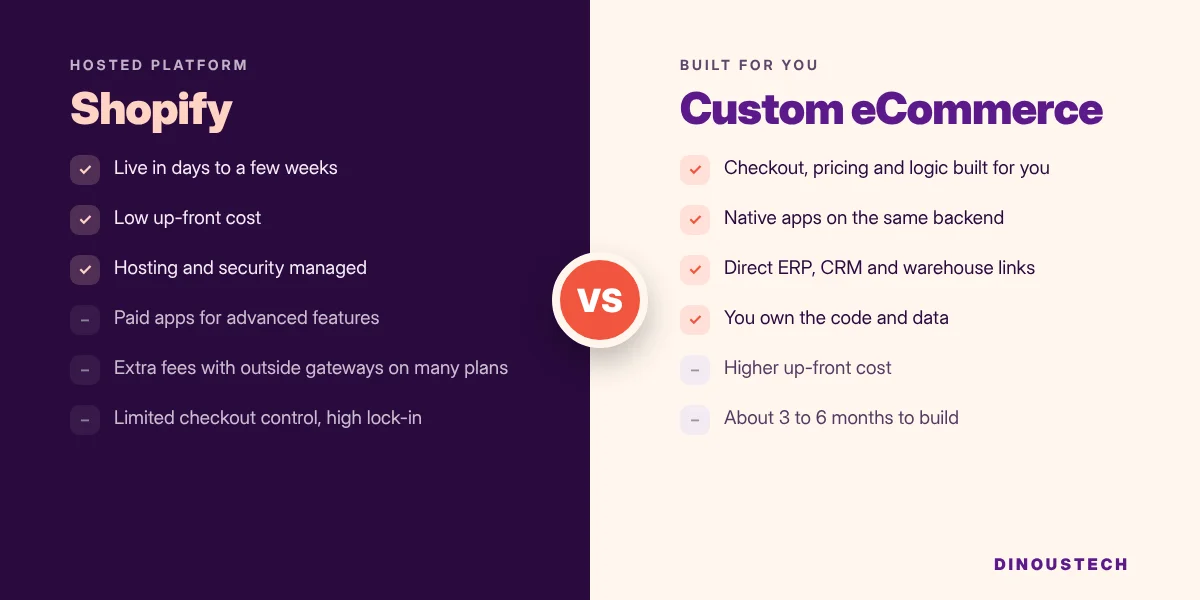
Side-by-Side Comparison
| Factor | Shopify | Custom eCommerce Development |
|---|
| Time to launch | Days to a few weeks | Roughly 3 to 6 months for a full build |
| Up-front cost | Low (theme plus setup) | Higher (design, development, testing) |
| Ongoing cost | Monthly plan, paid apps, possible transaction fees | Hosting, maintenance and new features |
| Checkout control | Limited on standard plans | Fully customisable |
| Data ownership | Stored on the platform, exported via its tools | Your database, your rules |
| Business logic | Fits standard retail; complex rules need apps or workarounds | Built around your exact model |
| Native mobile app | Through third-party app builders | Built natively on the same backend |
| Performance | Good, but themes and many apps can slow pages | Optimised for your pages and traffic |
| Vendor lock-in | High: themes and apps do not move with you | Low: you own the code |
Cost: Subscription Fees vs Ownership
Comparing cost by the first invoice is the most common mistake. A fair comparison looks at three to five years.
Shopify cost components
- Monthly plan fee, which rises as you move to higher tiers.
- Premium theme and customisation by a developer.
- App subscriptions: reviews, subscriptions, upsells, search, loyalty, B2B pricing, multi-currency tools. Ten apps at modest monthly fees add up quickly.
- Payment processing fees, plus platform transaction fees if you use an outside gateway on many plans.
Custom eCommerce cost components
- One-time design and development, priced by scope.
- Cloud hosting that scales with traffic.
- Maintenance, security updates and new features, usually on a monthly retainer.
- Payment processing fees from your chosen gateway, with no extra platform layer on top.
As revenue grows, percentage-based fees and app subscriptions grow with it, while the cost of owning custom software stays far more stable. That is why the break-even point depends on your order volume, average order value and how many paid apps you rely on. For a deeper breakdown of build costs, read how much it costs to build an eCommerce app and our tips on optimising eCommerce development costs.
Flexibility, Checkout and Customer Experience
Checkout is where revenue is won or lost. On a hosted platform, the checkout is largely the same for every store, which is safe but rarely distinctive. A custom build lets you:
- Design one-page or step-by-step checkout based on your own conversion data.
- Offer local payment methods, wallets and instalment options for each country you sell in.
- Add custom fields such as delivery slots, gift notes, prescriptions, trade account numbers or installation booking.
- Build product configurators, bundles and subscription rules that would otherwise need several apps.
- Show different prices, catalogues and payment terms to B2B and retail customers.
If your offer is standard, Shopify's checkout is good enough. If your offer is your competitive edge, it should not be squeezed into a template.
Performance, SEO and Mobile Apps
Page speed affects both conversions and search rankings. A well-built Shopify store can be fast, but heavy themes and stacked apps often load extra scripts on every page. A custom storefront loads only what each page needs, and modern frameworks can render pages on the server for faster first loads and cleaner SEO.
Mobile is the other big difference. Shoppers increasingly buy inside apps, where push notifications, saved payment details and personalised feeds drive repeat orders. With Shopify, a mobile app usually comes from a third-party builder with its own fees and limits. With a custom backend, native iOS and Android apps share the same APIs, inventory and customer accounts as the website. Our mobile app development team builds these apps on the same backend as the store, and we explain the business case in why retail businesses need a custom eCommerce mobile app.
Integrations and Business Logic
As a brand grows, the store becomes one part of a larger system. Orders flow to the warehouse, invoices to accounting, customers to the CRM and stock levels back from suppliers. On Shopify, these connections usually run through apps or middleware, each with its own cost and failure points.
A custom platform connects directly to your systems through APIs. That matters when you need:
- Real-time stock sync across several warehouses or physical stores.
- ERP integration for pricing, tax and invoicing.
- Multi-vendor marketplace logic with seller onboarding, commissions and payouts.
- Rental, booking or pay-per-use models.
- Region-specific tax, invoicing and data rules in several countries.
Payment integration is a good example. Our guide on integrating a payment gateway explains how custom builds connect directly to providers without an extra platform layer.
When Shopify Is the Right Choice
- You are validating a new product and need to launch fast.
- Your catalogue is small to medium with standard variants.
- Your budget is limited and you do not yet know your conversion data.
- You do not need a native mobile app, B2B pricing or complex integrations yet.
- Your team prefers a fully managed tool and has no technical staff.
When Custom Development Is the Right Choice
- Platform fees and app subscriptions have become a meaningful share of your margin.
- You keep hitting limits in checkout, product structure or pricing rules.
- You are building a marketplace, subscription service, rental platform or B2B portal.
- You need deep ERP, warehouse or CRM integration.
- You want native mobile apps tightly linked to your store.
- You want to own your code, data and roadmap, and avoid lock-in.
Large retailers with custom stacks show where this leads. Our guide on how to make an app like Amazon shows the type of features that are only practical on a custom platform.
The Middle Path: Headless Commerce and Phased Migration
The choice is not always all or nothing. Two middle paths are popular:
Headless commerce
A headless setup keeps a commerce engine in the backend but replaces the storefront with a custom frontend and apps connected through APIs. You get design freedom and speed, but you still pay platform fees and live with some backend limits.
Phased migration
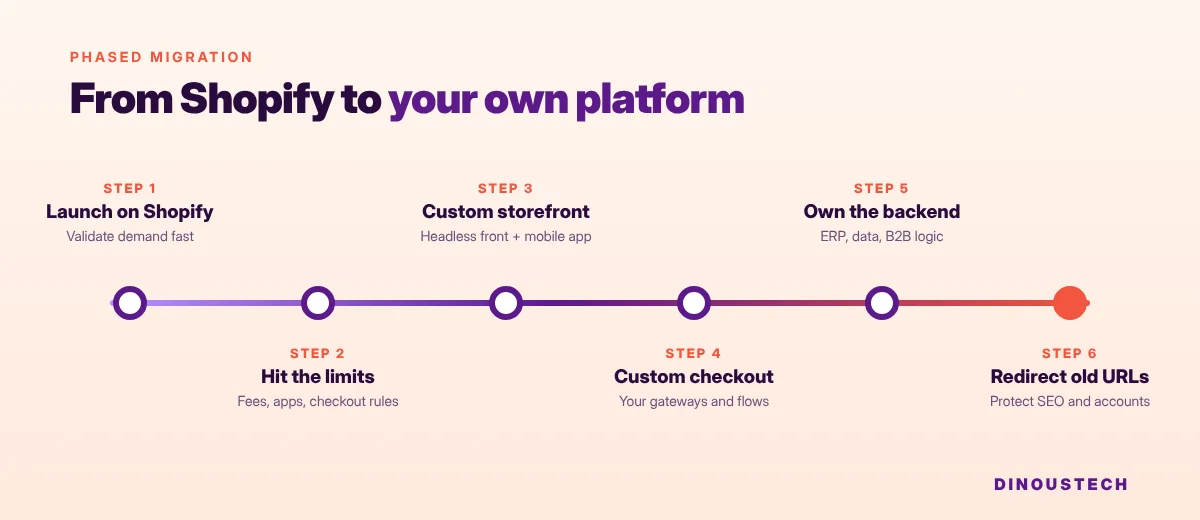
Many brands start on Shopify, prove demand, then move to a custom platform in stages: first the storefront and mobile app, then checkout, then the backend. Done carefully, with redirects for every old URL and a clean data migration, this protects SEO rankings and customer accounts during the switch.
How Dinoustech Uses AI in eCommerce Development
AI is now part of how we build and what we build. On custom eCommerce projects, it shows up in three ways.
AI-assisted development
Our engineers use AI coding assistants to speed up repetitive work such as data models, API scaffolding, test cases and code reviews. Senior developers review every change, so speed improves without lowering quality. This helps keep timelines and budgets realistic for custom builds.
AI features inside your store and app
- Personalised recommendations based on browsing and purchase history.
- Smart search that understands natural language, typos and synonyms.
- Dynamic merchandising that reorders collections based on what converts.
- Demand forecasting to plan stock and reduce out-of-stock days.
- Fraud screening that flags risky orders before they ship.
- AI-written product descriptions drafted for your team to review and approve.
On a custom stack these features use your own data, rules and branding, instead of a generic app that every competitor can install.
AI support agent for your customers and team
We can add an AI support agent that answers order status, returns and product questions around the clock, and hands complex cases to a human. For our clients, we also use AI support tools to answer questions about project progress and handle routine requests faster after launch.
How to Decide: A Simple Checklist
Answer these questions honestly:
- How much do you pay each year in platform fees, apps and transaction fees, and how fast is that growing?
- How many important features rely on workarounds or several apps working together?
- Do you need a native mobile app in the next 12 months?
- Does your model include B2B, marketplace, subscription or rental logic?
- Which systems (ERP, CRM, warehouse) must connect in real time?
- How important is owning your code and data to your investors or future exit?
If most answers point to limits and growing costs, it is time to plan a custom build. If not, stay lean on a hosted platform and revisit the question as you grow. You can also compare approaches with our post on why every retail business needs an eCommerce app.
Timeline for a Custom eCommerce Build
| Phase | What happens | Typical duration |
|---|
| Discovery and planning | Requirements, user journeys, integrations and migration plan | 2 to 3 weeks |
| UI/UX design | Wireframes, design system, storefront and checkout screens | 3 to 5 weeks |
| Development | Storefront, backend, admin, payments and integrations | 8 to 16 weeks |
| Mobile apps (optional) | iOS and Android apps on the same backend | 6 to 10 weeks, often in parallel |
| Testing and migration | QA, performance, data import, URL redirects | 2 to 4 weeks |
| Launch and support | Go-live, monitoring, improvements | Ongoing |
These are honest ranges, not promises. Scope, integrations and the number of markets you sell in all change the timeline.
Why Choose Dinoustech
- End-to-end eCommerce delivery: strategy, design, web, mobile apps, integrations and support.
- Honest advice, including telling you when a hosted platform is the better first step.
- Experience with retail, grocery, marketplace and D2C projects, which you can explore in our portfolio.
- Clean migration planning that protects your SEO, URLs and customer data.
- AI built into both our development process and the features we deliver.
- Clients across the USA, UK, Europe, the Middle East and Australia, with transparent communication and time-zone friendly updates.
Get Expert Advice on Shopify vs Custom eCommerce
Not sure which path fits your brand? Share your current setup, monthly orders and growth plans, and our team will give you a clear recommendation, including when to stay on a hosted platform and when to invest in custom. Contact Dinoustech for a free consultation on your eCommerce web and app development project.