Tarot Reading App Development: How to Build a Tarot App with AI Readings and Live Readers
Tarot has moved from paper decks and street-corner booths to the phone in your pocket. People now draw a daily card on the way to work, ask a quick question before a big decision and book a live reader from another country in a few taps. Tarot reading app development is the process of building that experience: digital card spreads, clear meanings, AI-assisted readings, live readers, payments and a safe, respectful space for users. This guide explains how to build a tarot app in 2026, from the business models that work to the features, step-by-step process, tech stack, AI, cost factors and timeline. It is written for founders, astrology brands and spiritual-wellness businesses worldwide, from the USA, UK and Europe to the UAE and Australia.
Dinoustech is an astrology app development company that builds horoscope, consultation and divination apps for clients around the world. The guidance below is based on the questions spiritual-tech founders ask us before they start a project.
Key Takeaways
- A tarot app can be a self-serve reading app, a live reader marketplace, or a hybrid of both. The model you choose shapes every other decision.
- The heart of the app is the reading experience: shuffle, spread, card reveal and a clear, well-written meaning for each card and position.
- Live readers need their own app or panel for availability, chat and call sessions, earnings and payouts.
- AI can draft personalised interpretations, power a reading chat and help with support, but it should be framed as guidance and entertainment, not as fact.
- Card artwork rights, honest disclaimers, privacy and app store rules matter as much as the code.
- Start with a focused MVP (daily card, a few spreads, a journal and one paid feature), then grow based on real usage.
What Is a Tarot Reading App?
A tarot reading app is a mobile or web application that lets users draw tarot cards digitally and read what they mean. A traditional deck has 78 cards: 22 Major Arcana cards (such as The Fool, The Lovers and The Tower) and 56 Minor Arcana cards split into four suits. A reading places cards into a "spread", where each position has its own meaning, for example past, present and future in a simple three-card spread.
A good tarot app does more than show random cards. It creates a calm ritual (shuffling, choosing, revealing), explains each card in plain language, connects the meaning to the user's question, saves readings in a journal and, in many cases, connects users with real human readers for deeper sessions. Some apps are purely self-serve; others work like a marketplace, similar to how astrology consultation apps connect users with astrologers.
Why Build a Tarot App Now
Interest in tarot, astrology and other reflective practices has grown strongly among younger, mobile-first audiences. Many users treat tarot as a tool for self-reflection, journaling and mindfulness rather than prediction, which makes it a natural fit for daily-habit apps. For a business, that daily habit is valuable: a "card of the day" notification brings users back every morning, and engaged users are far more likely to buy a premium spread or book a live reading.
Tarot is also a strong add-on for existing brands. If you already run a horoscope or astrology platform, a tarot module gives your users a new reason to open the app. If you are a well-known reader or spiritual coach with a social media following, your own app lets you own the relationship with your audience instead of depending on platform algorithms. For a wider look at the category, see our guide on must-have features for an astrology app.
Types of Tarot Apps
Before any design work, decide which kind of tarot product you are building. Most successful apps fall into one of these groups.
1. Self-Serve Reading Apps
Users draw cards and read written or AI-generated interpretations on their own. These apps focus on beautiful card art, many spreads, daily cards and a journal. Revenue usually comes from subscriptions, premium decks and in-app purchases.
2. Live Reader Marketplaces
Users browse verified readers, check ratings and pay per minute or per session for chat, voice or video readings. The platform takes a commission. This model needs a reader app, wallet, payouts and strong quality control.
3. Hybrid Apps
The most common model in 2026. Free daily cards and simple spreads bring users in, and live readers or premium AI readings convert the most engaged users into paying customers.
4. Learning and Community Apps
These help people learn tarot: card-by-card lessons, quizzes, practice readings and community discussion. They suit creators and teachers who want to sell courses.
5. Tarot Inside a Larger Astrology App
Many brands add tarot as a section inside a horoscope, kundli or birth-chart app, sharing the same user accounts, wallet and reader pool.
Designing the Reading Experience
The reading flow is where users decide whether your app feels special or cheap. Treat it as the core product, not just one screen.
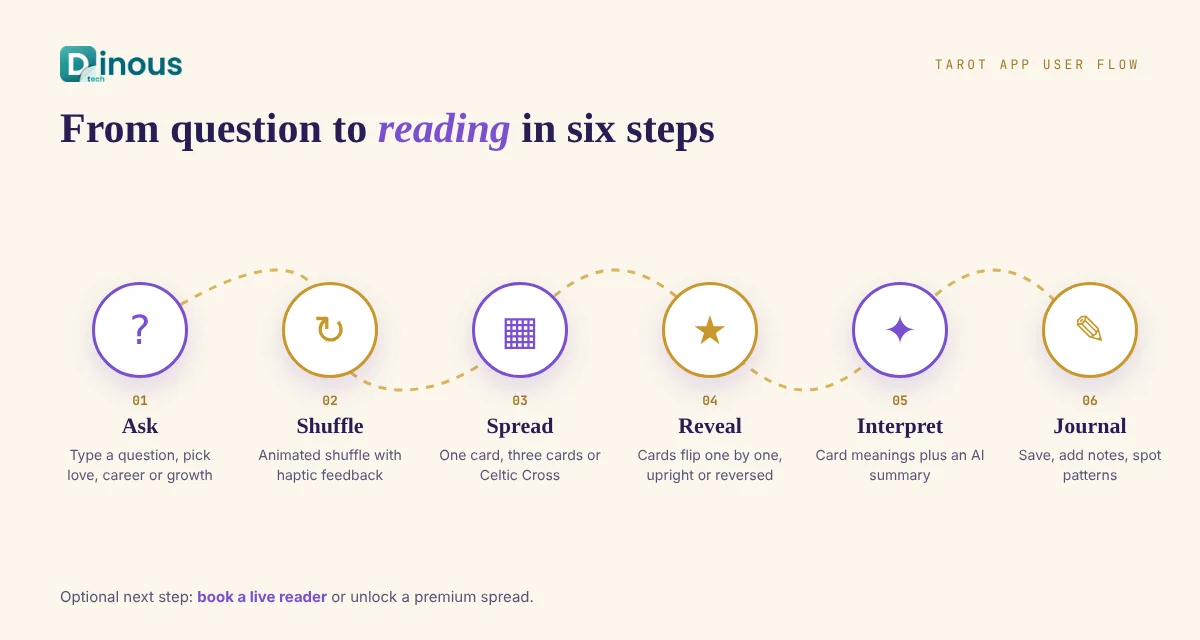
- Set the intention: let the user type or choose a question and pick a topic such as love, career, money or personal growth.
- Shuffle and cut: a short, satisfying shuffle animation with haptic feedback. Keep it skippable for regular users.
- Choose the spread: one card, three cards (past, present, future), relationship spreads, the Celtic Cross and custom spreads.
- Reveal: cards flip one at a time, with upright and reversed meanings if your reading style uses reversals.
- Interpret: a short summary first, then a meaning for each card in its position, then how the cards relate to each other.
- Save and reflect: save the reading to a journal, add notes and look back at patterns over weeks or months.
- Next step: offer a deeper premium reading or a live reader, without pushing too hard.
Use a secure random number generator for card draws so readings cannot be predicted or repeated by mistake. Write the card meanings carefully, in a warm and clear voice, and have them reviewed by an experienced reader. Good content is one of the biggest differences between a tarot app people love and one they delete.
Key Features: User, Reader and Admin
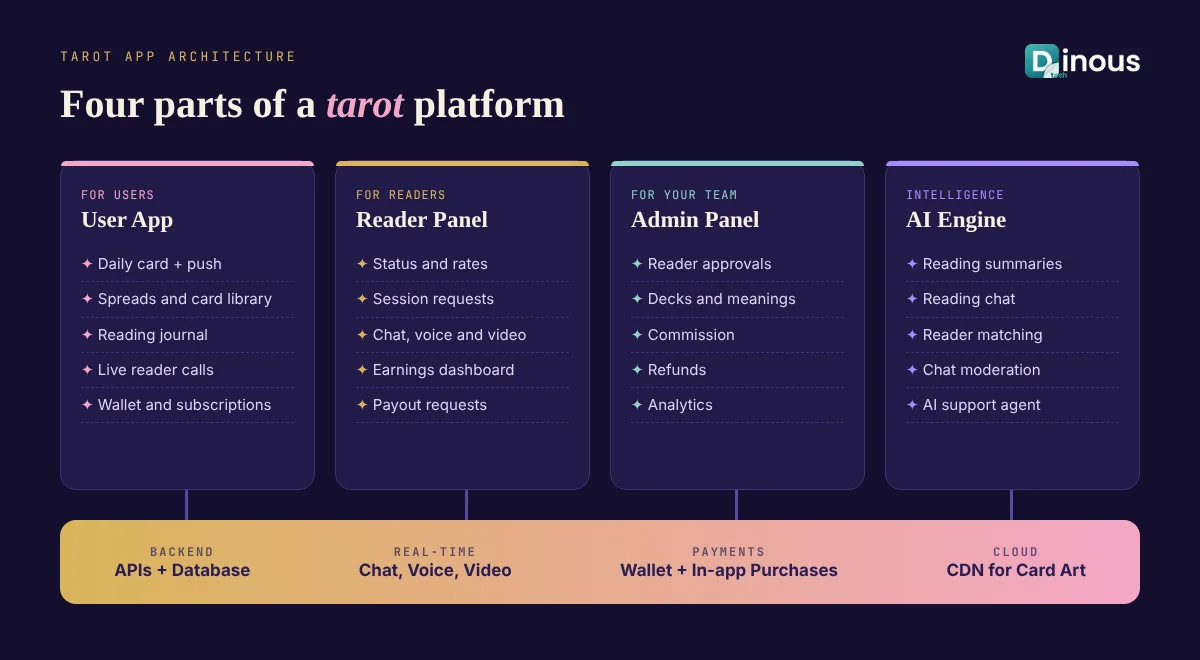
User App Features
- Sign-up with email, phone, Google or Apple, plus an optional birth date for combined astrology content
- Daily card with push notification and a short daily message
- Spread library with one-card, three-card, love, career and Celtic Cross spreads
- Full card encyclopedia with upright and reversed meanings, symbols and keywords
- Reading journal with notes, tags, mood and search
- Live reader listing with profiles, specialities, languages, ratings and reviews
- Chat, voice and video sessions with a per-minute timer and wallet balance
- Wallet, subscriptions and in-app purchases for premium decks or spreads
- Multi-language support and dark mode
- Report, block and help centre
Reader App or Panel Features
- Onboarding with identity checks and a sample reading for quality review
- Online/offline status, working hours and per-minute rate settings
- Incoming request alerts, chat, voice and video sessions
- Session history, earnings dashboard and payout requests
- Ratings, reviews and follower count
Admin Panel Features
- User and reader management, approvals and suspensions
- Deck, card meaning and spread content management
- Commission, pricing, coupon and promotion settings
- Payment, refund and payout management
- Session monitoring, complaint handling and content moderation
- Analytics on daily active users, reading volume, conversion and revenue
If you plan a live consultation model, our article on key features of a modern astrology consultation app covers the marketplace side in more depth.
Tarot Reading App Development Process
- Discovery: define your audience, reading style, business model and the one feature that makes your app different. Study competitor reviews to see what users complain about.
- Content plan: choose or commission a deck, confirm artwork rights, and plan the card meanings, spreads and daily messages.
- UX and UI design: wireframes for the reading flow, journal, reader listing and wallet, then a visual style with card animations and a calm colour palette.
- MVP scope: pick the smallest set of features that proves users want the app. Our MVP app development guide explains how to cut scope without hurting the experience.
- Development: build the mobile apps, backend APIs, admin panel and, if needed, the reader app. Integrate payments, push notifications and chat or calls.
- AI integration: connect an AI model for reading summaries and chat, with safety rules and tone guidelines.
- Testing: functional, device, payment, load and security testing, plus content review of every card meaning.
- Launch: app store listings, screenshots, privacy labels and a soft launch with a small audience.
- Grow and improve: track retention, add new spreads and decks, and run seasonal campaigns.
Recommended Tech Stack
| Layer | Common Options |
|---|
| Mobile apps | Flutter or React Native (one codebase), or Swift and Kotlin for native apps |
| Web app and admin | React or Next.js |
| Backend | Node.js or Python, REST or GraphQL APIs |
| Database | PostgreSQL or MongoDB, Redis for caching and sessions |
| Chat, voice and video | WebSockets, Firebase, or a real-time SDK such as Agora or Twilio |
| Payments | Stripe, PayPal, Razorpay, Apple and Google in-app purchases |
| Notifications | Firebase Cloud Messaging and Apple Push Notification service |
| AI | Large language model APIs with prompt templates and moderation |
| Cloud and media | AWS, Google Cloud or Azure, with a CDN for card images |
For most tarot startups, a cross-platform framework is the fastest route to both iOS and Android. Learn more about our Flutter app development services.
How Dinoustech Uses AI in Tarot Apps
AI is now part of how we build apps and part of what we build into them. In a tarot project, it shows up in three places.
AI-Assisted Development
Our developers use AI coding assistants to write boilerplate code, generate test cases and review code for common bugs. This shortens the build without cutting corners, because every change is still reviewed and tested by our team. AI also helps us draft and check large content sets, such as 78 cards with upright and reversed meanings across several topics, which an experienced reader then edits.
AI Features Inside the App
- Personalised reading summaries: the app combines the drawn cards, their positions and the user's question into a short, readable interpretation.
- Reading chat: users can ask follow-up questions about a reading, such as "what does this card mean for my career?"
- Journal insights: gentle summaries of themes that repeat across a user's saved readings.
- Smart reader matching: suggests live readers based on topic, language and past ratings.
- Moderation: flags abusive messages or risky content in chats.
We set clear guardrails: AI readings are labelled, the tone stays supportive, and the model is instructed not to give medical, legal or financial instructions or to make frightening predictions. For more on AI in this category, read how to build an AI-powered astrology app like Astra.
AI Support Agent for Clients
After launch, we can set up an AI support agent that answers routine questions from your users, such as wallet top-ups, refunds or how to book a reader, and hands complex cases to your human team. That keeps support costs low as your user base grows.
Monetization Models
- Freemium subscription: free daily card and basic spreads; premium unlocks all spreads, decks, AI chat and an ad-free experience.
- Pay-per-minute live readings: users top up a wallet and pay readers by the minute; the platform keeps a commission.
- One-time premium readings: detailed written or AI readings for love, career or the year ahead.
- Premium decks and themes: unique card art sold as in-app purchases.
- Courses: paid lessons for people who want to learn tarot.
- Ads: only on free tiers, and placed carefully so they do not break the reading mood.
Our guide on how astrology apps make money compares these models in more detail.
Ethics, Privacy and Store Rules
Tarot apps deal with personal questions about love, health and money, so trust matters. Plan these points from the start:
- Clear disclaimers: state that readings are for entertainment and self-reflection, and are not a replacement for professional advice.
- Privacy: users share sensitive questions. Encrypt data, collect only what you need and follow privacy laws such as GDPR in Europe and the UK and CCPA in California.
- Card artwork rights: use public-domain art, commissioned art or a properly licensed deck. Do not copy a modern published deck without permission.
- App store rules: Apple and Google review fortune-telling apps closely. Avoid template clones, show real value, and use in-app purchases where store rules require them.
- Reader conduct: a code of conduct, session recording or logs where lawful, and a fast complaint process.
- Payments: transparent per-minute pricing, low-balance warnings and a fair refund policy.
Note: this section is general information, not legal advice. Please check the rules in your target countries with a qualified advisor.
Tarot App Development Cost Factors
There is no single price for a tarot app, because two apps with the same name can be very different in scope. These factors have the biggest effect on cost:
- Business model: a self-serve app is far simpler than a live reader marketplace with a reader app, wallet and payouts.
- Platforms: iOS, Android, web, or all three.
- Design and animation: custom card animations, illustrations and sound add polish and effort.
- Content: commissioned deck art and expert-written meanings in several languages.
- Real-time features: chat, voice and video calls with per-minute billing.
- AI features: reading summaries, chat and moderation, plus ongoing model usage costs.
- Integrations: payment gateways, in-app purchases, analytics and CRM.
- Maintenance: hosting, updates, new spreads and store compliance changes after launch.
The fastest way to a reliable estimate is a short discovery call where we map your features. You can also compare with our breakdown of AI astrology app development cost, since the two products share many parts.
Development Timeline
| Phase | Typical Duration |
|---|
| Discovery and content planning | 1 to 2 weeks |
| UX and UI design | 2 to 4 weeks |
| Self-serve MVP development | 6 to 10 weeks |
| Live reader marketplace (added scope) | 4 to 8 extra weeks |
| AI integration | 2 to 4 weeks, often in parallel |
| Testing and store launch | 2 to 3 weeks |
A focused self-serve MVP usually takes about three to four months. A full hybrid app with live readers, AI and an admin panel takes longer. These are honest ranges; your final plan depends on scope.
Common Challenges
- Standing out: many tarot apps look alike. A unique deck, a strong voice in the meanings, or a niche audience makes a big difference.
- Retention: daily cards, streaks, journals and seasonal spreads give users reasons to return.
- Reader quality: one poor live reader can damage your brand. Vet readers and use ratings.
- AI tone: AI readings must feel warm and personal, not generic or alarming. This needs careful prompt design and testing.
- Store approval: clone-like apps get rejected. Original content and real features help.
Why Choose Dinoustech for Tarot Reading App Development
Dinoustech builds apps for spiritual-tech and astrology businesses, alongside dating, fintech, healthcare and other industries. With us you get:
- Experience with consultation marketplaces, wallets, per-minute billing and live chat and calls
- A design team that understands calm, premium spiritual app experiences
- Practical AI features with safety guardrails
- Cross-platform builds for iOS, Android and web
- Admin panels that make content, readers and payments easy to manage
- Support and maintenance after launch
See examples of our work in our portfolio, or read about the related idea of an astrology app like Co-Star.
Conclusion
A successful tarot app is a mix of good content, a beautiful reading ritual, honest positioning and reliable technology. Start by choosing your model, design the reading flow with care, launch a focused MVP and add live readers and AI features as your audience grows. If you want to build a tarot reading app for users worldwide, contact Dinoustech to discuss your idea, or explore our astrology app development services.